%20%20--%3E%0A%3Csvg%20version%3D%221.1%22%20id%3D%22Layer_1%22%20xmlns%3D%22http%3A%2F%2Fwww.w3.org%2F2000%2Fsvg%22%20xmlns%3Axlink%3D%22http%3A%2F%2Fwww.w3.org%2F1999%2Fxlink%22%20x%3D%220px%22%20y%3D%220px%22%0A%09%20width%3D%2239px%22%20height%3D%2240px%22%20viewBox%3D%220%200%2039%2040%22%20enable-background%3D%22new%200%200%2039%2040%22%20xml%3Aspace%3D%22preserve%22%3E%0A%3Cpath%20fill%3D%22%23FFFFFF%22%20d%3D%22M38.5%2C7H28.2v26h10.3V7z%22%2F%3E%0A%3Cpath%20fill-rule%3D%22evenodd%22%20clip-rule%3D%22evenodd%22%20fill%3D%22%23FFFFFF%22%20d%3D%22M26.1%2C25.5c0%2C5.8-4.1%2C7.5-12.9%2C7.5C3.9%2C33%2C0%2C31.2%2C0%2C25.2v-1.1h11.6%0A%09v2.4c0%2C0.7%2C0.1%2C1.4%2C1.2%2C1.4c1%2C0%2C1.2-0.4%2C1.2-1.3v-0.9c0-1.6-0.9-1.6-3.5-2.2C2.2%2C21.7%2C0%2C19.7%2C0%2C15.3v-0.9C0%2C9.3%2C5.5%2C7%2C12.9%2C7%0A%09c10.2%2C0%2C12.8%2C2.6%2C12.8%2C7.4v1.8h-11v-2.9c0-0.6-0.4-1.1-1.2-1.1c-0.6%2C0-1.2%2C0.4-1.2%2C1.1v0.9c0%2C1.5%2C0.9%2C2%2C3.3%2C2.5%0A%09c8%2C1.6%2C10.5%2C3.3%2C10.5%2C7.5V25.5z%22%2F%3E%0A%3C%2Fsvg%3E%0A)
How Muhammad Ali’s death was covered, plus best article links
Your teams on the go or at home. Personalize SI with our new App. Install on iOS or Android.
When ESPN is at its best, when it marshals its immense resources to educate, entertain, report and make sports viewers smarter, it is an unmatched sports media organization. Such was the case during the early morning hours on Saturday when preparation and happenstance converged for the network’s covering of the death of Muhammad Ali.
The announcement of Ali’s death was made by the Los Angeles-based anchors Neil Everett and Stan Verrett at 12:28 a.m. ET Saturday. The network then forged into non-stop, commercial-free coverage from 12:28 a.m. until 4:14 a.m. ET. Think about that: No breaks in nearly four hours of coverage. ESPN then played a taped version of SportsCenter between 5 a.m. and 6 a.m. before live coverage resumed from 6 a.m. to noon on Saturday.
A group of seven anchors (Bob Ley, Jeremy Schaap, Scott Van Pelt, John Anderson, Steve Levy, Everett and Verrett) on two different coasts hosted the first 5 1/2 hours of Ali coverage. Linda Cohn and Michael Eaves replaced the group above at 6 a.m. ET, followed by Sara Walsh and Randy Scott, who hosted until 12 p.m. ET.
There was much pre-planning by ESPN on how to cover Ali’s death, but planning is one thing. Execution is ultimately how coverage is judged. Schaap said he and his bosses were discussing all day Friday whether he should come to the Bristol studios as news about Ali’s health grew worse. It wasn’t until about 5:30 p.m. when he was summoned by Andy Tennant, the executive producer of Outside The Lines. At the time, Schaap was on his way to JFK airport in New York City to work on a Vin Scully story. He arrived in Bristol at 7:30 p.m. and waited.
Muhammad Ali—boxer, activist and provocateur—dead at 74
“Ali was the most important figure in sport, and one of the most important in the world beyond sports, in the second half of the 20th century,” Schaap said. “There is so much to say, so many stories to tell, so many angles to cover. Like so many millions of people, I’ve been thinking about, talking about and fascinated by Ali for my whole life. Personally, for me, I felt I was on set representing my father [Dick Schaap], who was very close to Ali. He first met Ali before Rome [Olympics, in 1960], he loved Ali, and I think wrote some of our finest stories about Ali. My dad’s not here to tell his stories or offer his thoughts. I just wanted to communicate, as best I could, his perspective on his favorite subject and one of his favorite people.”
Van Pelt was scheduled to be off on Friday night, but he got a call from his bosses in the afternoon informing him that Ali might not survive the night. He arrived at ESPN around 9 p.m., which is about four hours later than he’d typically head in for SportsCenter. Around midnight, Van Pelt was about to head home after taping one small feature on Ali. As he was walking out of the studio, Anderson and Schaap were running up the stairs toward the same studio. The news had come down:
The champ was gone.
Van Pelt said because of the timing of the death, it was a confusing couple of minutes figuring out who would be on the air in Bristol.
“I sat with Jeremy, and John was on the main set and we just started talking,” Van Pelt said. “I looked up at some point and in walks Bob Ley, who had turned around on his way home to take his very rightful place on a desk as well. There was no idea among us how long we’d be on the air. It was Muhammad Ali, we were going to talk and allow others to talk until it seemed like we’d covered it. Nobody was looking at watches or wondering when they could go home. Nobody wanted to. We just kept going.”
A child of contradiction, Muhammad Ali was an essential American
Ley initially left ESPN at 4:30 p.m. ET on Friday when the office called and told him to come back because things were looking particularly dire for Ali. He arrived at the SportsCenter studio about 6:30 p.m. ET on a standby basis and was scouring for material, watching vintage Ali on YouTube to pass the time. “Remember, nothing had been confirmed yet, though all sources and indications were that it was extremely grave,” Ley said. “We had a front row seat doing nothing for the 11 p.m. SportsCenter while strategizing with [SportsCenter executive] Mike McQuade how to staff and approach this into the night and potentially through Saturday.”
Around midnight, Ley left ESPN for home, again, when he received a text from Robbin Dunn, an Outside The Lines producer, that Ali had died. Luckily, Ley was just 10 miles from Bristol and turned quickly around, speeding back to the office. He walked into the SportsCenter studio at 12:35 a.m. ET to join Van Pelt, Schapp and Anderson on-air. “It was probably at the moment I was screeching up an exit ramp and back to Bristol that I had a sense that the day which had begun at 4:50 a.m. for me was gonna take a while to put into the books,” Ley said.
The guests ESPN had during its Ali overnight coverage included Kareem Abdul-Jabbar, Bob Arum, Dr. Harry Edwards, Evander Holyfield, Jesse Jackson, Larry Merchant, David Remnick, Al Sharpton and Janet Evans, who passed the torch to Ali at the Atlanta Olympics in 1996. There were also a slew of ESPN pundits weighing in on Ali’s life, as well as live reporter coverage from the hospital in Scottsdale (Michele Steele) and the Ali Museum in Louisville (Britt McHenry and Coley Harvey). Feature content included a Schaap obituary, a William Nack essay, pieces on Ali and Howard Cosell and Ali’s relationship with his Louisville hometown.
Muhammad Ali gave joy to millions and never stopped having fun
“Not a lot of pictures, pretty basic television,” Ley said. “Just some good stories, opinions and perspectives, grounded in the most personal of recollections. Generally, I was proud of the spirit which infused the entire enterprise. The people booking guests, the crew, our producers and directors, all of my colleagues, it was in the sprit of how we built the place along time ago, grew it and sustained it. Those moments and opportunities can be rare, and it’s a proper reminder of what I hope makes our place special.”
The network said there were more than 100 production, programming and other personnel working on the overnight coverage from Bristol, Louisville, Los Angeles, San Francisco, Scottsdale and other locations.
“I say this with respect to my peers and friends who work in the business other places in sports television,” Van Pelt said. “Maybe someone else could have done what we did, the way we did it. But I doubt it. Either way, what anyone else did or didn’t do is of no consequence. Our only concern was doing what was required in that very significant moment. We have resources and infrastructure, and we are wired for moments like that. But my point is when that level of professionalism and ability are demanded, when they are absolutely required, they were delivered. You can rightly criticize us for things, as you could anyone, but late Friday into very early Saturday is the shining example of what we are prepared to do, what we are able to do and what we do.”
SI's 100 Greatest Photos of Muhammad Ali
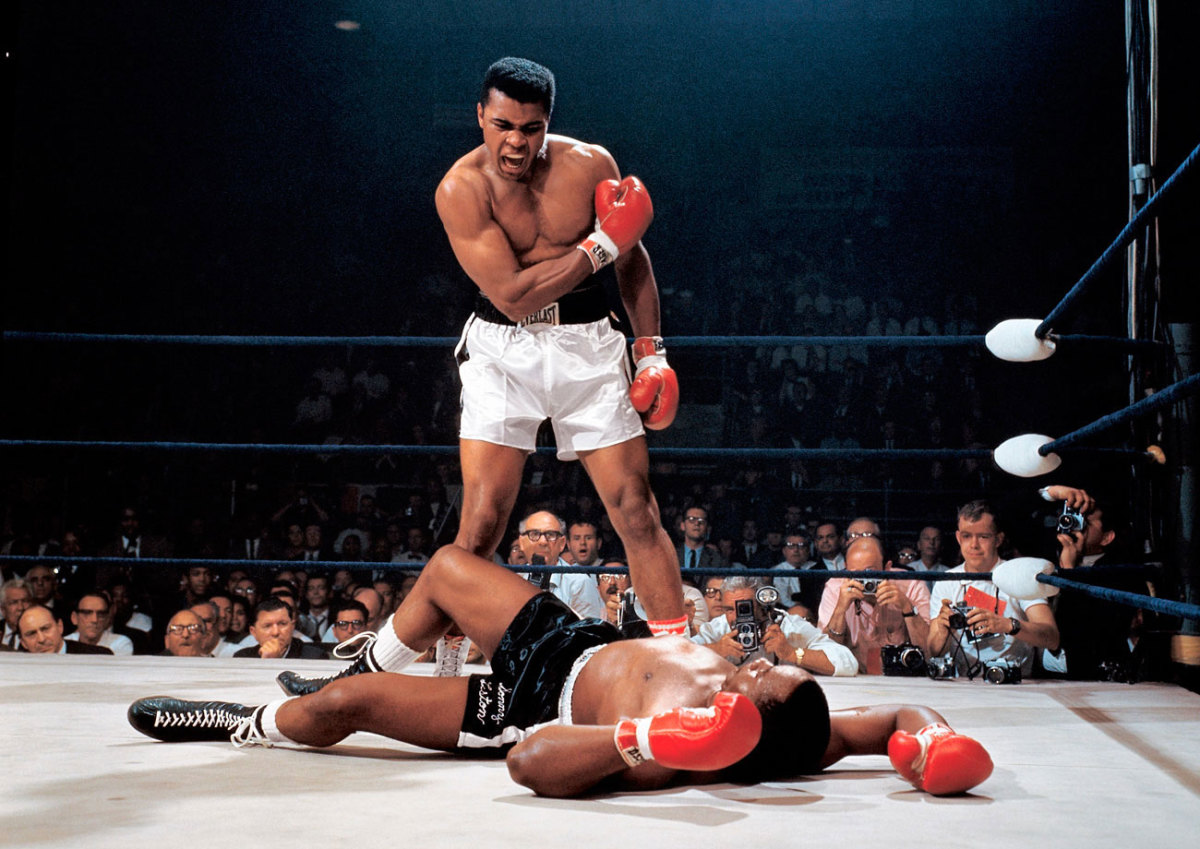
In one of the most iconic and controversial moments of his career, Ali stands over Sonny Liston and yells at him after knocking the former champ down in the first round of their 1965 rematch. Skeptics dubbed it "the Phantom Punch," but films show Ali's flashing right caught Liston flush, knocking him to the canvas. Refusing to go to a neutral corner, Ali stood over Liston and told him to "get up and fight, sucker."
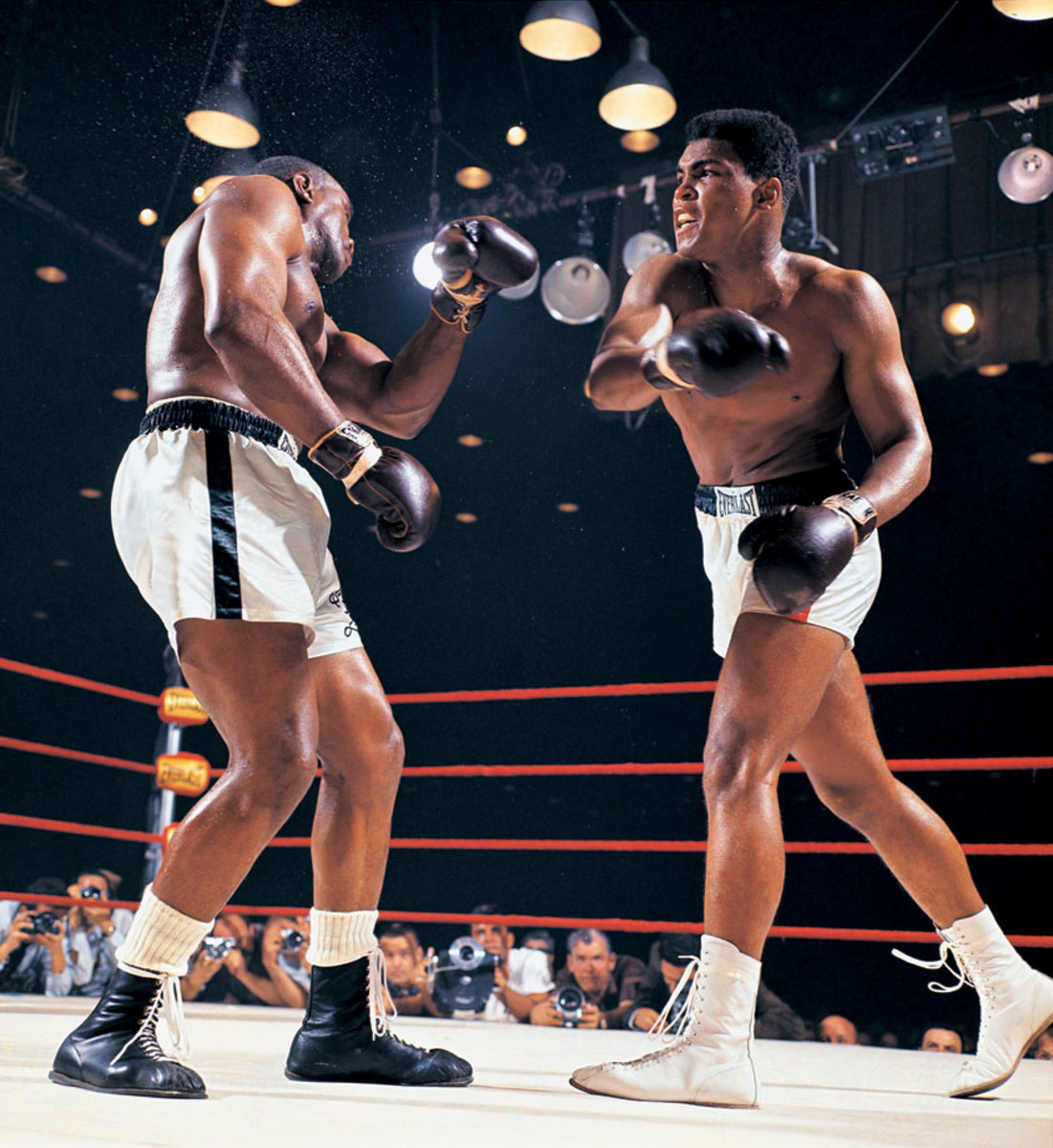
At 22-years-old, Cassius Clay (Muhammad Ali) battered the heavily favored Sonny Liston in a bout that shook the boxing world. The fight ignited the career of one of sports' most charismatic and controversial figures, whose bouts often became social and political events rather than simply sports contests. At the peak of his fame, Muhammad Ali was the best known athlete in the world. Liston, one of the most feared heavyweight champions in history, was a 1-8 favorite over the young challenger known as the Louisville Lip. But Clay, here stinging the champ with a right, used his dazzling speed and constant movement to dominate the action and pile up points.
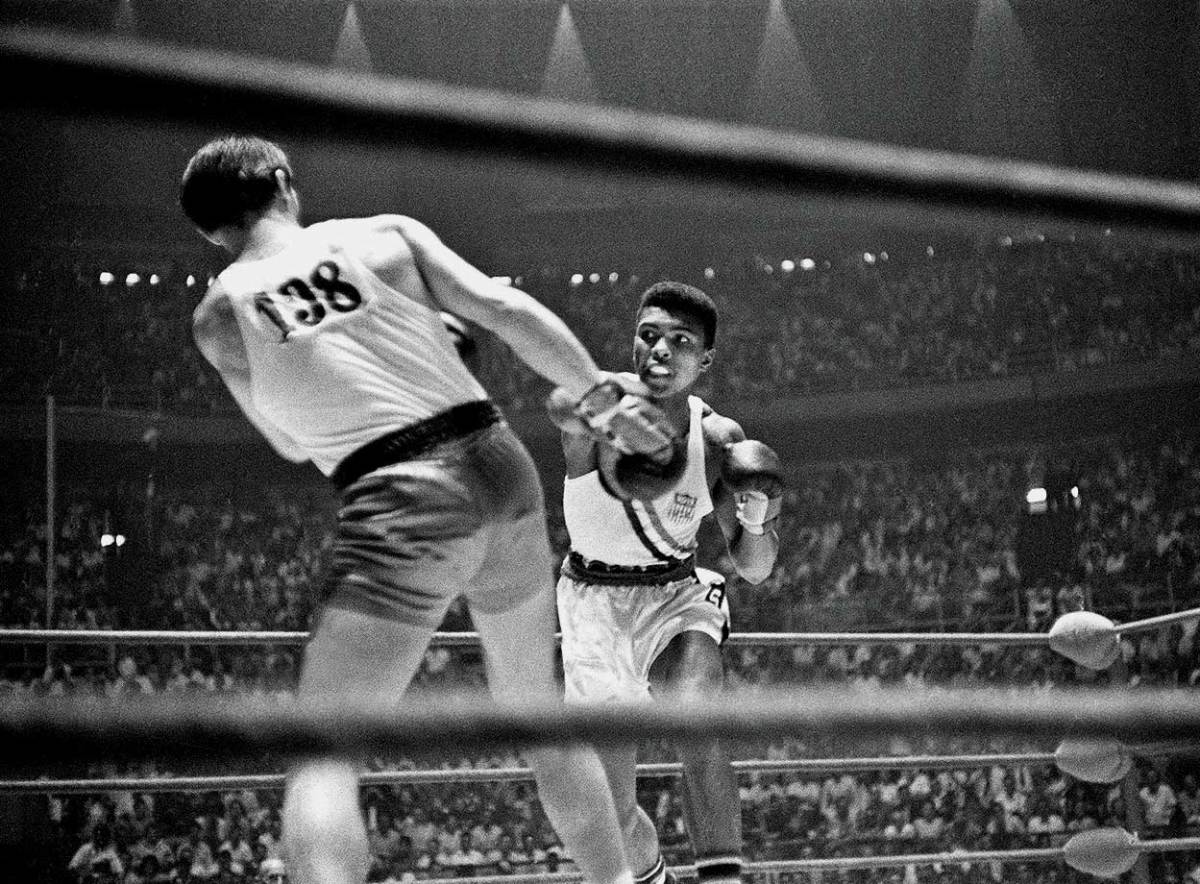
Cassius Clay punches Zbigniew Pietrzykowski of Poland during their gold medal bout at the 1960 Rome Olympics. Clay defeated Pietrzykowski 5-0 for the light heavyweight gold medal.
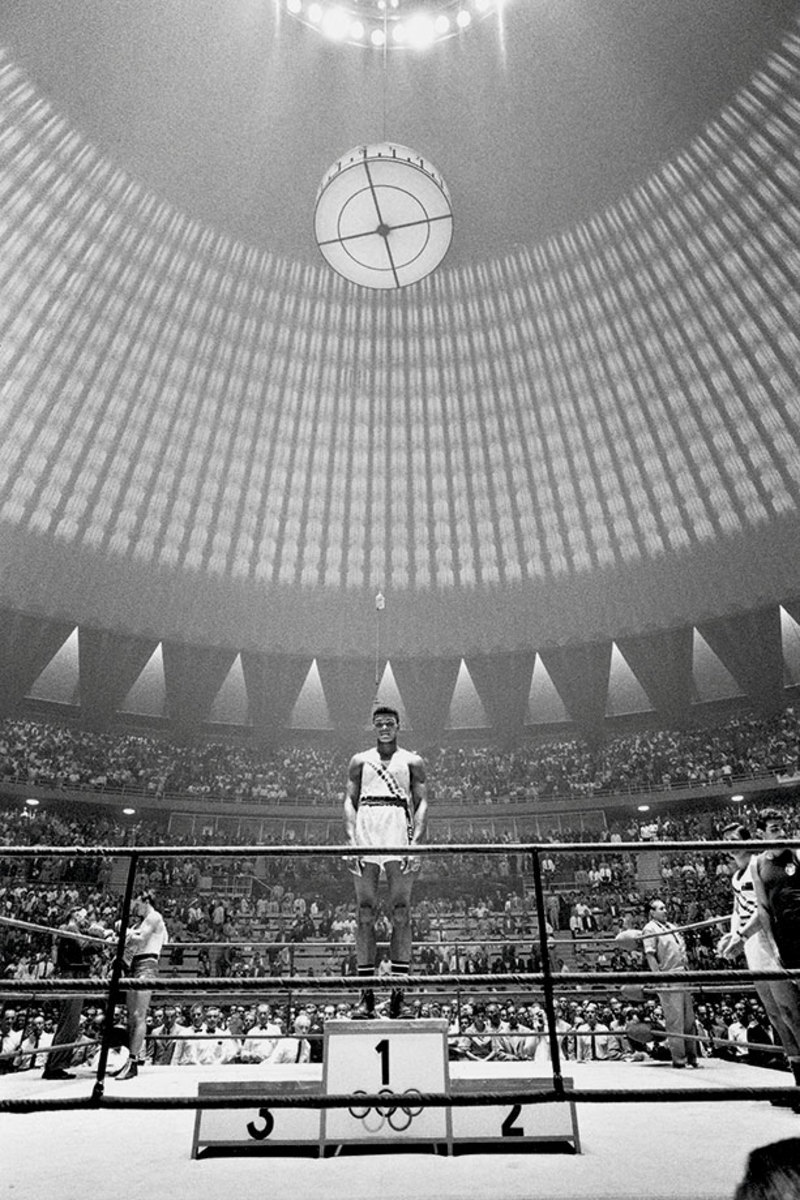
For the 18-year-old from Louisville, here atop the medal stand after his Olympic victory, all roads led from Rome. Clay finished his amateur career with a record of 100-5 and made his professional debut two months after the Games.
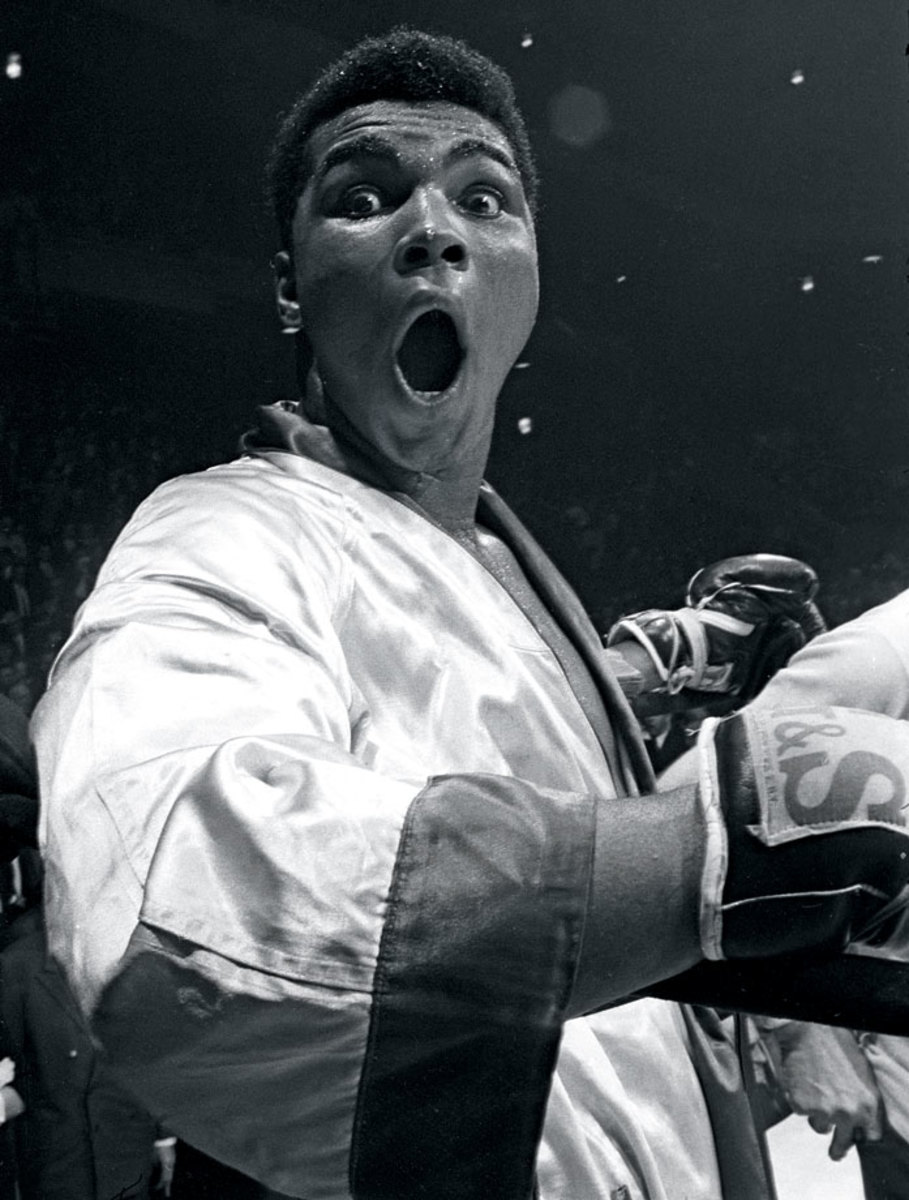
Undefeated in his first 17 pro fights, Clay mugged for the camera before the start of his 1963 bout against Doug Jones in Madison Square Garden.
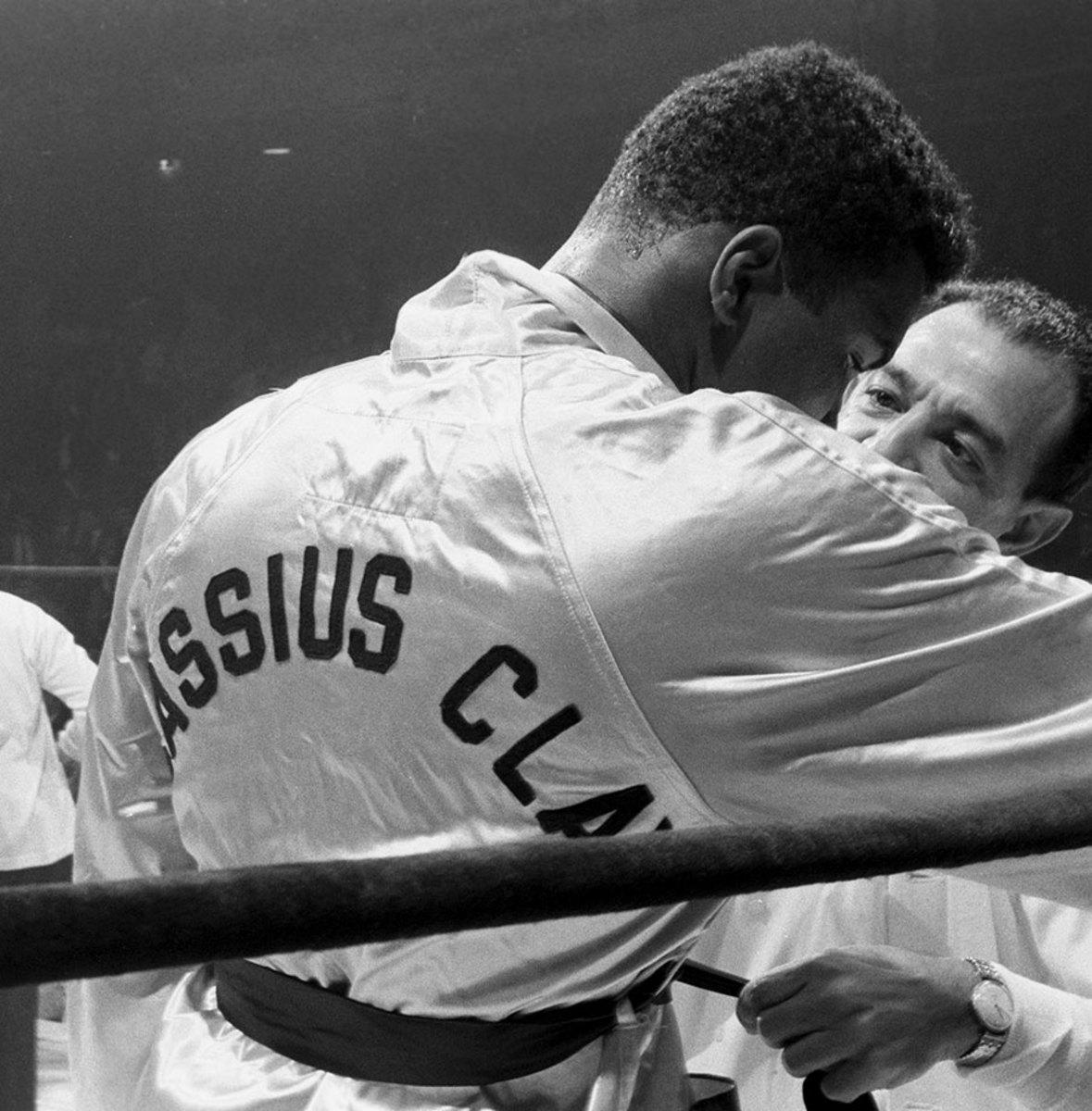
Trainer Angelo Dundee urged his young charge to get serious before the opening bell against Jones. Clay followed instructions and emerged from a tough fight with a unanimous decision victory. Three months later he would stop Henry Cooper and close out 1963 at 19-0.
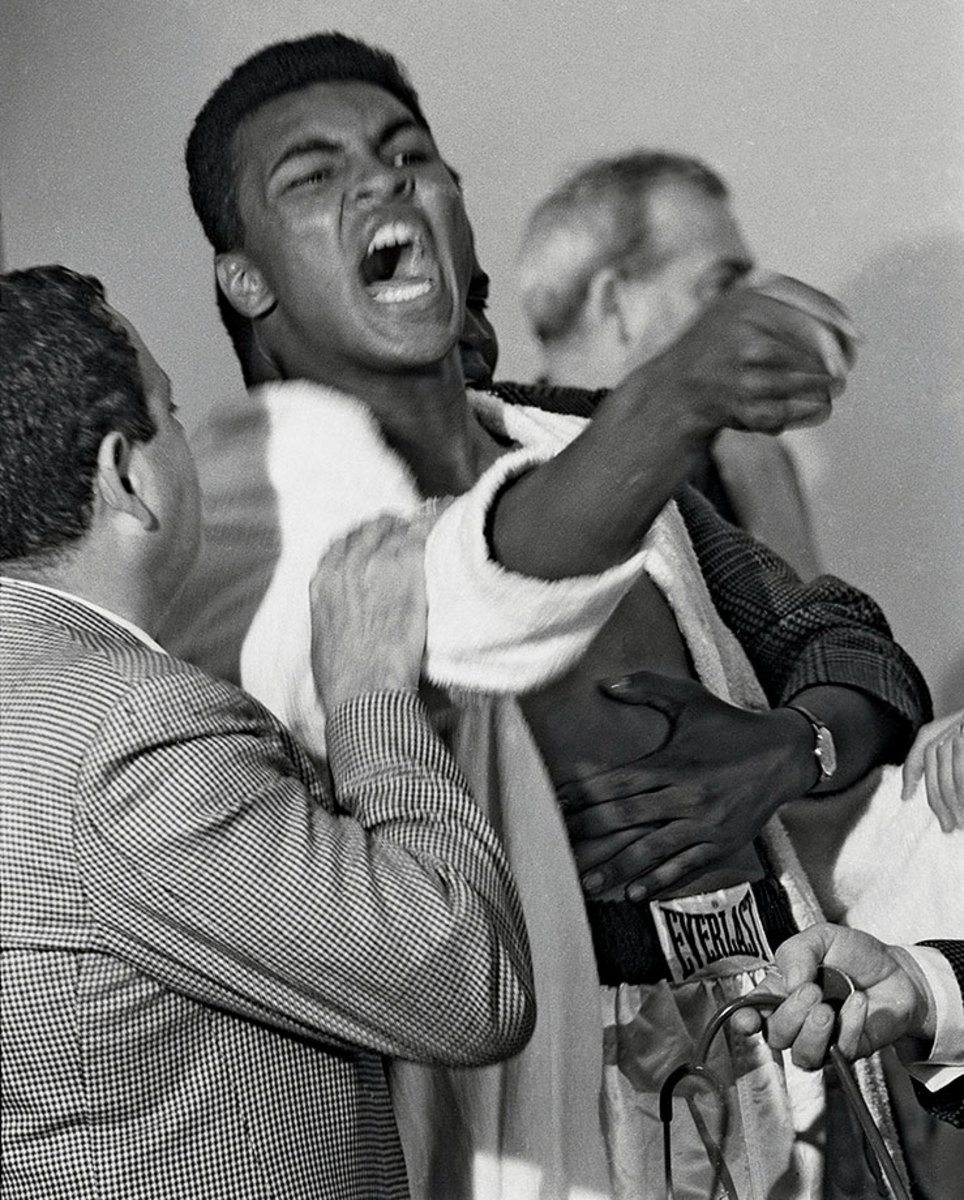
A seemingly hysterical Clay taunted Sonny Liston during the pre-fight physical for their 1964 bout. He had consistently baited the Big Bear during the lead-up to the fight, saying he was going to "use him as a bearskin rug ... after I whup him." The Miami Boxing Commission would fine Clay $2,500 for his outburst at the physical.
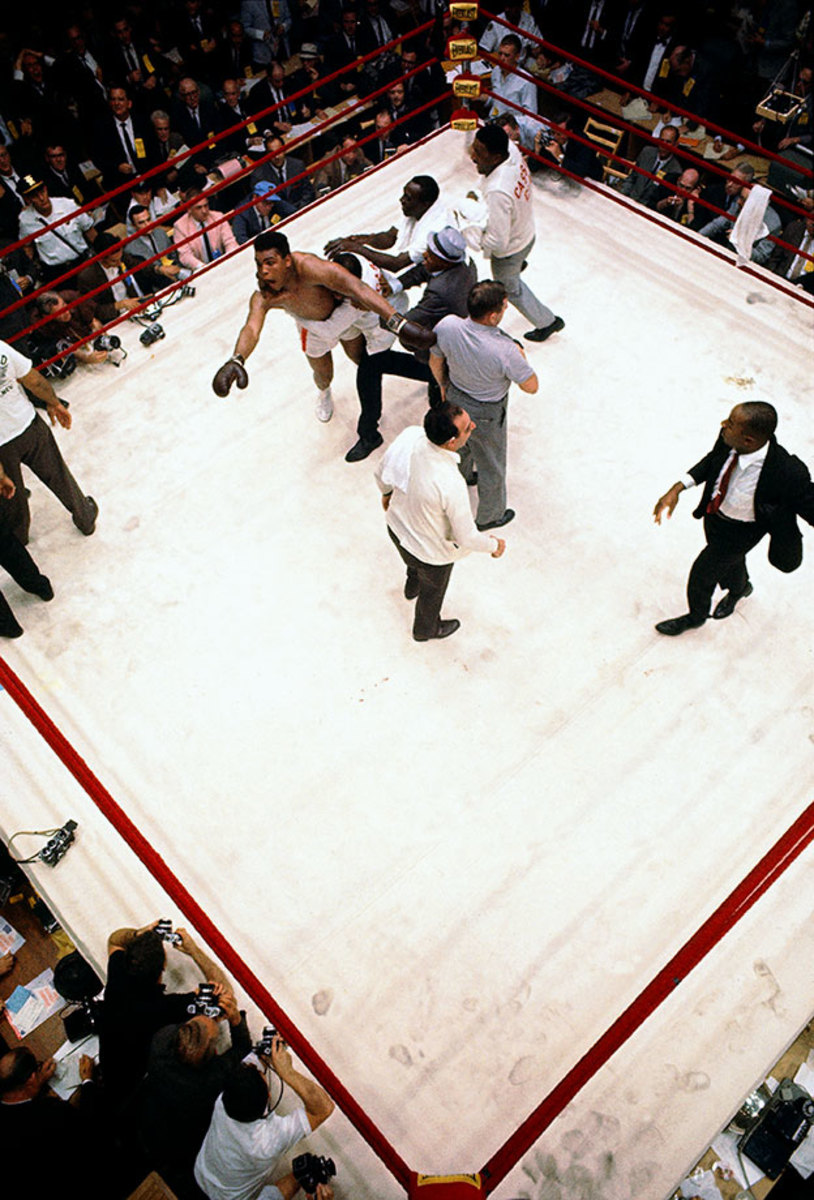
"I shook up the world!" an emotional Clay hollered to ringside reporters after his shocking defeat of Liston. And he did just that, claiming the heavyweight title at age 21 after a clearly beaten Liston, complaining of a shoulder injury, failed to answer the bell for the seventh round.
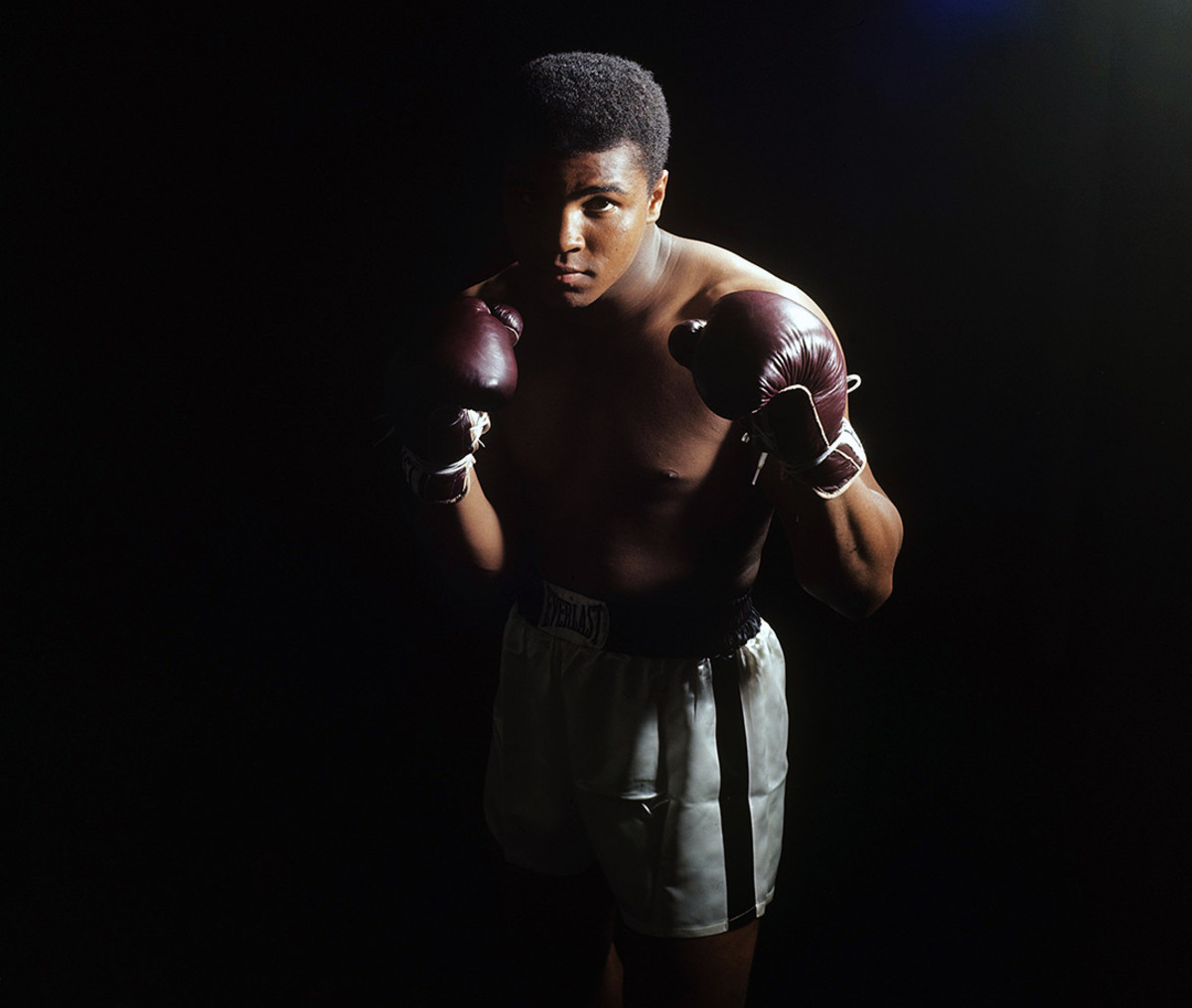
Draped in shadow, the young king — now known as Muhammad Ali — stared down the camera during a photo shoot in April 1965, one month before his rematch against Sonny Liston.
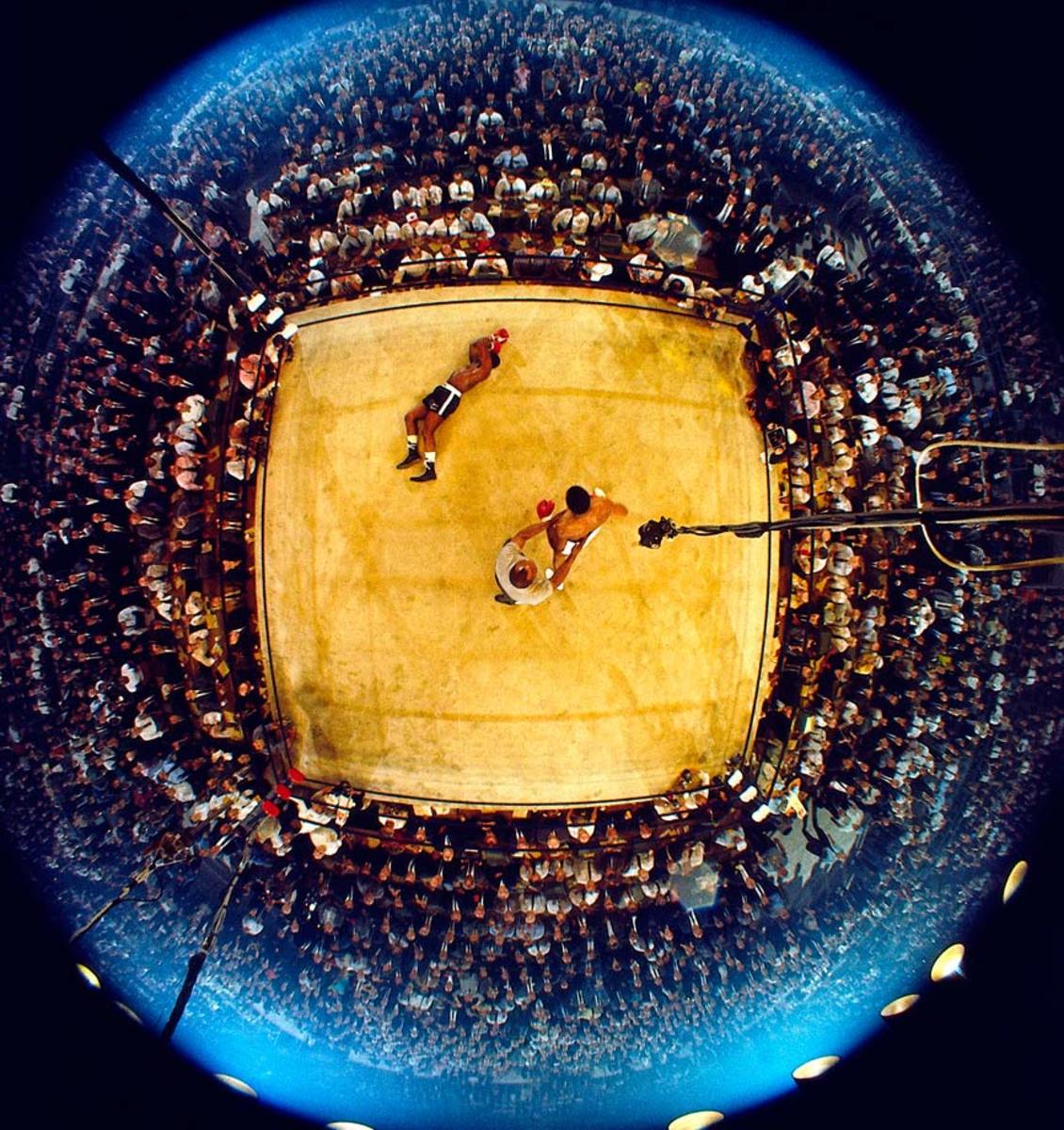
As Liston lingered on the canvas and the referee, former heavyweight champ Jersey Joe Walcott, tried to control Ali, the 2,434 spectators on hand in the Lewiston, Me., hockey arena — a record low for a heavyweight championship fight — tried to make sense of what all that had happened in less than two minutes after the opening bell.
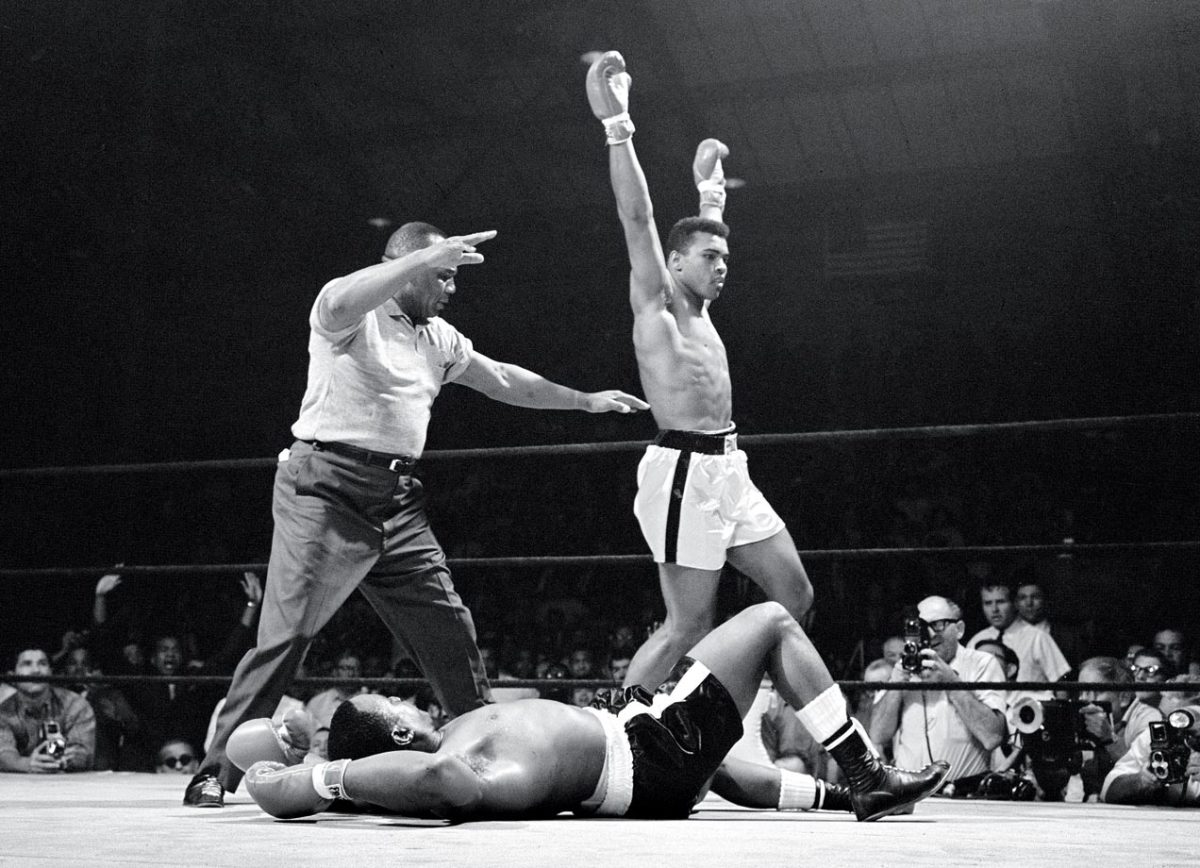
The celebration over Liston continued. In a chaotic ending, Ali was awarded a knockout when Nat Fleischer, publisher of The Ring, informed referee Jersey Joe Walcott from ringside that Liston had been on the canvas for longer than 10 seconds after Ali knocked him down. The bout remains one of the most controversial in boxing history, with many observers insisting that Liston took a dive.
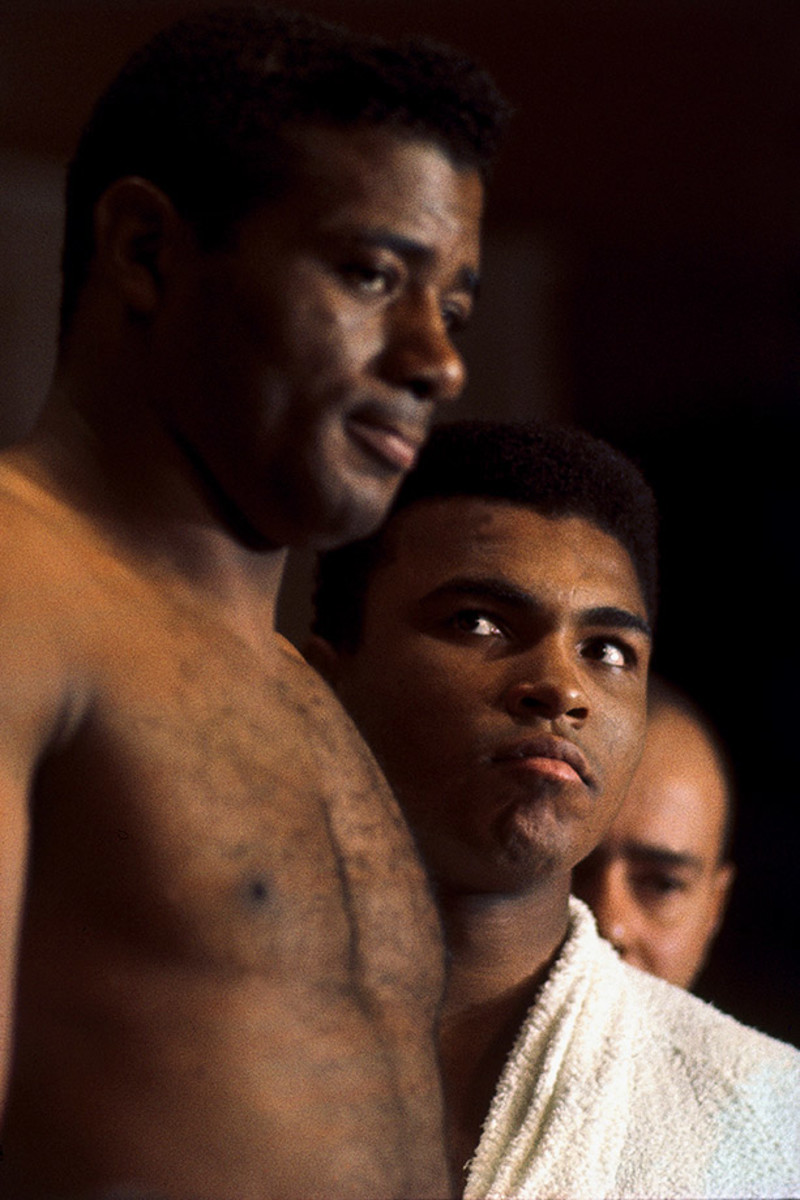
Ali's second title defense came in November 1965, against former two-time heavyweight champion Floyd Patterson. During the build-up to the bout, the normally soft-spoken Patterson earned the new champ's wrath by refusing to call Ali by his Muslim name. At the weigh-in, Ali's glare made it clear that he intended Patterson to pay for the disrespect.
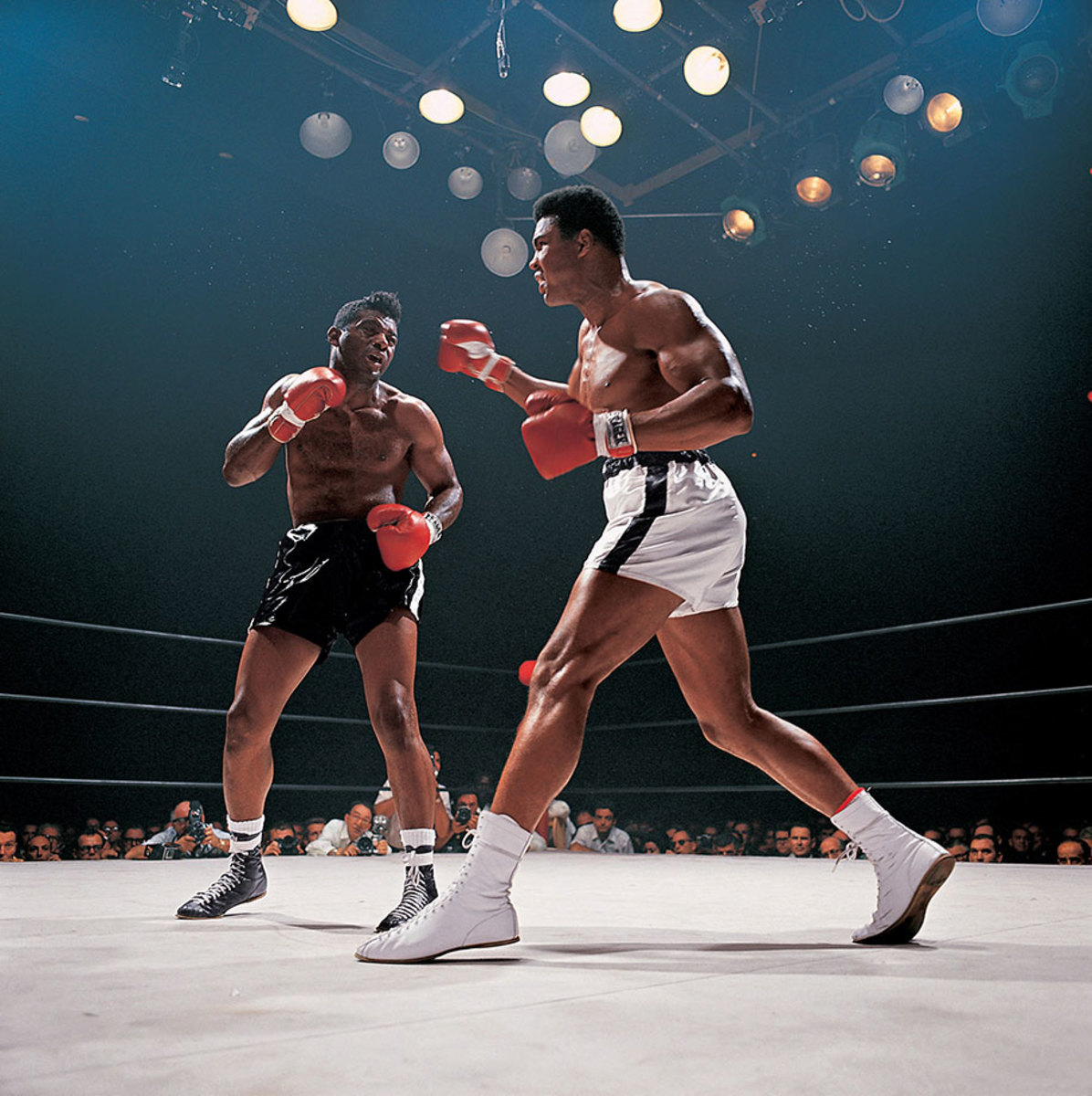
In cruelly efficient performance, Ali punished Patterson — who was hobbled by a painful back injury — seemingly toying with the former champ throughout the bout, hitting him at will and calling, "What's my name?" before finally winning on a 12th-round TKO.
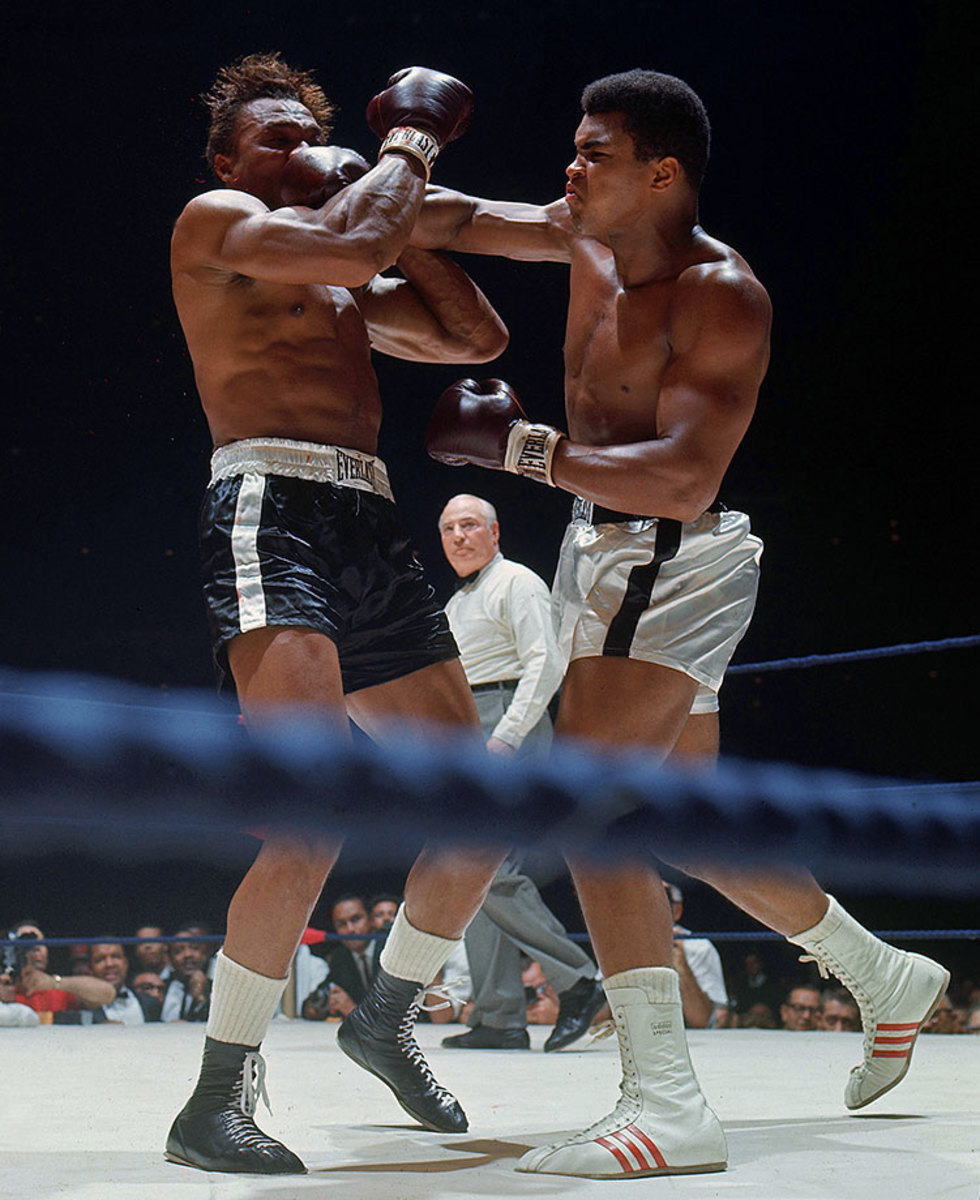
Capping off a five-fight campaign in 1966, Ali faced Cleveland Williams in the Houston Astrodome on Nov. 14. Known as the Big Cat, the heavily-muscled Williams was a power puncher who had racked up 51 knockouts in 71 fights. But he was also 33, barely recovered from a gunshot wound sustained the year before, and up against a young champion very much in his prime. Ali wasted little time in unleashing a withering attack.
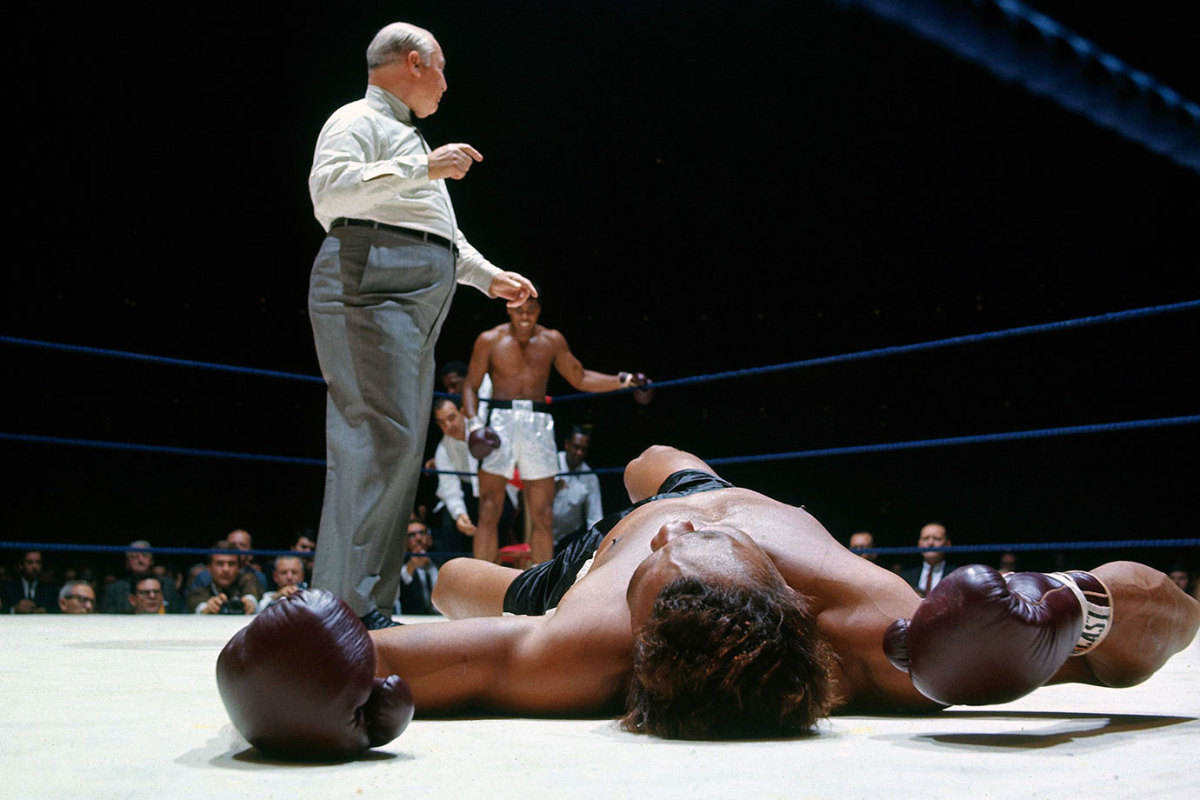
Float and sting: In a display of speed and combination punching unmatched in heavyweight history, Ali overwhelmed Williams from the start. The challenger, here down for the third time in round 2, would be saved by the bell before referee Harry Kessler could count him out, but it would only postpone the inevitable.
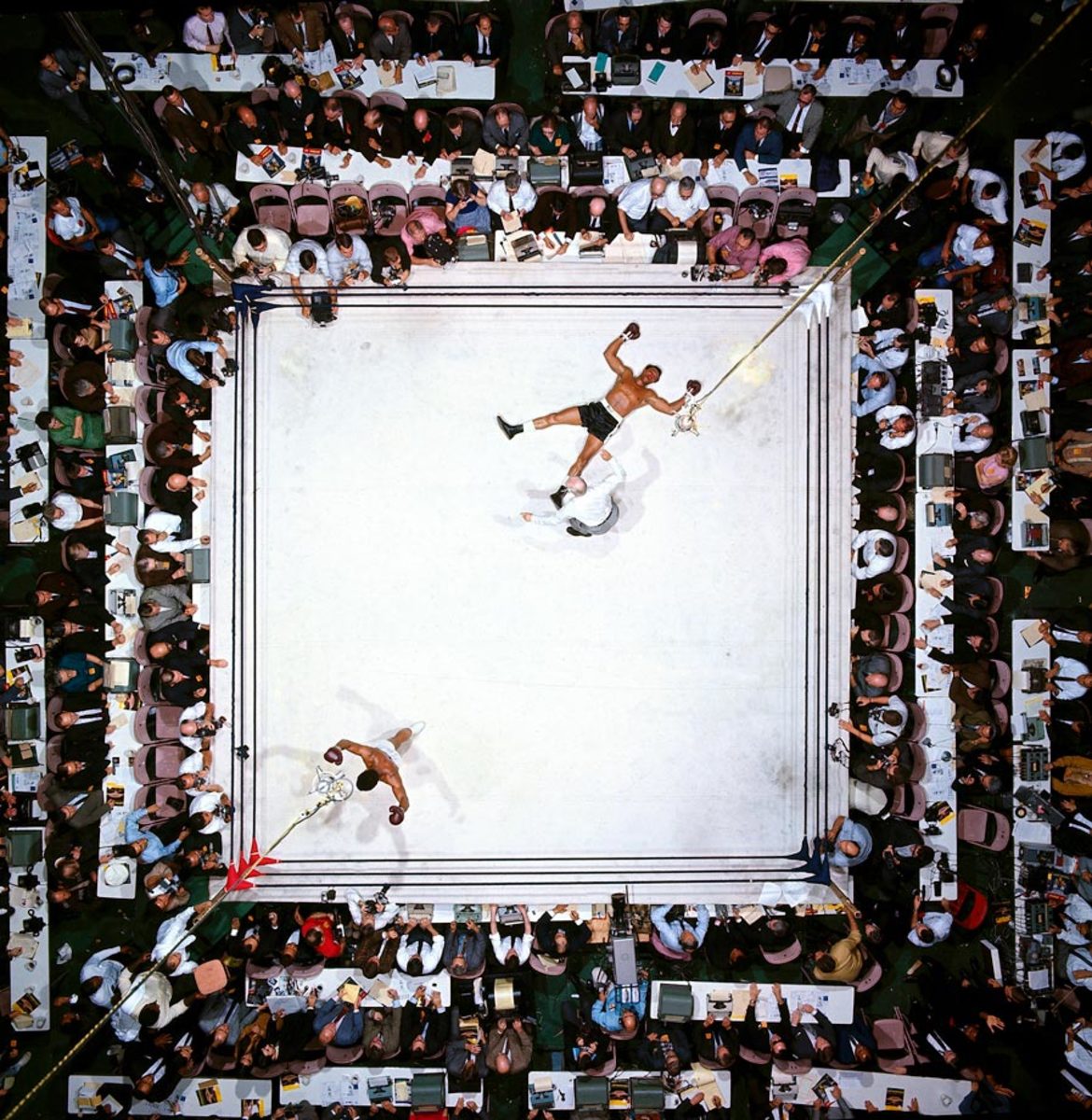
Ali dropped Williams again early in the third round, and Kessler waved the mismatch over at 1:08 of the third.
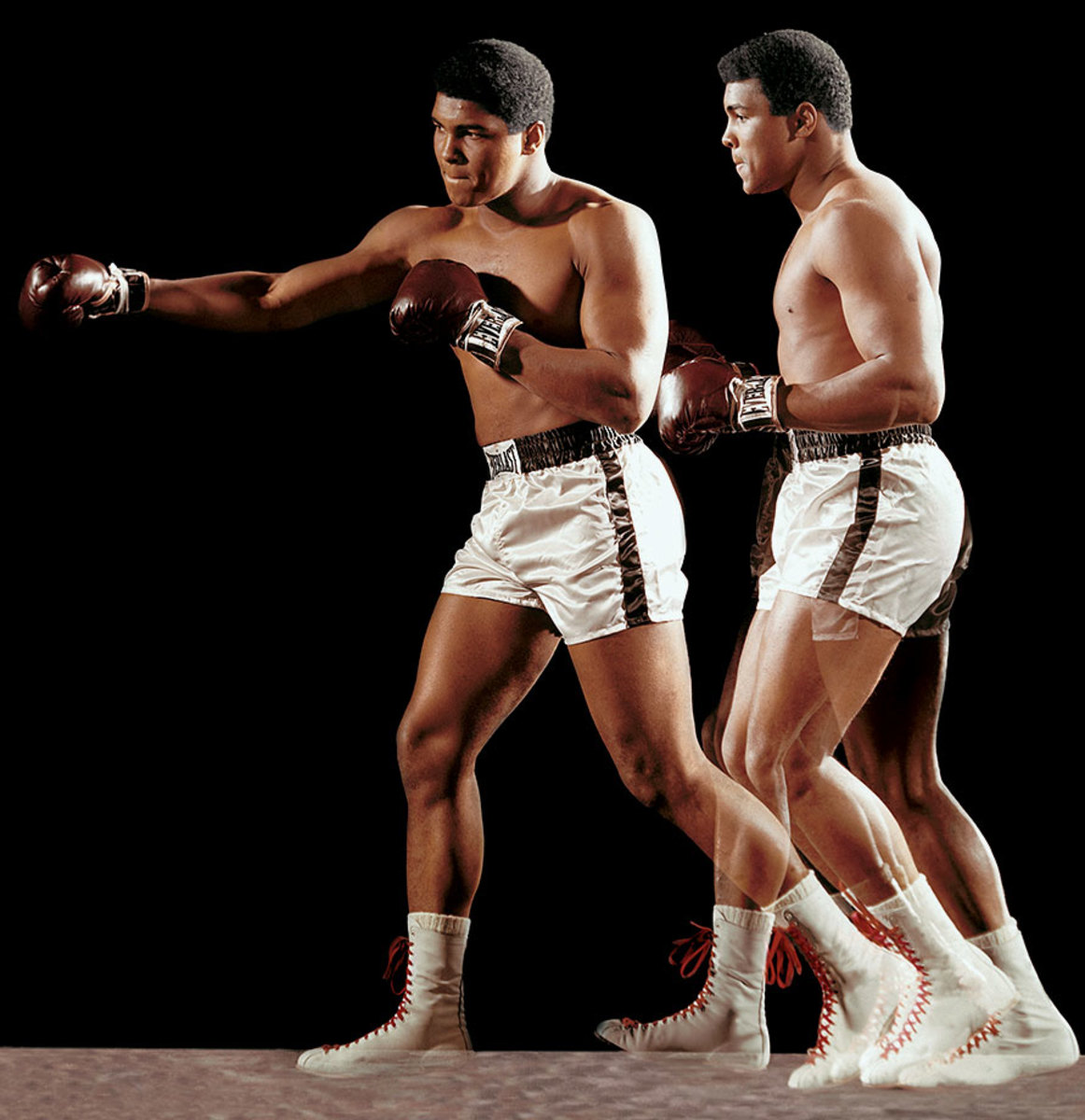
In a multiple-exposure portrait, Ali demonstrates his signature double-clutch shuffle during a photo shoot in December 1966.
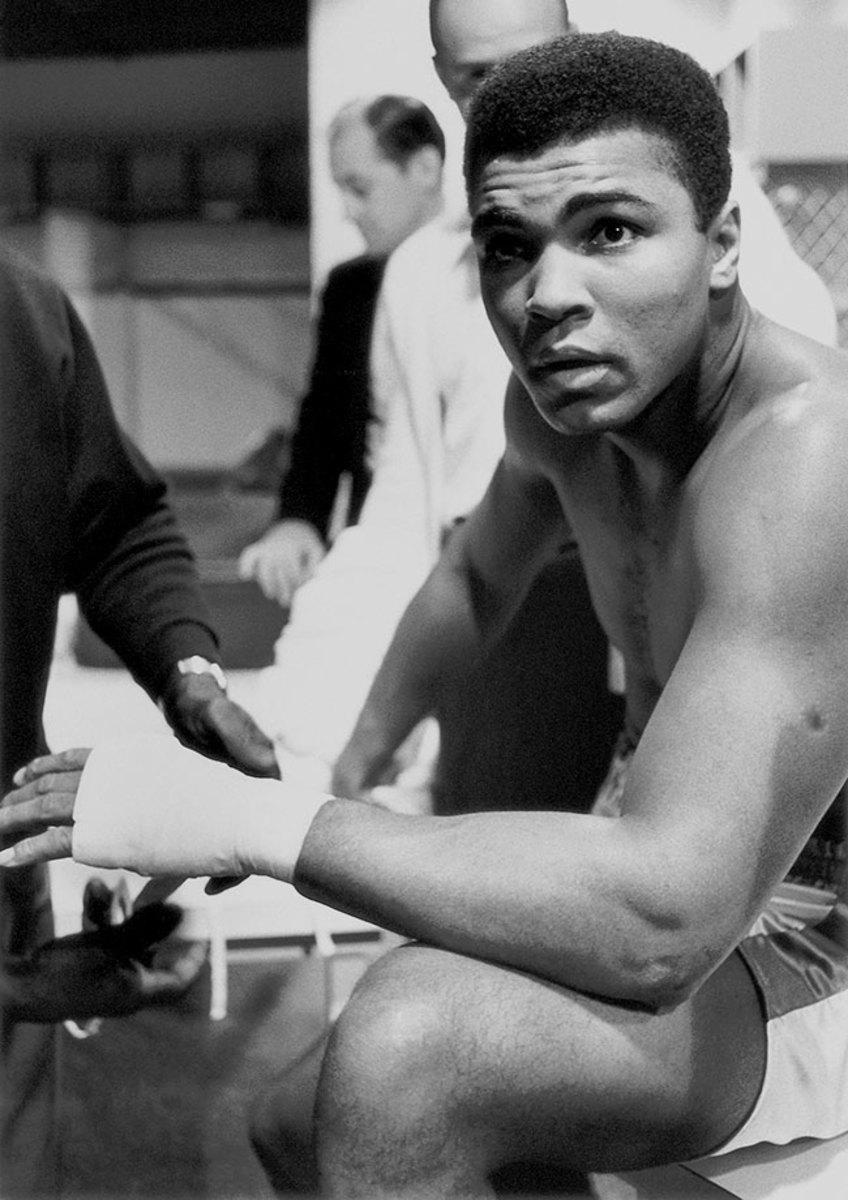
Ali sits in the locker room before his February 1967 fight against Ernie Terrell. Like Patterson before him, Terrell refused to call the champion by his Muslim name. Also like Patterson, he paid a stiff price, as Ali punished Terrell for 15 ugly rounds before winning by unanimous decision.
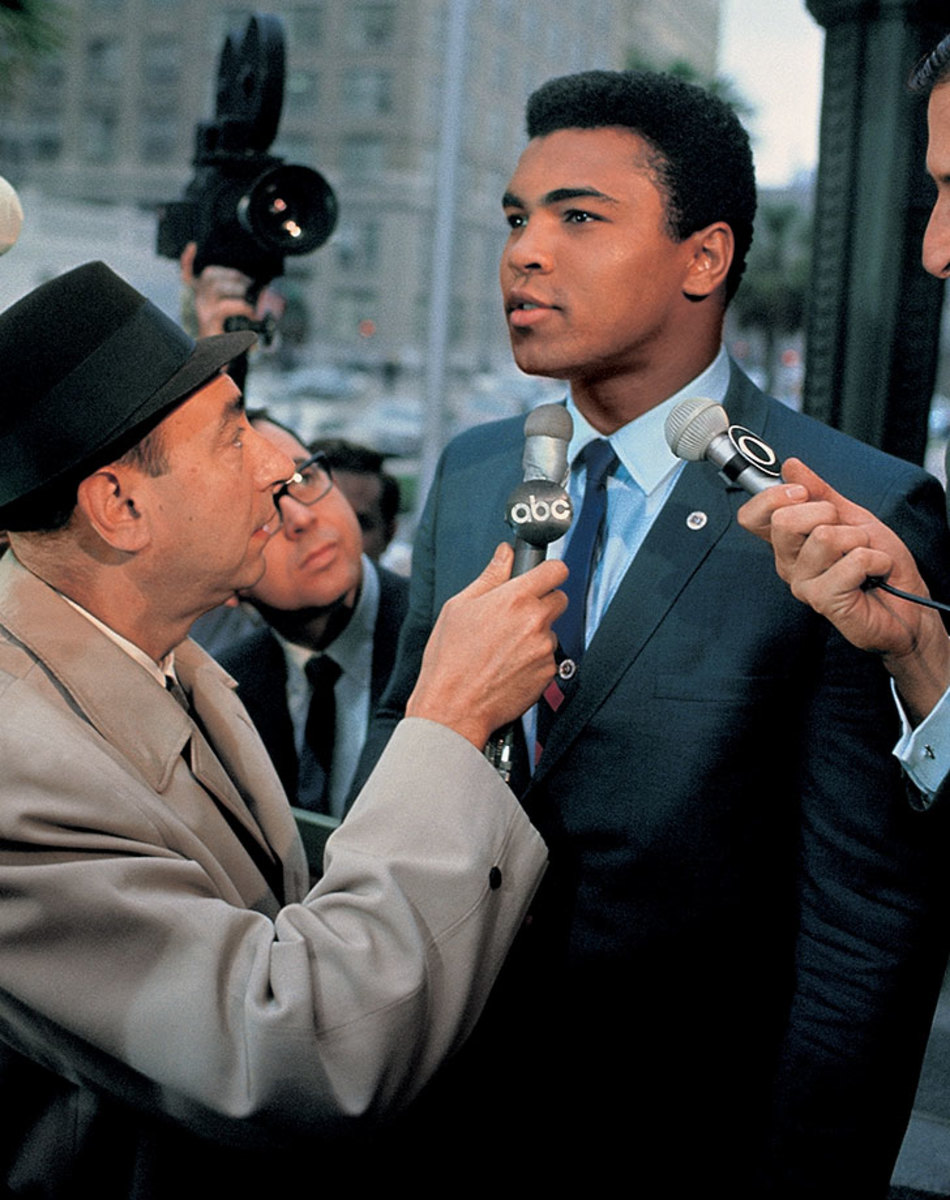
Outside the Armed Forces Examining and Entrance Station in Houston in April 1967, Ali spoke to the press about his refusal to be inducted into military service. Among those on hand was ABC's Howard Cosell, who would be a staunch supporter of the fighter's stance. The decision cost Ali his boxing license and his heavyweight title, and he was sentenced to five years in prison but remained free pending an appeal.
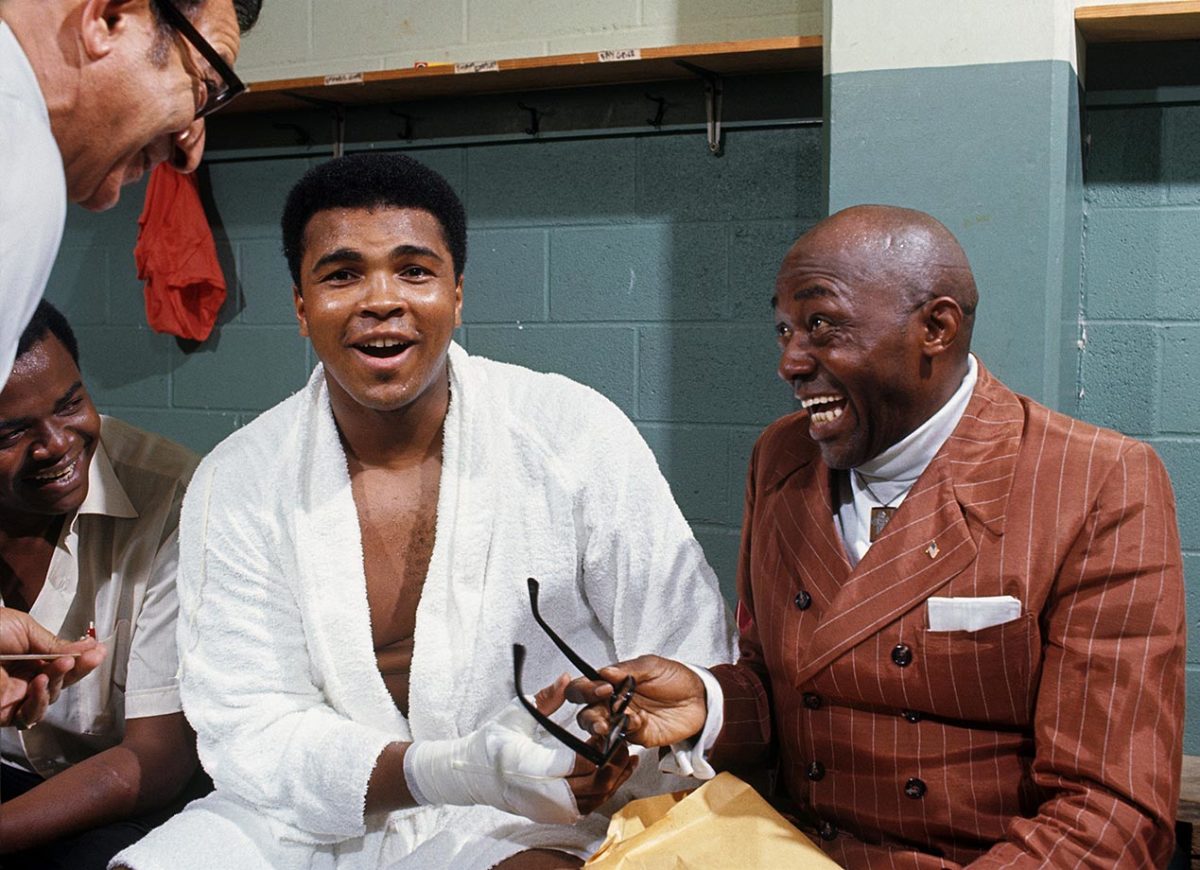
In professional exile for three and a half years because of his draft case, Ali sought to return to boxing in 1970. He began with a night of exhibition bouts at Morehouse College in Atlanta, where before going into the ring, he shared a locker room laugh with actor and comedian Lincoln Perry (right), better known by his stage name of Stepin Fetchit. The friendship between the two black icons would later be examined in an acclaimed play by Will Power, Fetch Clay, Make Man.
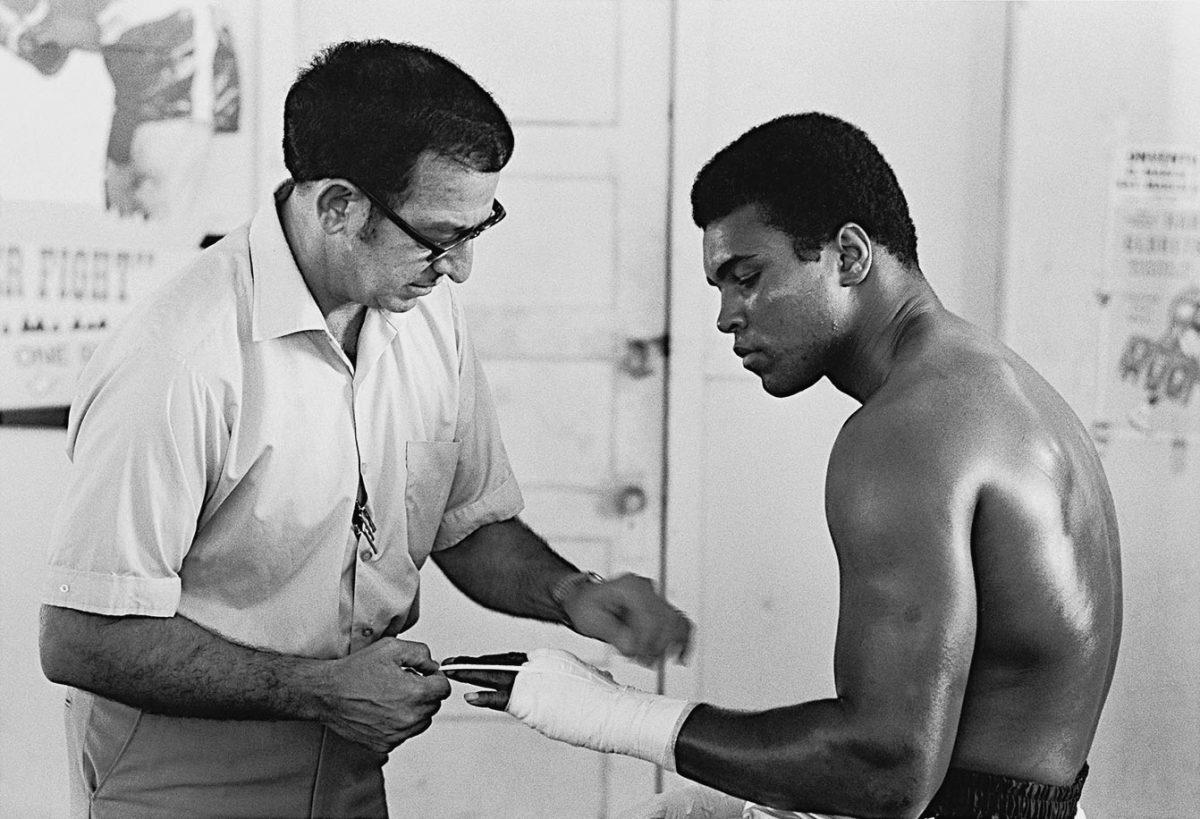
After the Atlanta Athletic Commission at last granted Ali a license, the deposed champion went back into serious training. He was, as ever, in the capable hands of trainer Angelo Dundee, here wrapping boxing's most famous fists at the 5th Street Gym in Miami in October 1970.
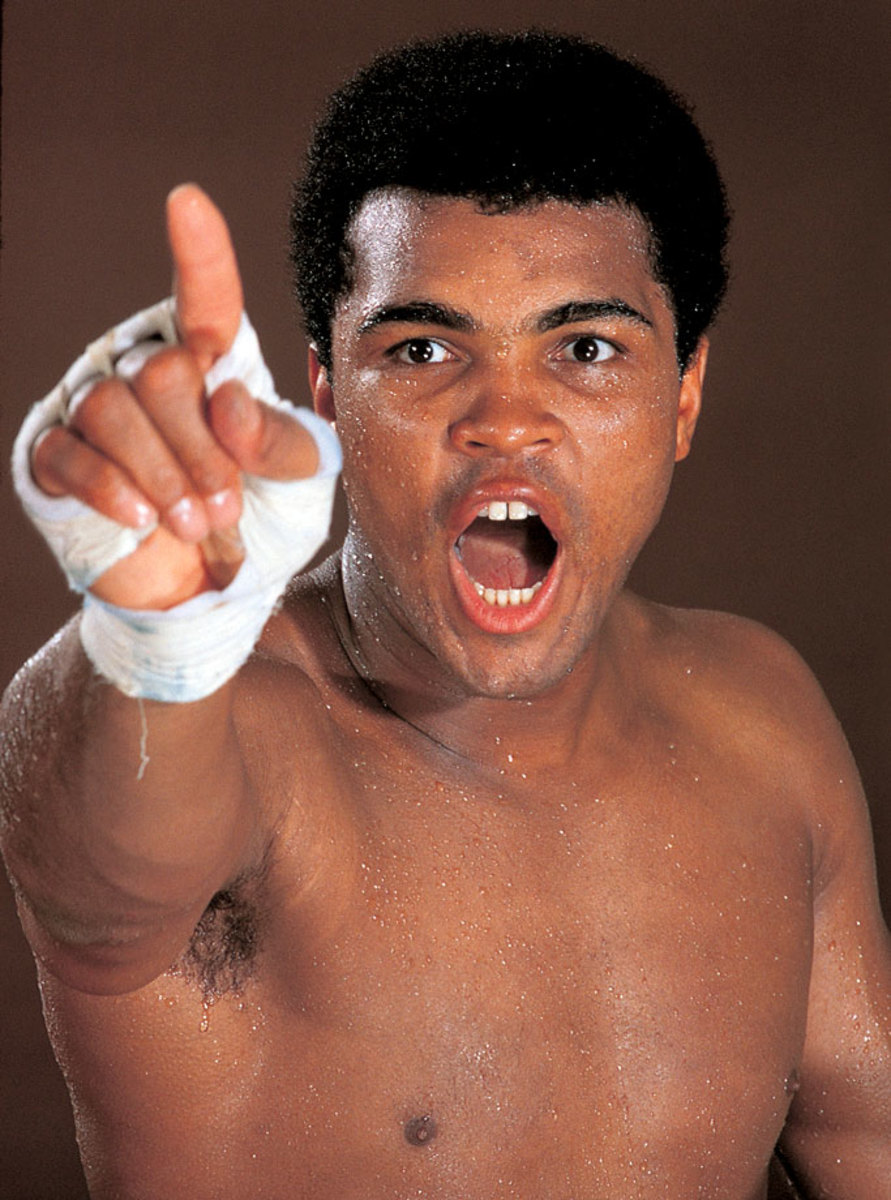
With his return to the ring scheduled for Oct. 26, 1970 in Atlanta, against dangerous contender Jerry Quarry, Ali made it clear to all who would listen that he was on a mission to reclaim the title that had been stripped of him.
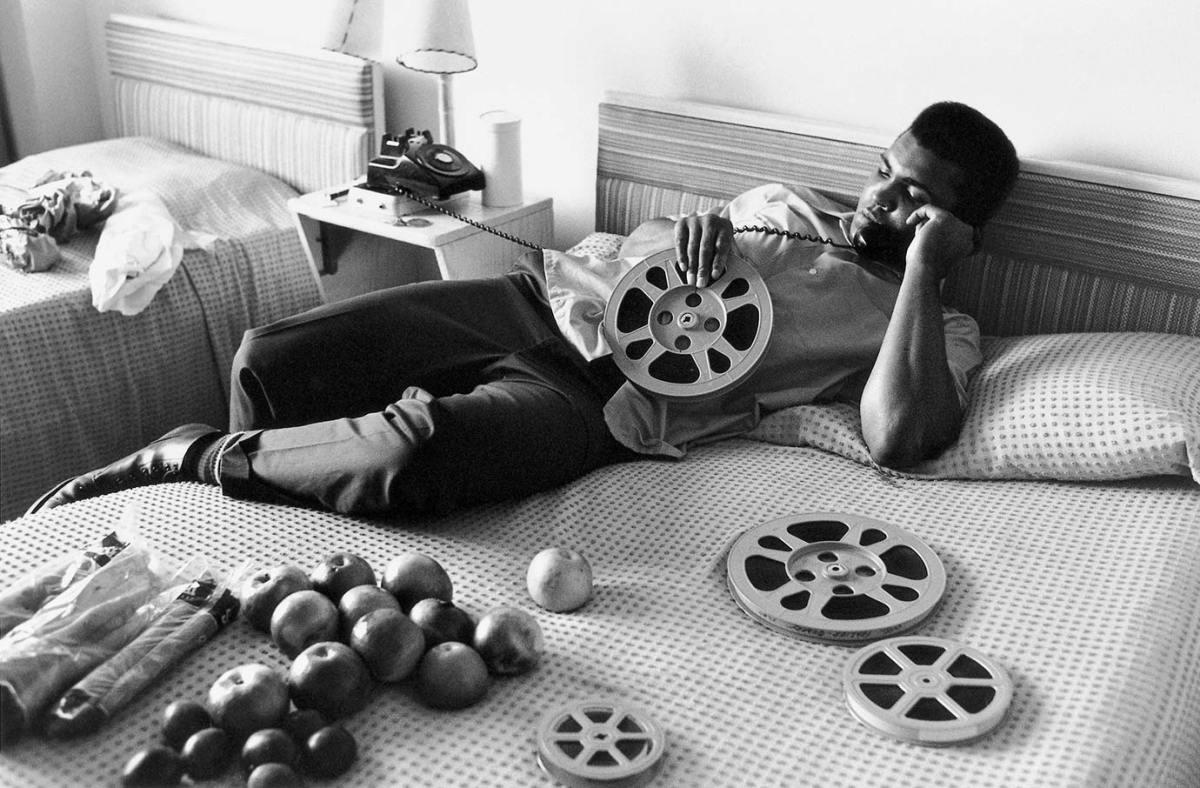
Reel to spiel: For the ever-loquacious Ali, even a rare moment of down time — like this afternoon in 1970 in a Miami hotel room — was a chance to do some talking.
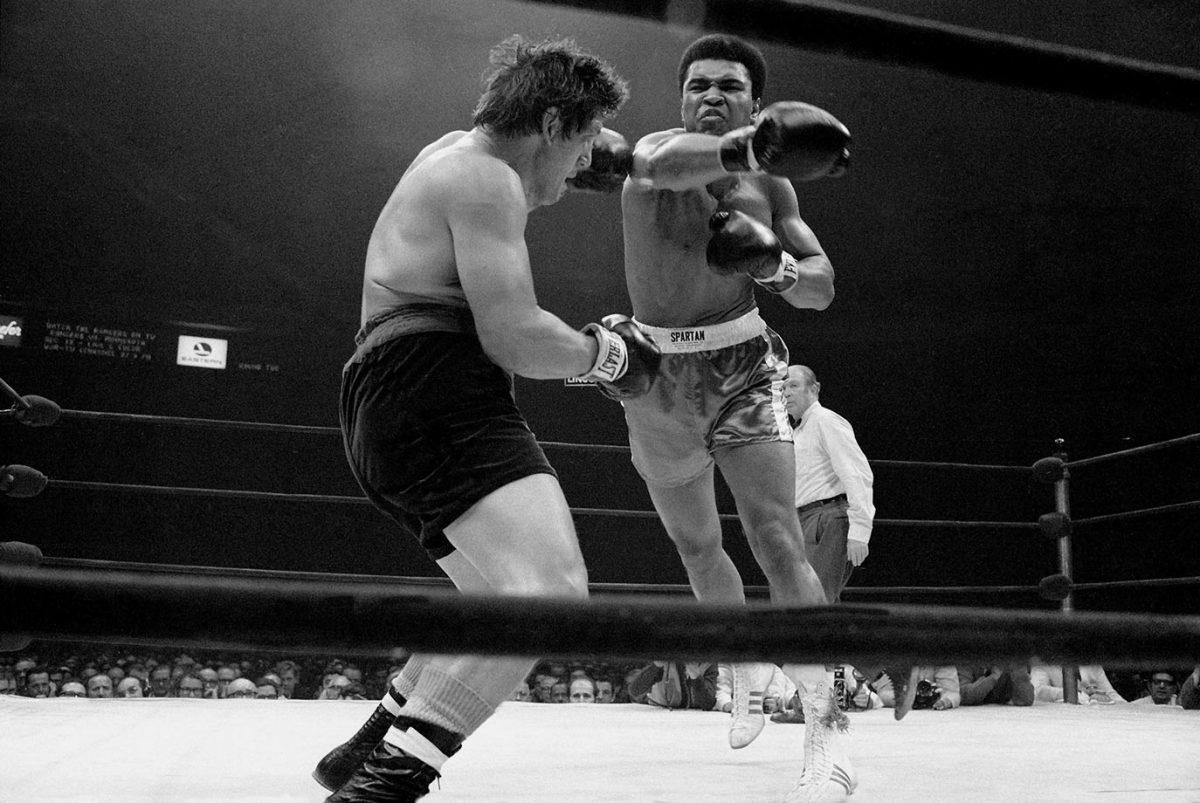
Despite Ali's long layoff, his comeback campaign would include no easy tune-up bouts. He stopped Quarry in three rounds on Oct. 26, 1970, then, just six weeks later — an unthinkably short interlude by today's standards — took on Argentine contender Oscar Bonavena in Madison Square Garden. Here, Ali fires a right at the rugged and awkward Bonavena, who took the fight to the former champion all night.
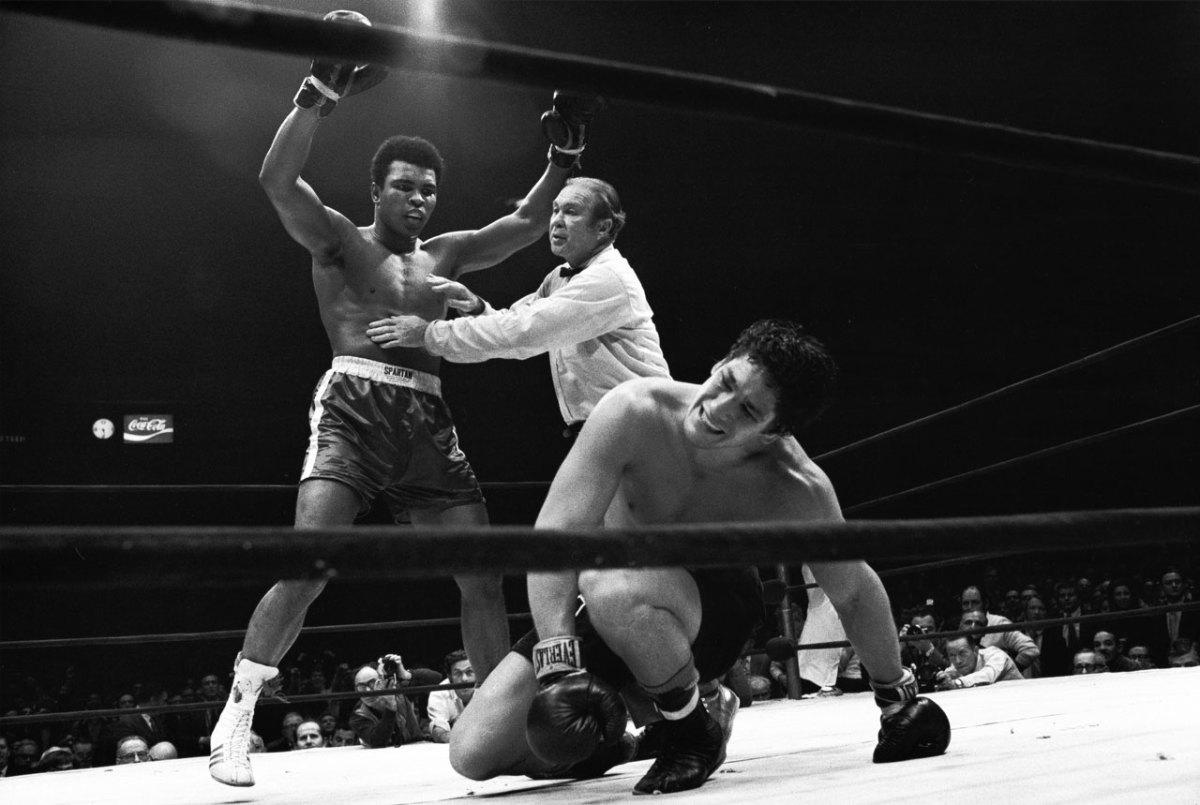
After a long, often sloppy bout, Ali — here being held back by referee Mark Conn — produced one of the most dramatic finishes of his career, dropping Bonavena three times in the 15th and final round to automatically end the fight. The win cleared the way for a showdown with Joe Frazier, the man who had taken the heavyweight title in Ali's absence.
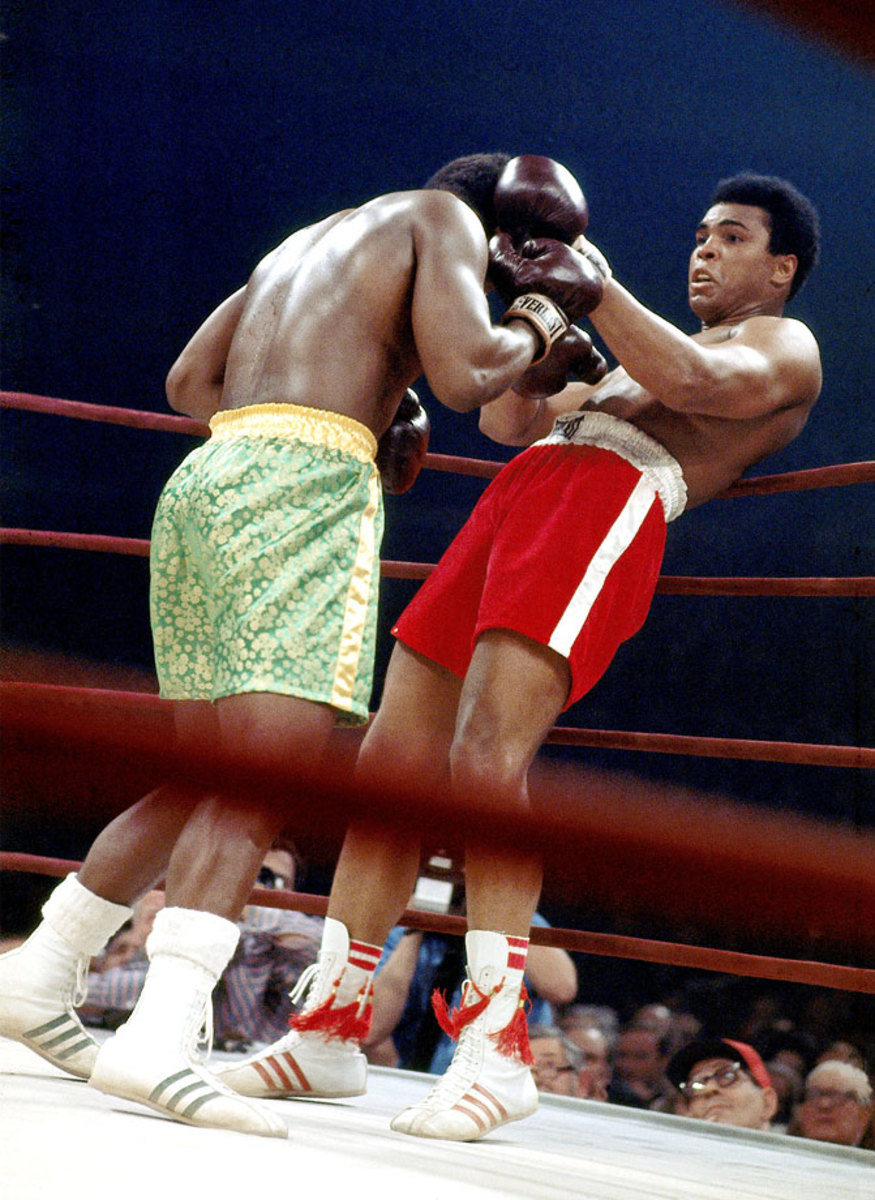
On the night of March 8, 1971, the eyes of the world were on a square patch of white canvas in the center of Madison Square Garden. There, Ali and Joe Frazier met in what was billed at the time simply as The Fight, but has come to be known, justifiably, as the Fight of the Century. For 15 rounds the two undefeated heavyweights battled at a furious pace, with each man sustaining tremendous punishment. In the end Frazier prevailed, dropping Ali in the final round with a tremendous left hook to seal a unanimous decision and hand The Greatest his first loss in 32 professional fights.
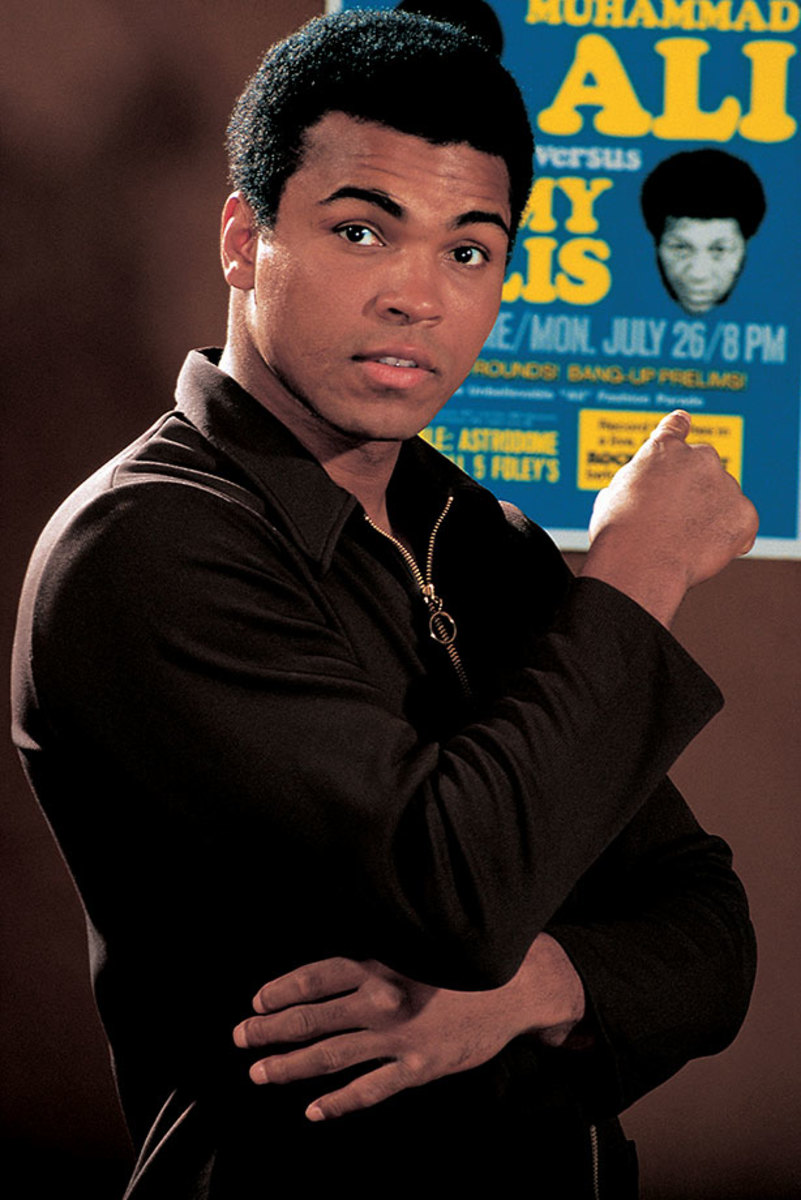
Ali poses with the fight poster for his upcoming fight against Jimmy Ellis during a photo shoot in July 1971. Ellis was an old friend of Ali's — both were trained by Angelo Dundee — and knew his fighting style well from many rounds of sparring.
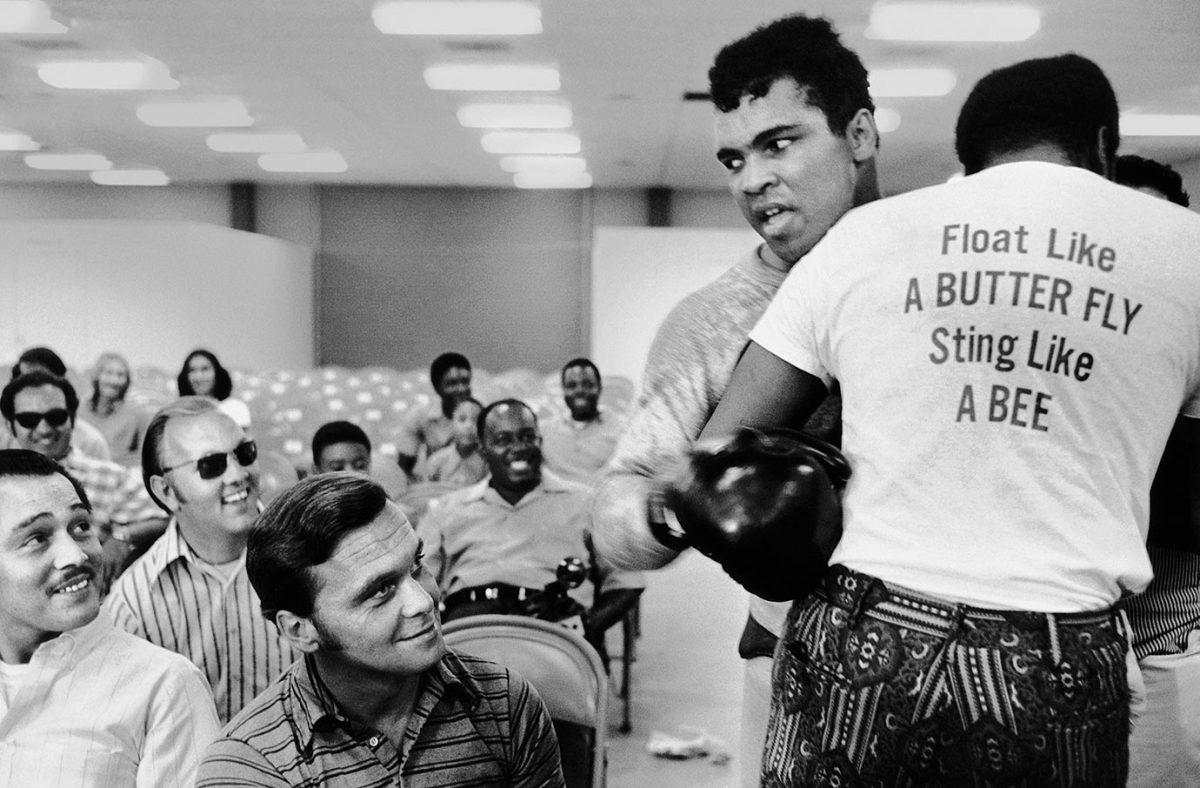
For those sportswriters lucky enough to cover Ali on a regular basis, each day brought surprises and, more often than not, plenty of laughs. of Trainer Drew Bundini Brown helps Ali train for his fight against Ellis. Ali won the bout by technical knockout in the 12th round to claim the vacant NABF heavyweight title.
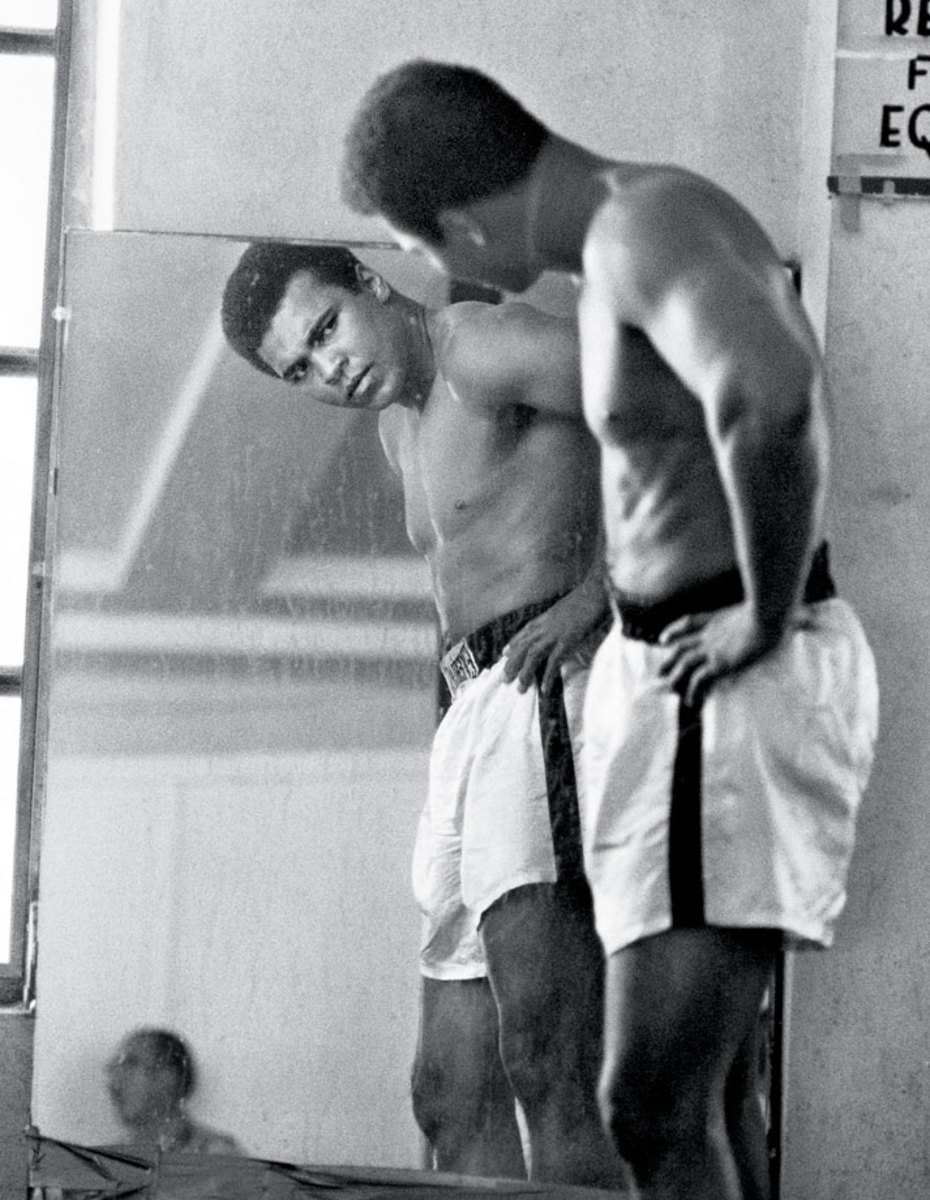
The man in the mirror stares back as Ali examines himself while training for a fight in 1972. He won all six of his fights that year.

The Louisville Lip stands next to George Foreman before Ali's fight versus Jerry Quarry in June 1972. Ali won by technical knockout in the seventh round. Foreman at the time was 36-0. Ali would not get his shot against Foreman for more than two years.
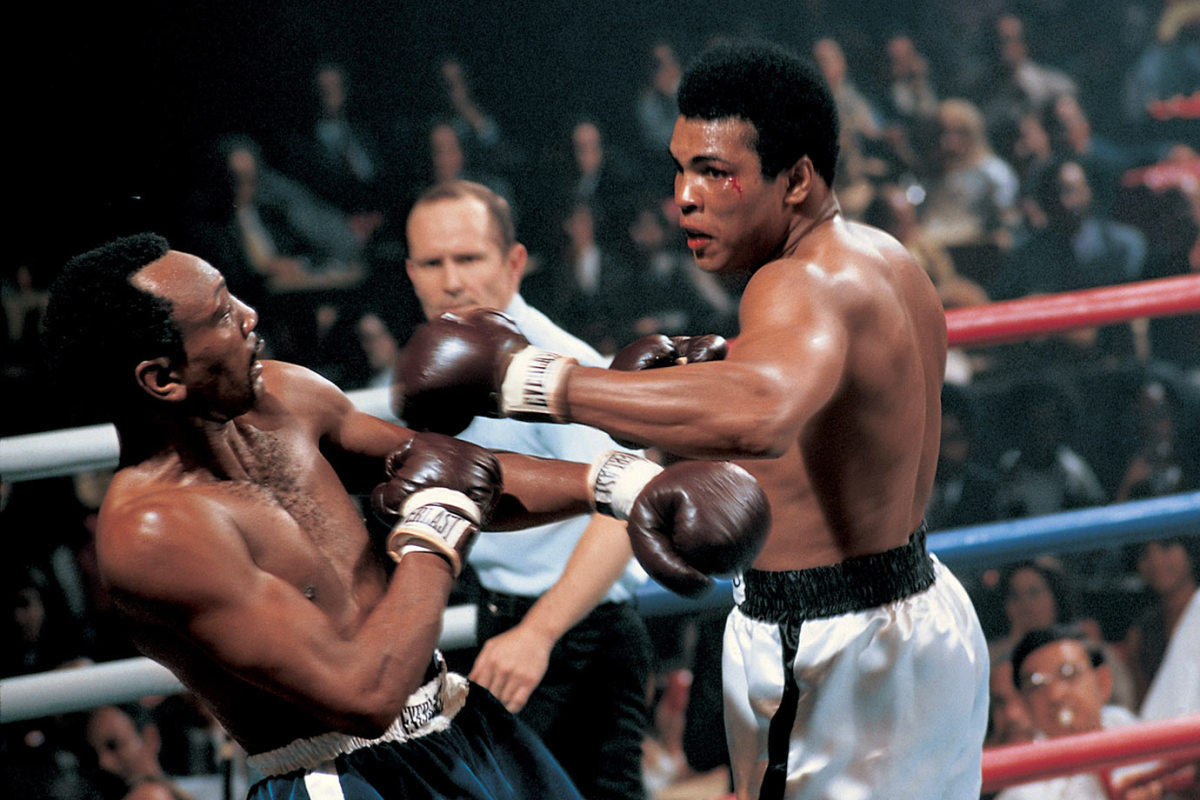
Ali throws a left hook at Bob Foster in their 1972 fight at Stateline, Nev. Although Ali knocked Foster out, Foster did leave his mark: a cut above Ali's left eye, his first as a professional.
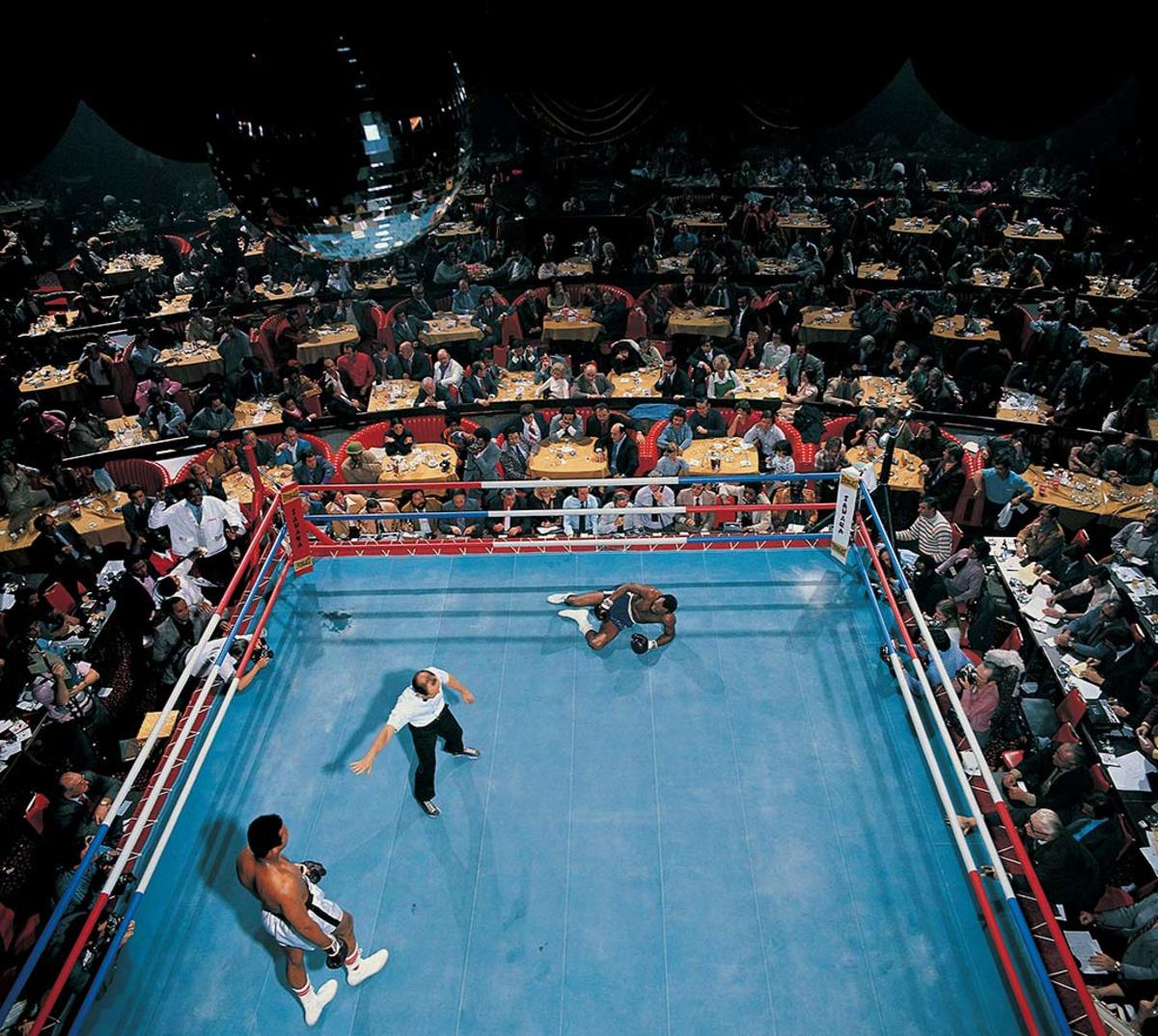
Foster lies on the canvas after getting knocked down by Ali. Ali knocked Foster down four times in the fifth round and twice more in the seventh round before he was finally counted out after Ali knocked him down again in the eighth round.
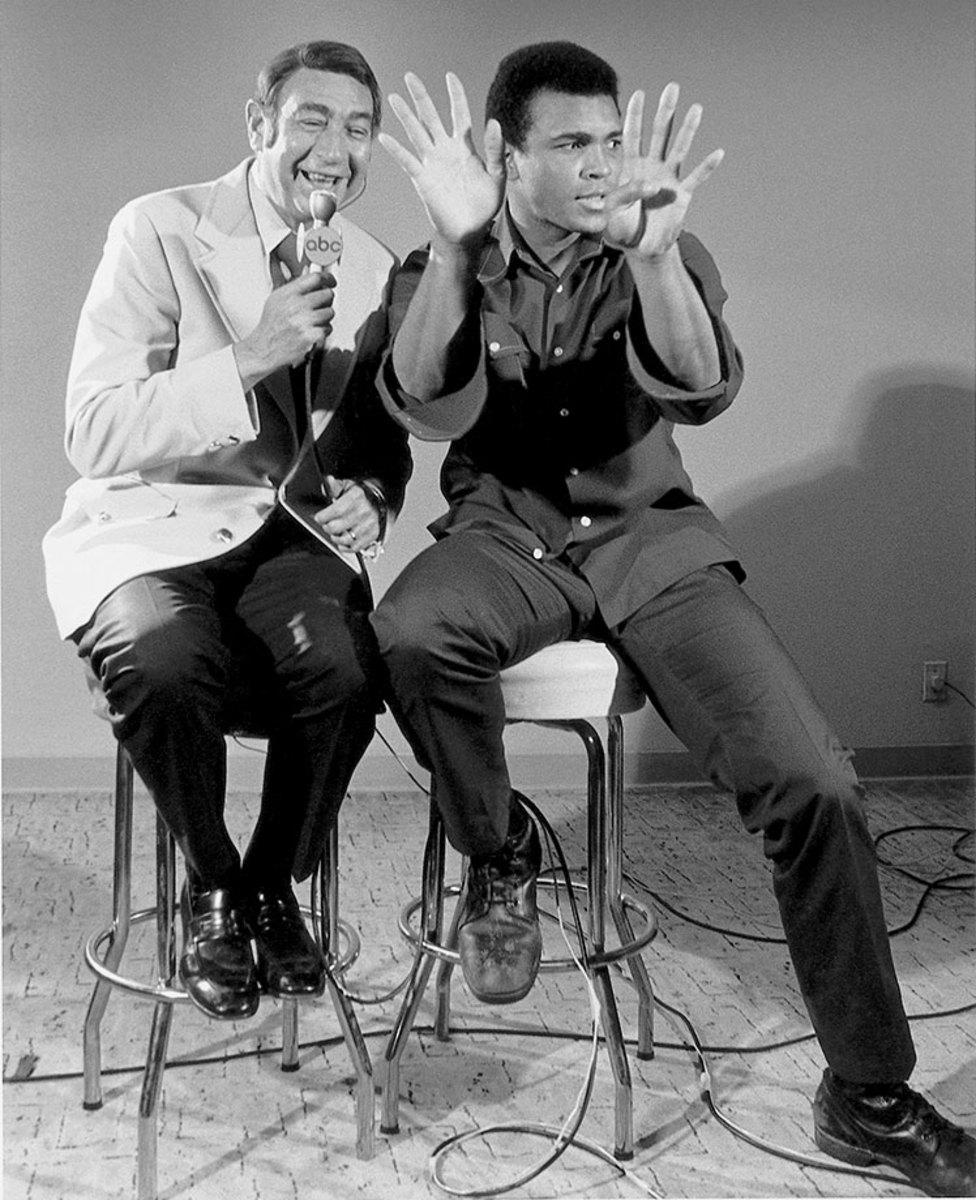
Ali sits with sportscaster Howard Cosell before his fight with Joe Bugner in February 1973. Although unable to knock Bugner out, Ali won comfortably by unanimous decision.
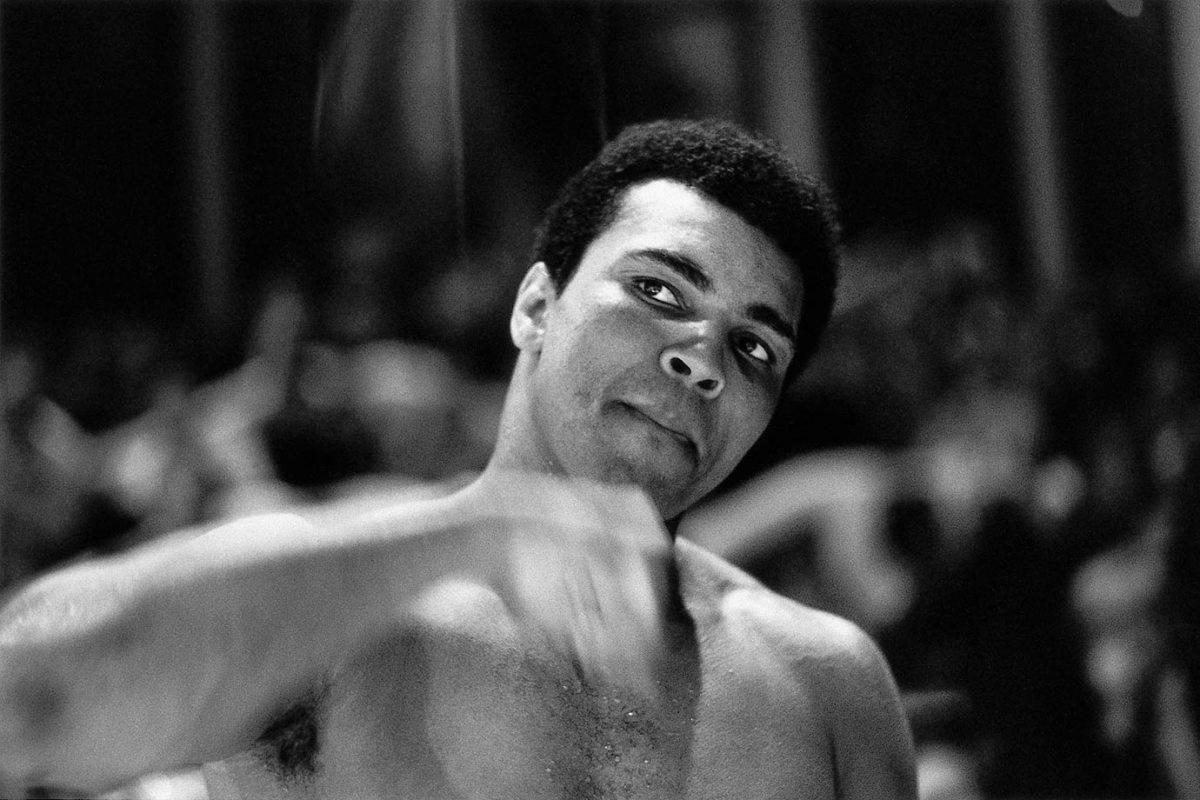
Ali hits a speed bag while warming up for his bout with Bugner in Las Vegas. Ali prepared ferociously for the fight, training 67 rounds the week leading up to the fight, including six rounds the day before the fight.
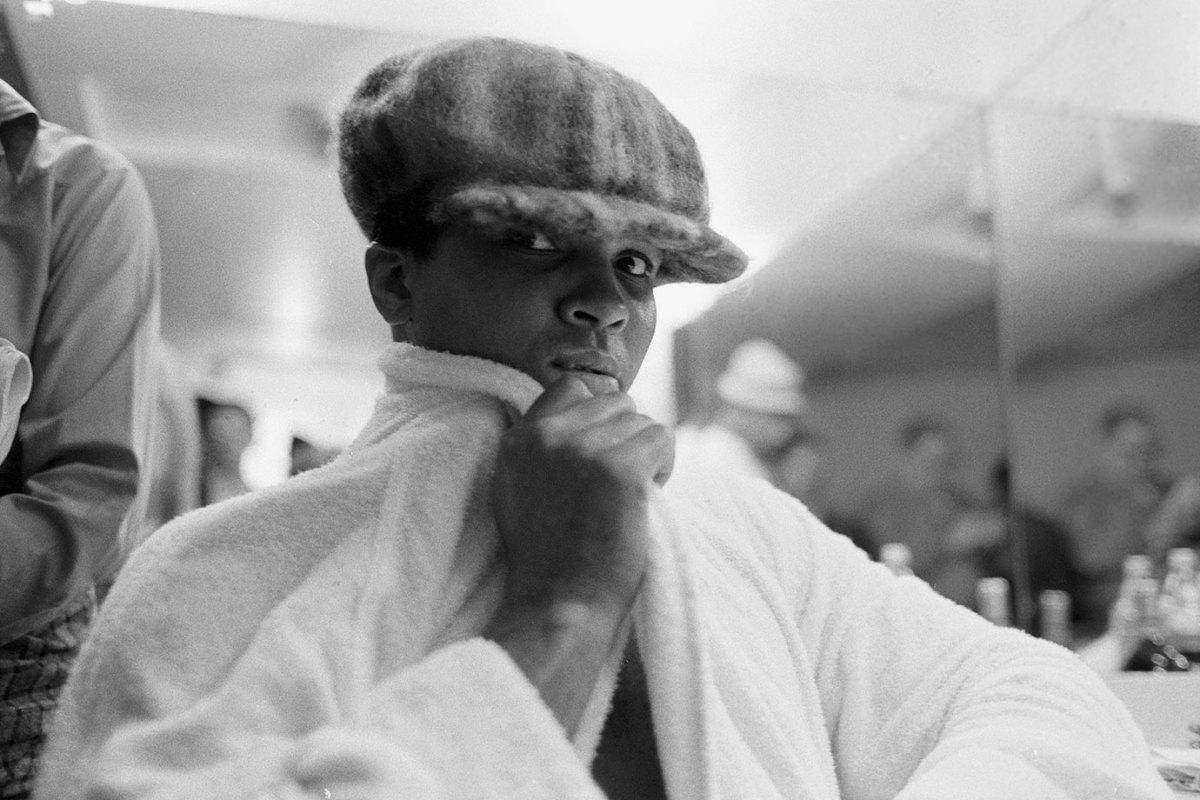
In a lighter pre-fight moment, Ali poses for a portrait wearing a hat in his dressing room before the match with Bugner.
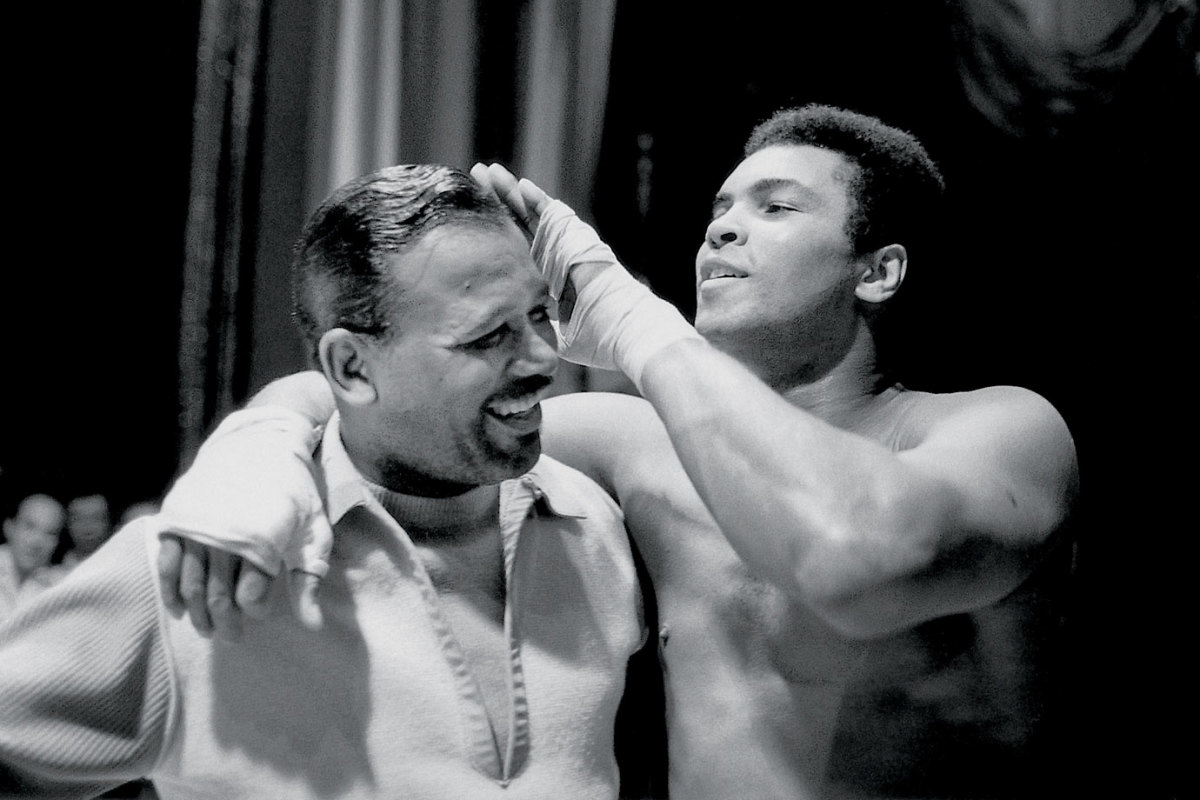
Ali plays with Sugar Ray Robinson's hair in the locker room before his bout with Bugner. The former welterweight and middleweight champion was Ali's childhood idol.
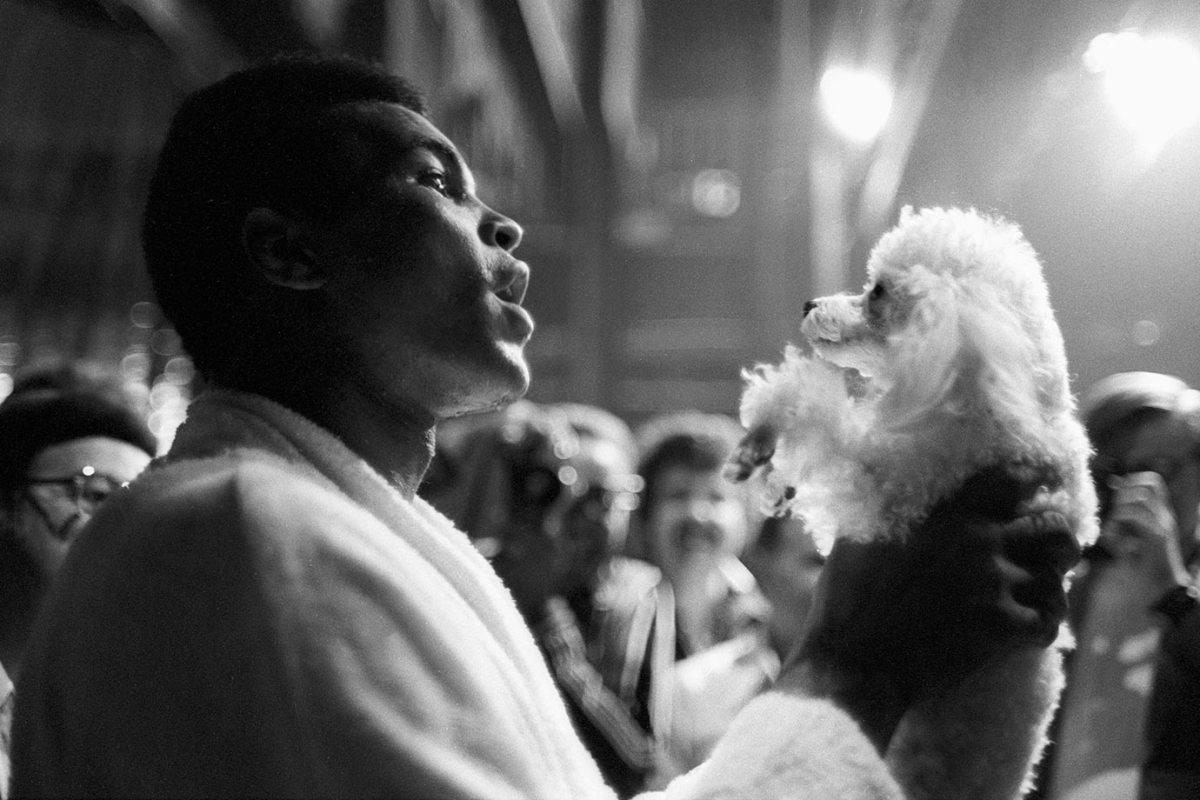
Before the fight with Bugner, Muhammad Ali enjoys a relaxed moment with a poodle at Caesars Palace Hotel. He won the fight with Bugner by unanimous decision.
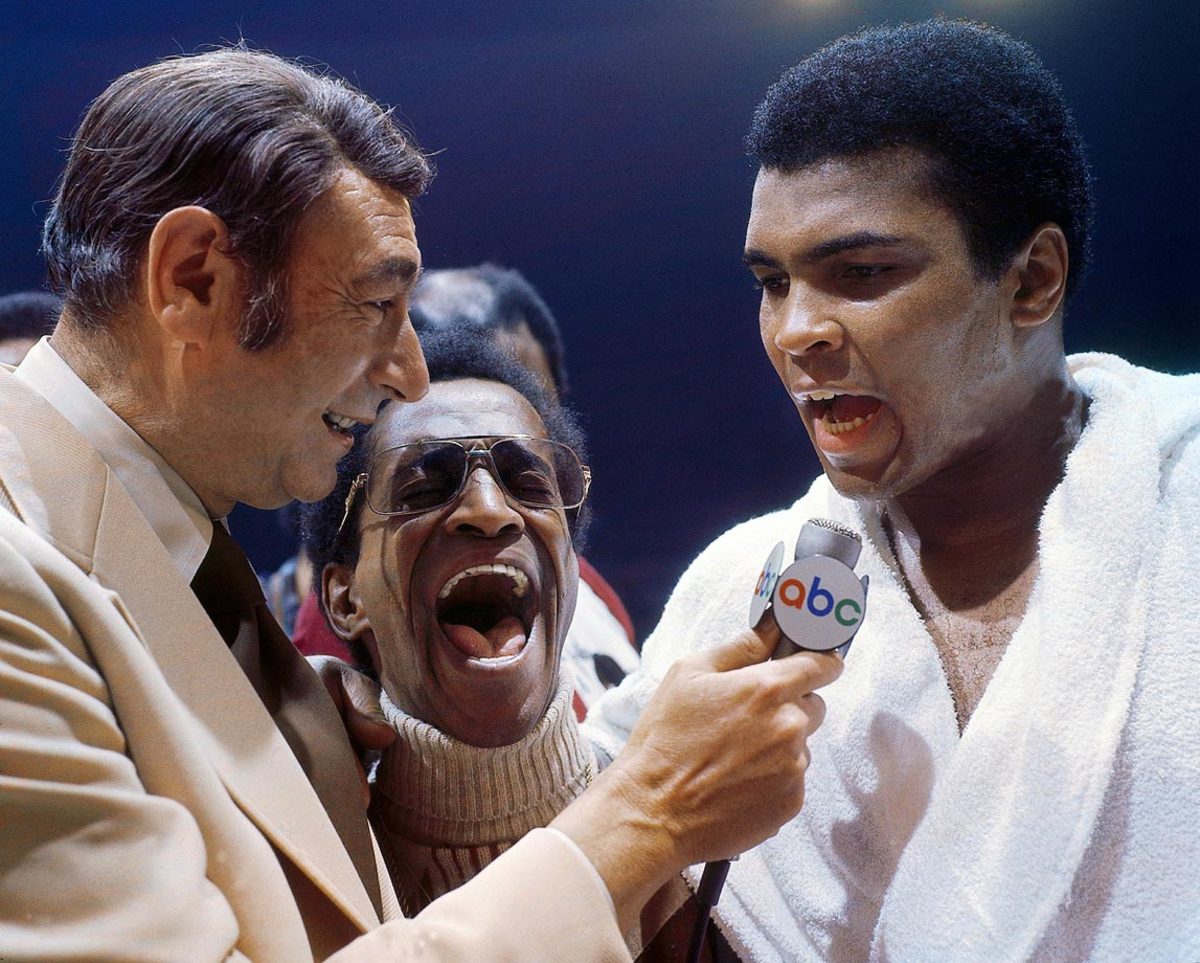
Howard Cosell interviews Ali, with entertainer Sammy Davis Jr. in the middle, after his victory over Joe Bugner by unanimous decision in. Although the fight was never in jeopardy of getting away from him, Ali praised Bugner's legs and said he could be a champion in a few years.
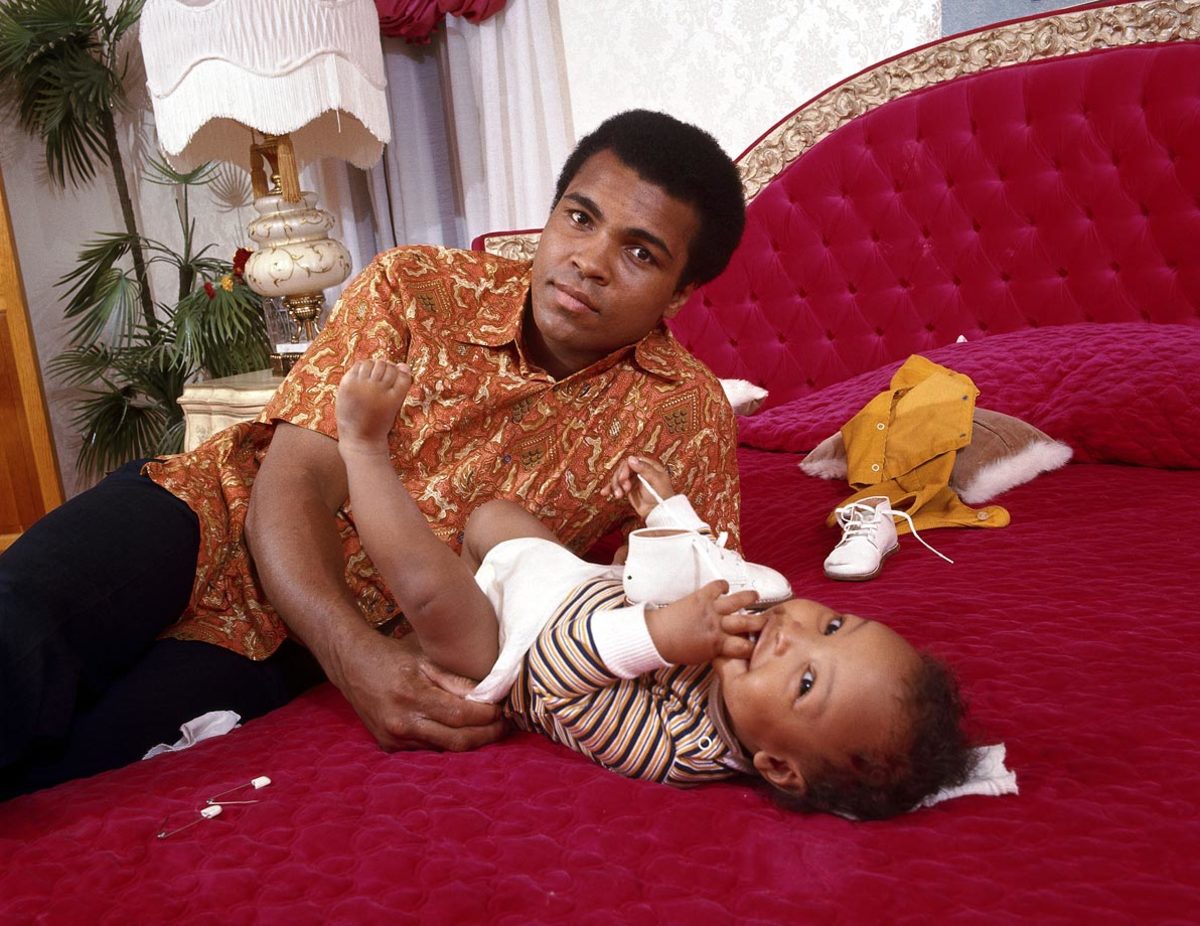
Ali changes the diaper of his son in his bedroom during a photo shoot at the family's home in April 1973. Ali had suffered a broken jaw less than a month earlier in his fight against Ken Norton.
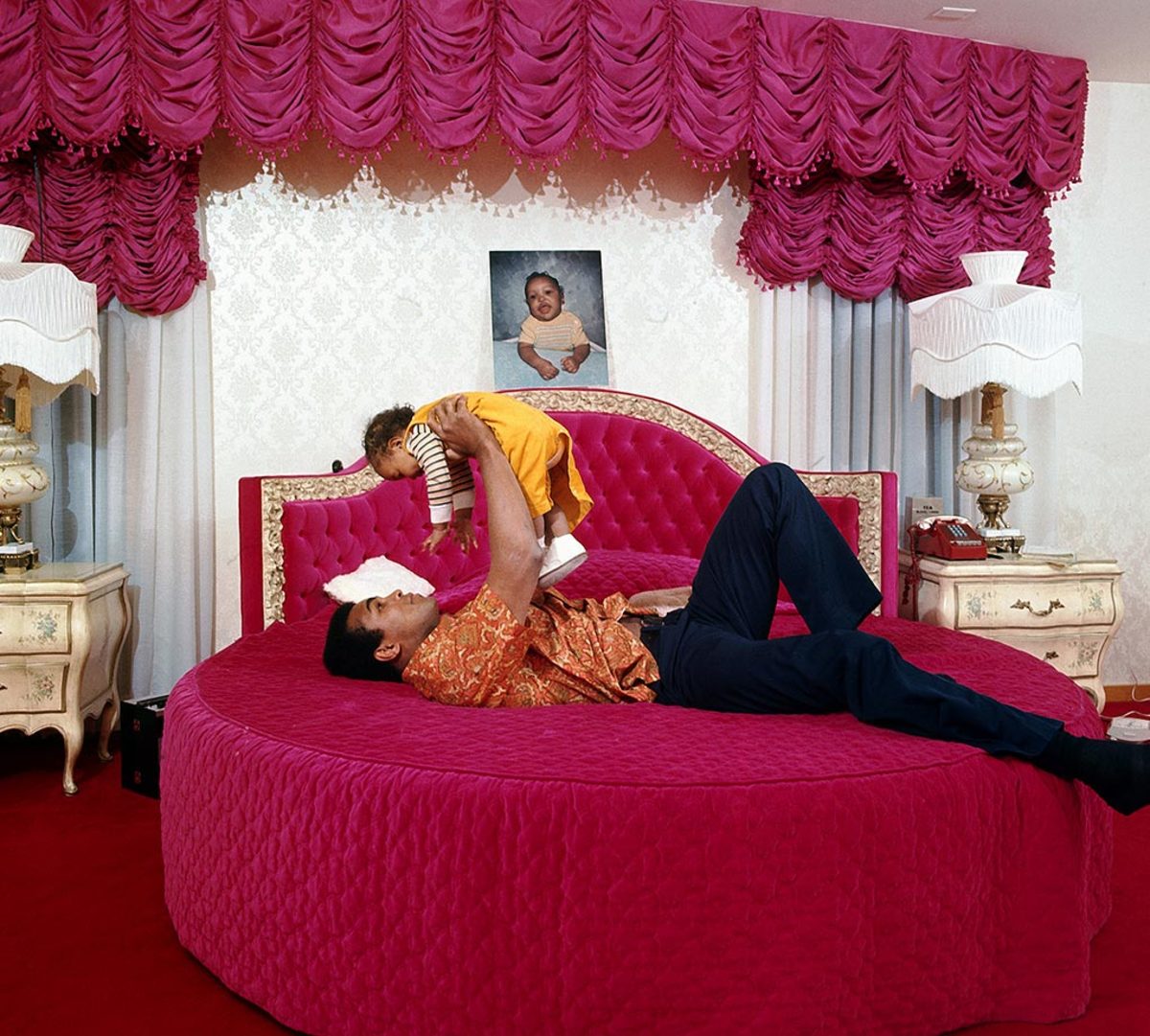
In the wake of his split decision loss to Norton, Ali plays with his son in his bedroom at home in Cherry Hill, N.J.
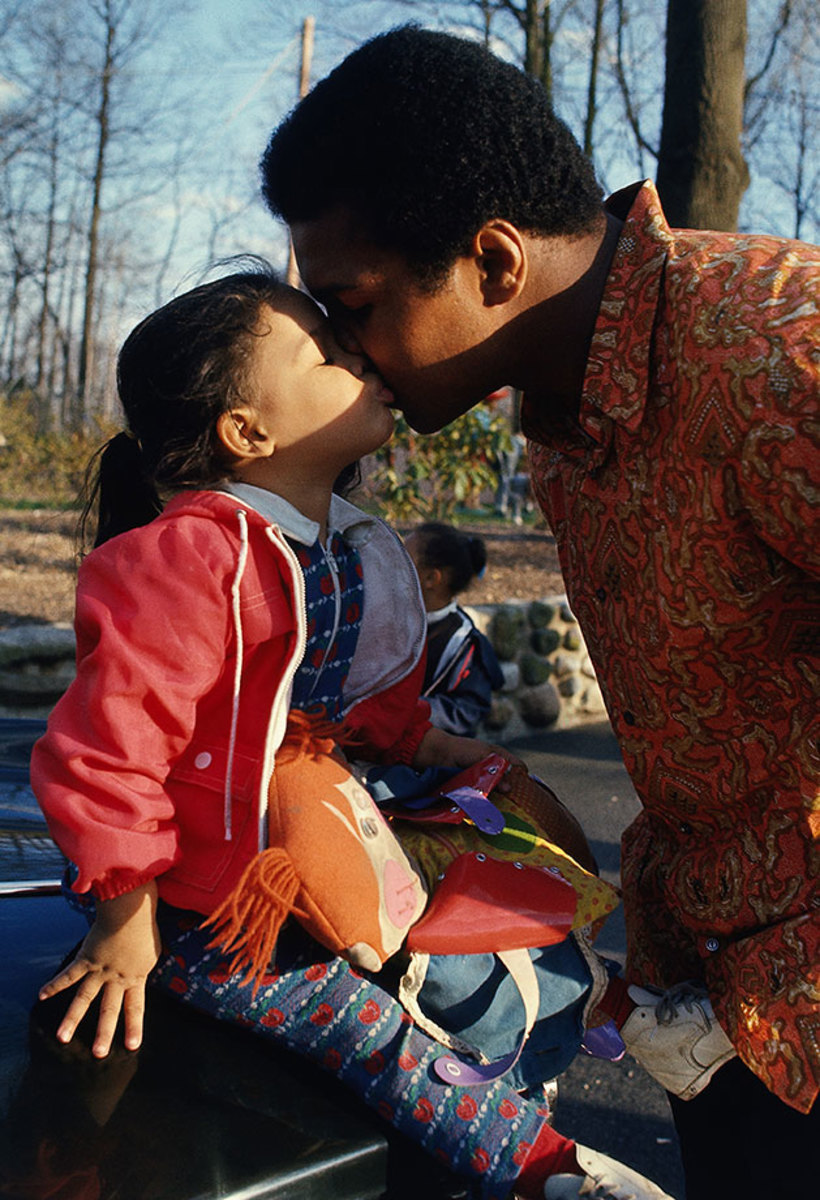
Ali kisses his daughter Jamillah outside of their home following the loss to Norton, just the second defeat of his career.
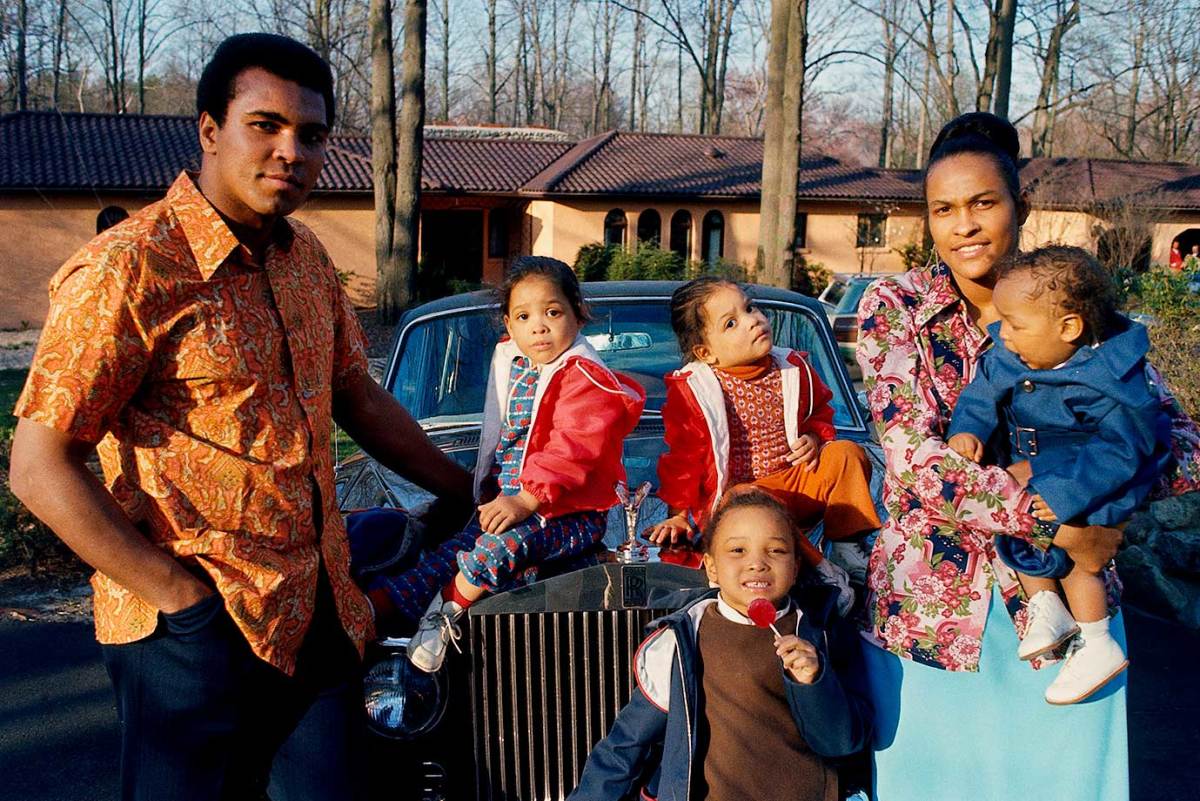
The Ali family standing outside their New Jersey home. To the right of Muhammad Ali are his twin daughters, Jamilllah and Rasheda, daughter Maryum and his wife, Khalilah, holding their son Ibn Muhammad Ali Jr.
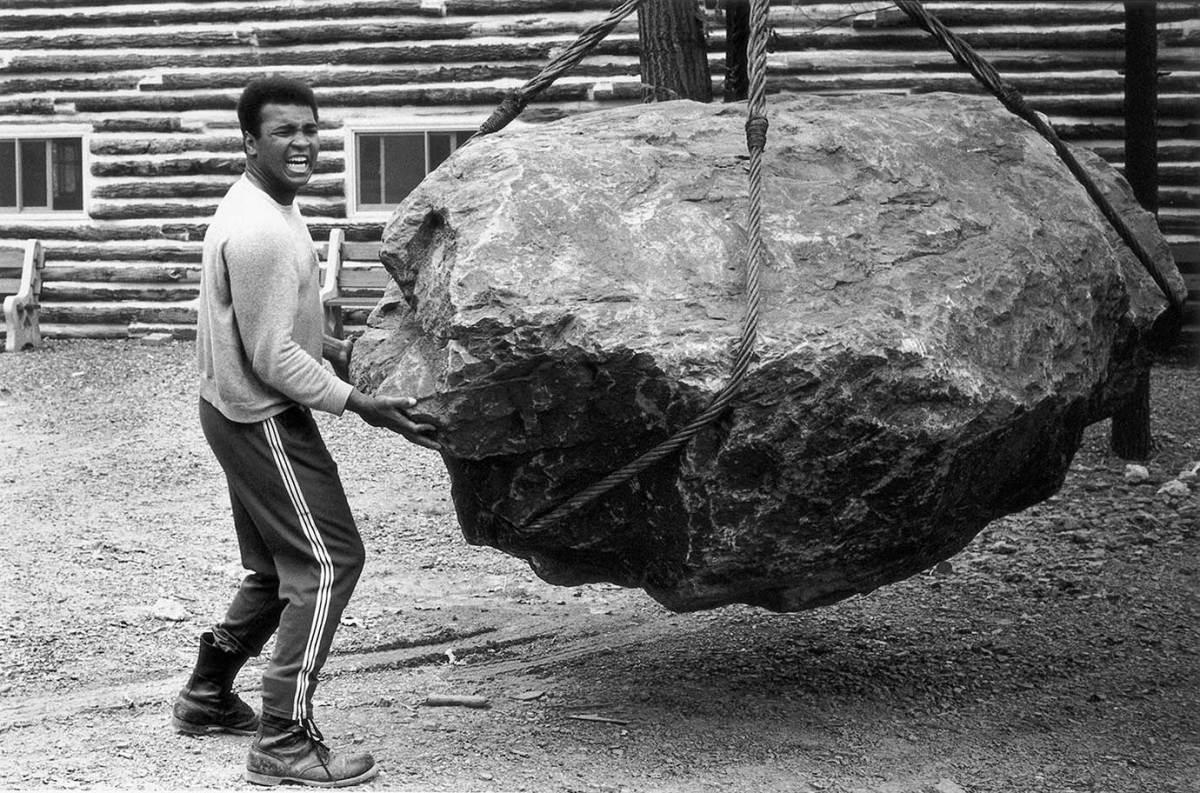
At his training camp cabin, Ali pushes a boulder during a photo shoot in Deer Lake, Penn., in August 1973. Ali was training for his rematch against Ken Norton, who broke his jaw five months earlier.
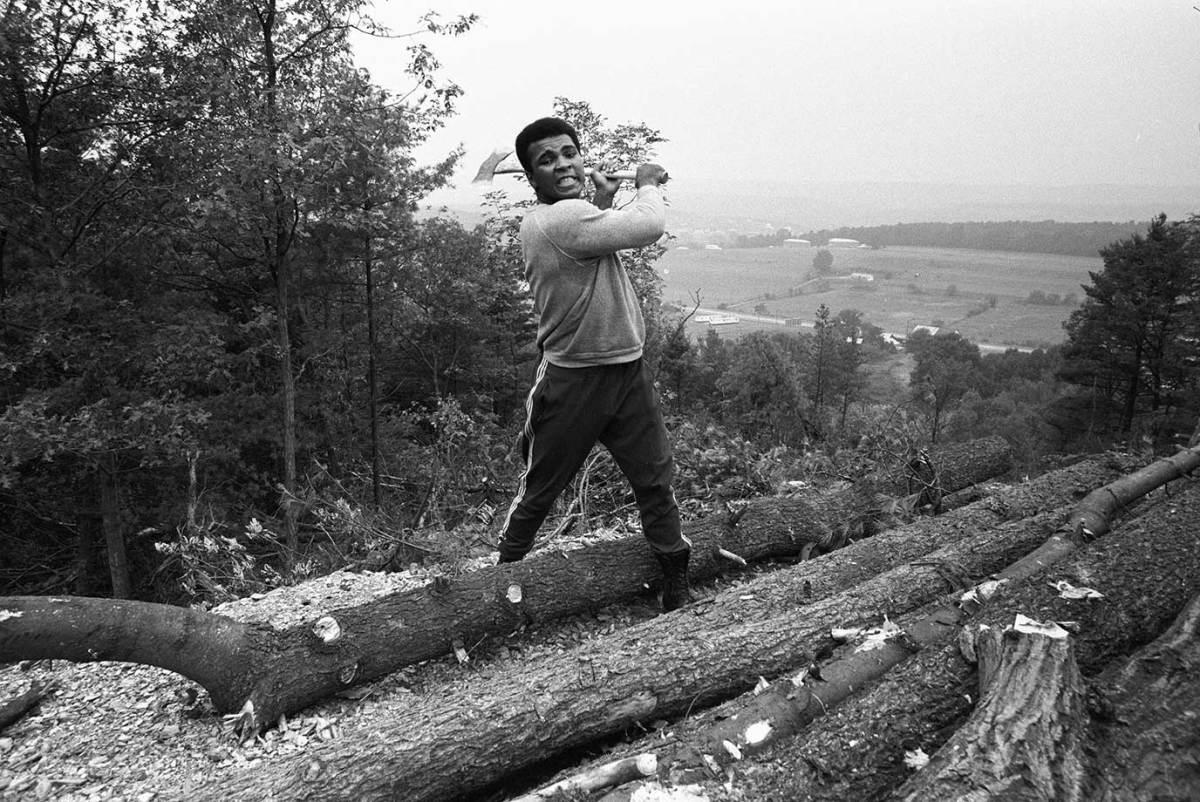
Ali chops wood at his cabin in Deer Lake. He referred to the training camp as "fighter's heaven" and used it to prepare for fights away from the spotlight.
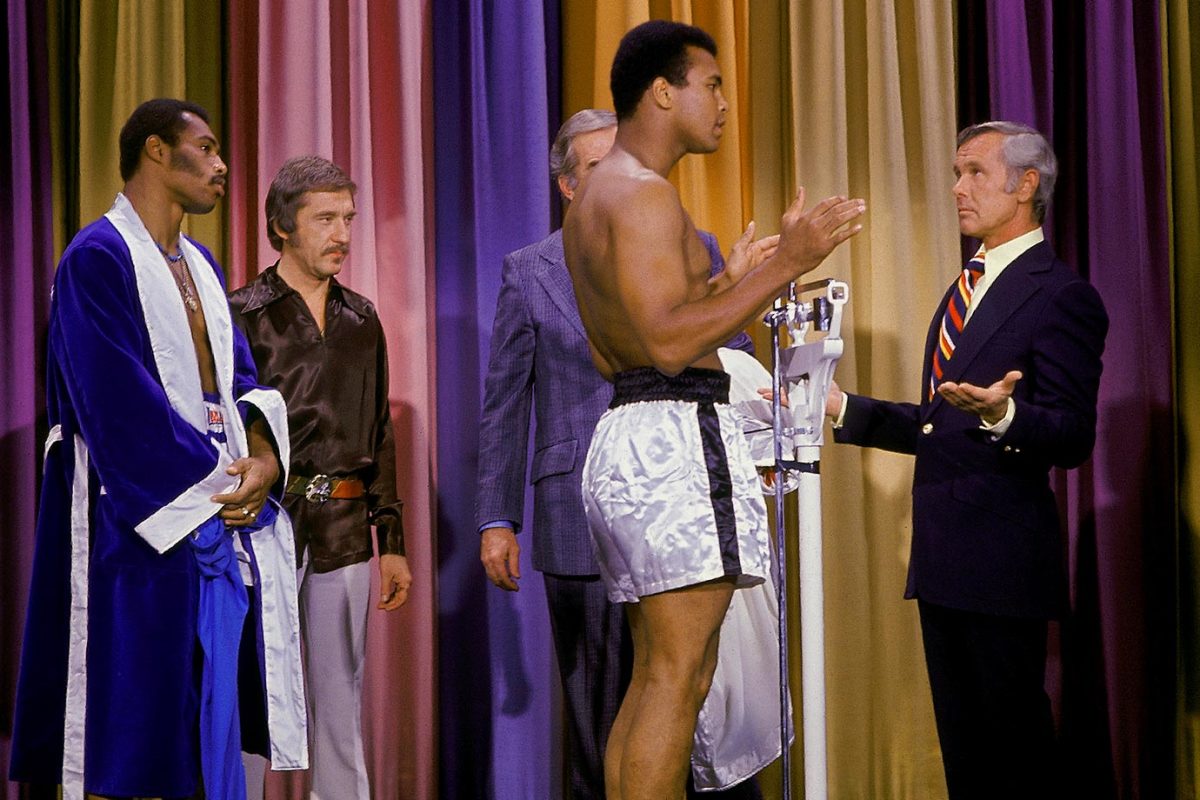
The fighters weigh in on the Tonight Show with Johnny Carson ahead of Ali and Ken Norton's September 1973 fight.
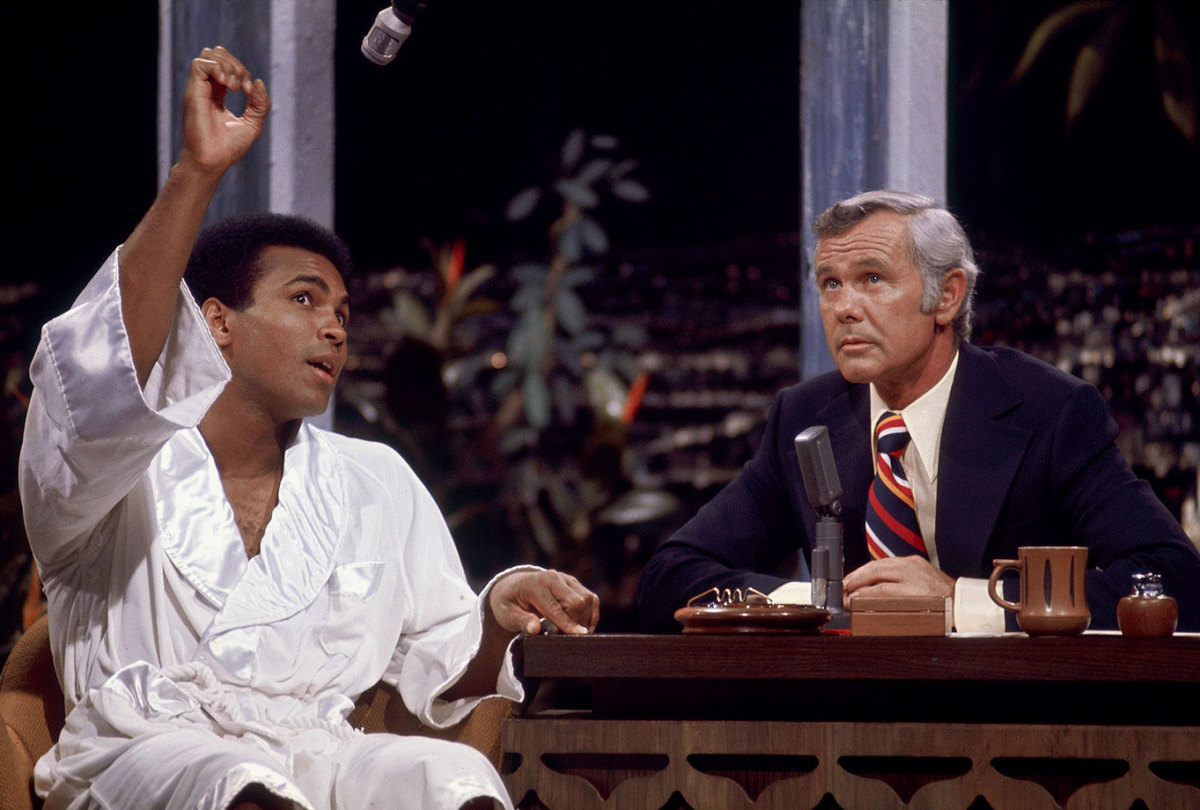
Johnny Carson listens to Ali on the Tonight Show three days before his rematch with Norton. Ali would avenge his earlier loss to Norton, winning a narrow split decision.
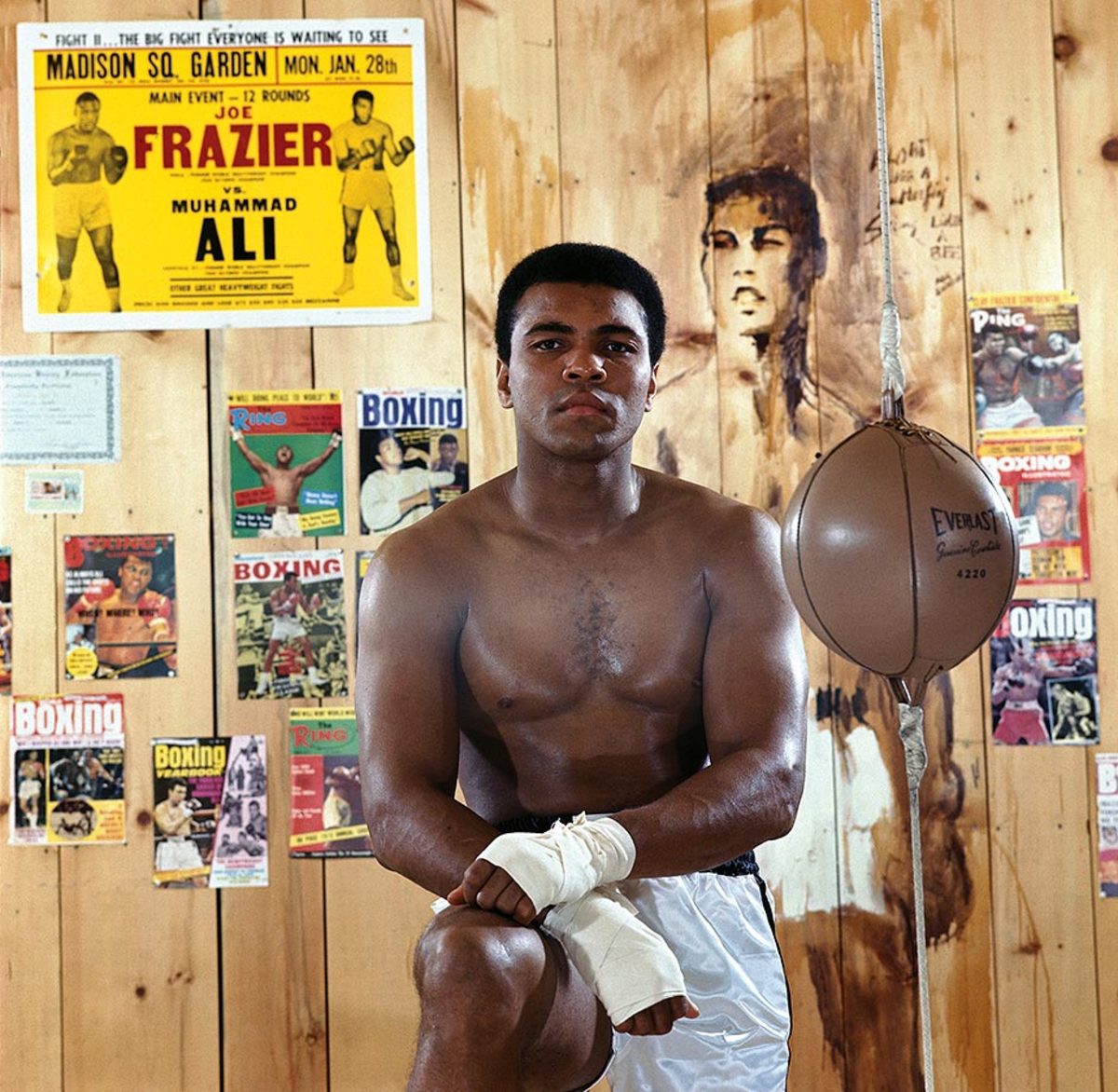
Ali poses in front of posters and magazine covers from throughout his career at his training camp cabin in Deer Lake in 1974.
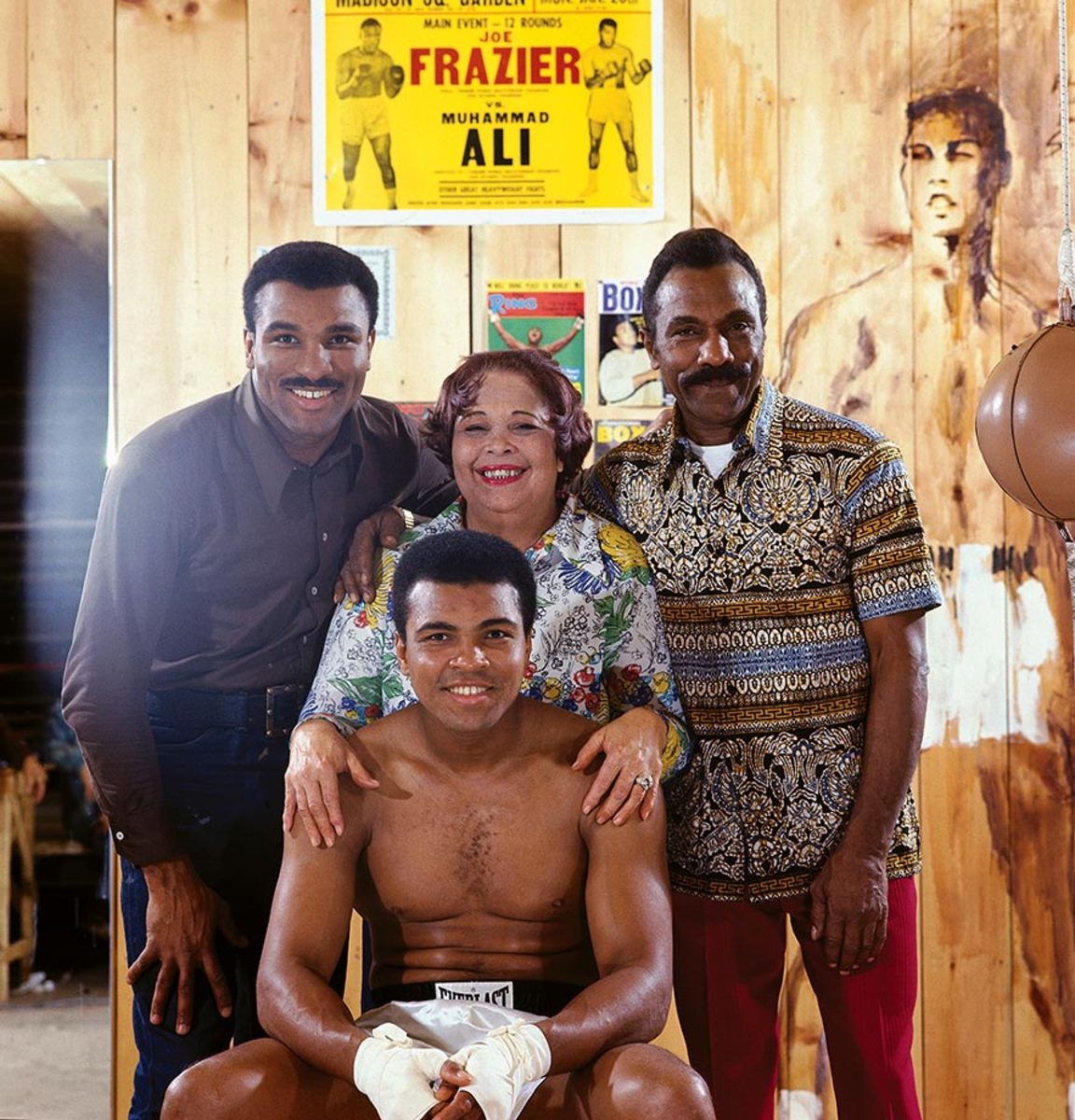
Ali poses with members of his family in front of a poster from his first fight with Joe Frazier. Ali's brother, Rahman Ali; mother, Odessa Clay; and father, Cassius Clay Sr. stand behind the boxer.
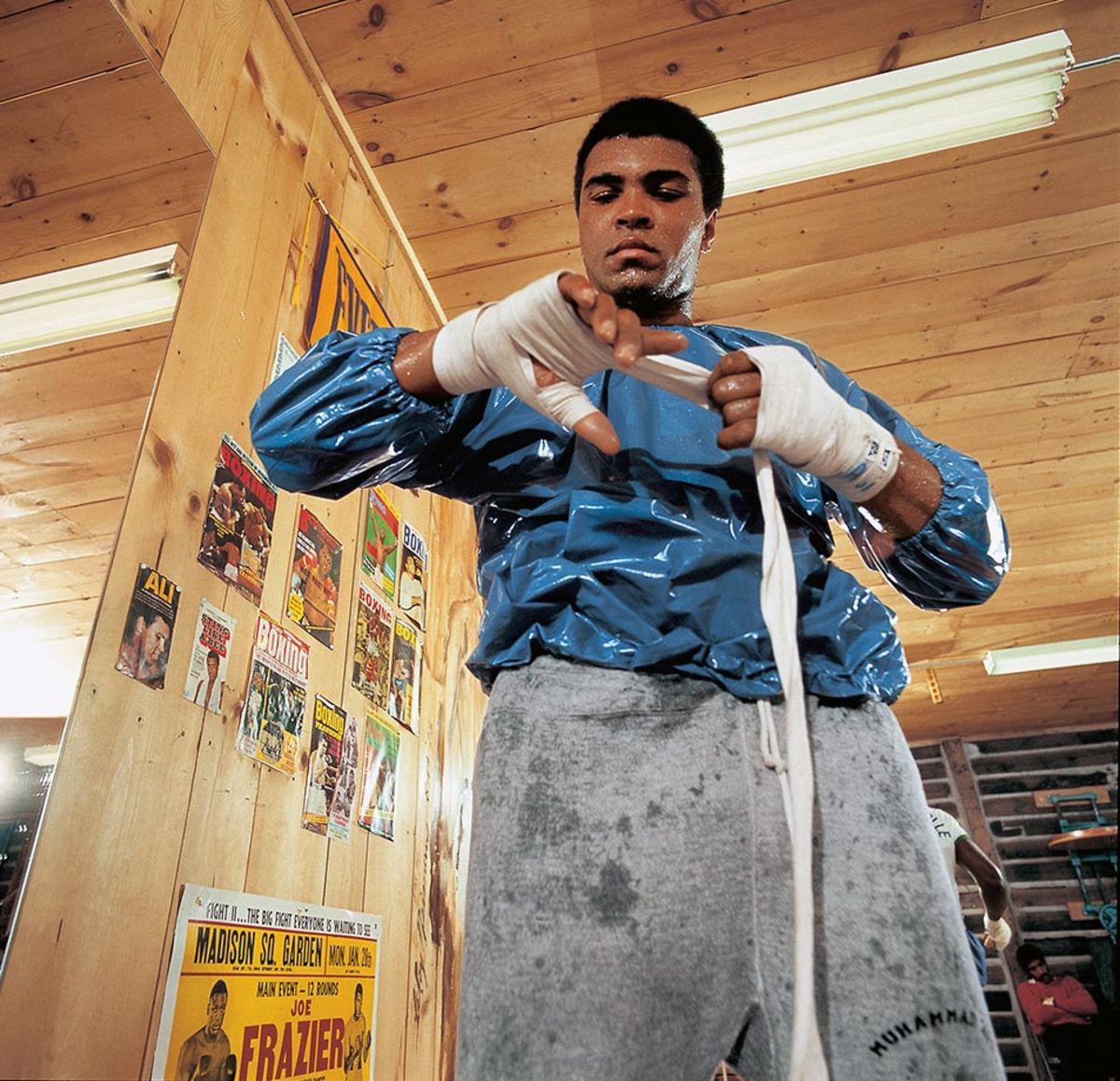
Less than three weeks before his rematch with Joe Frazier on Jan. 28, 1974, Ali wraps his hands while wearing a sauna suit at his training camp cabin.
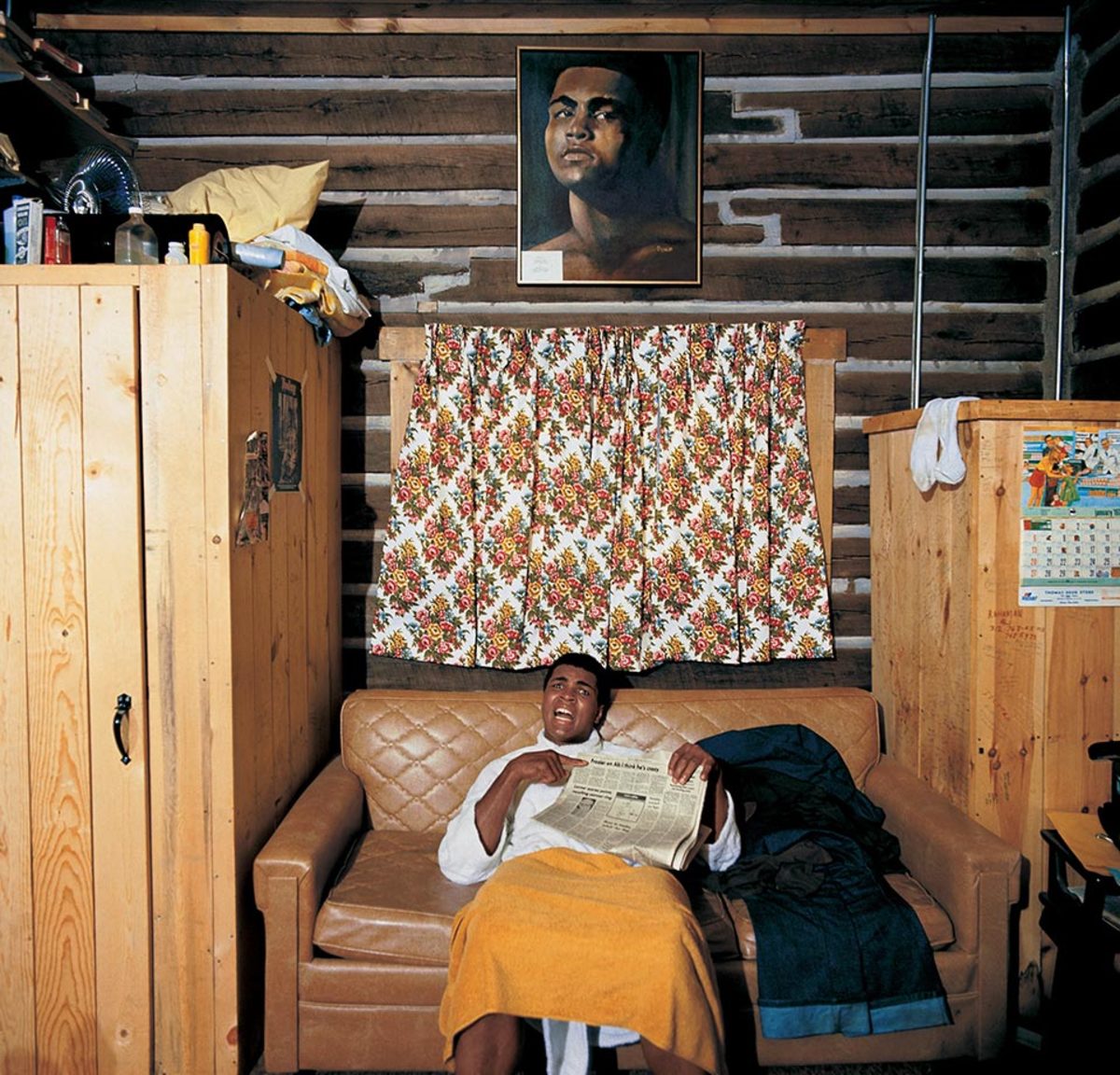
Ali holds a newspaper at his cabin in January 1974. He is pointing to a headline that reads, "Frazier On Ali, I Think He's Crazy." Ali and Frazier fought for the second time later that month with Ali winning by a unanimous decision.
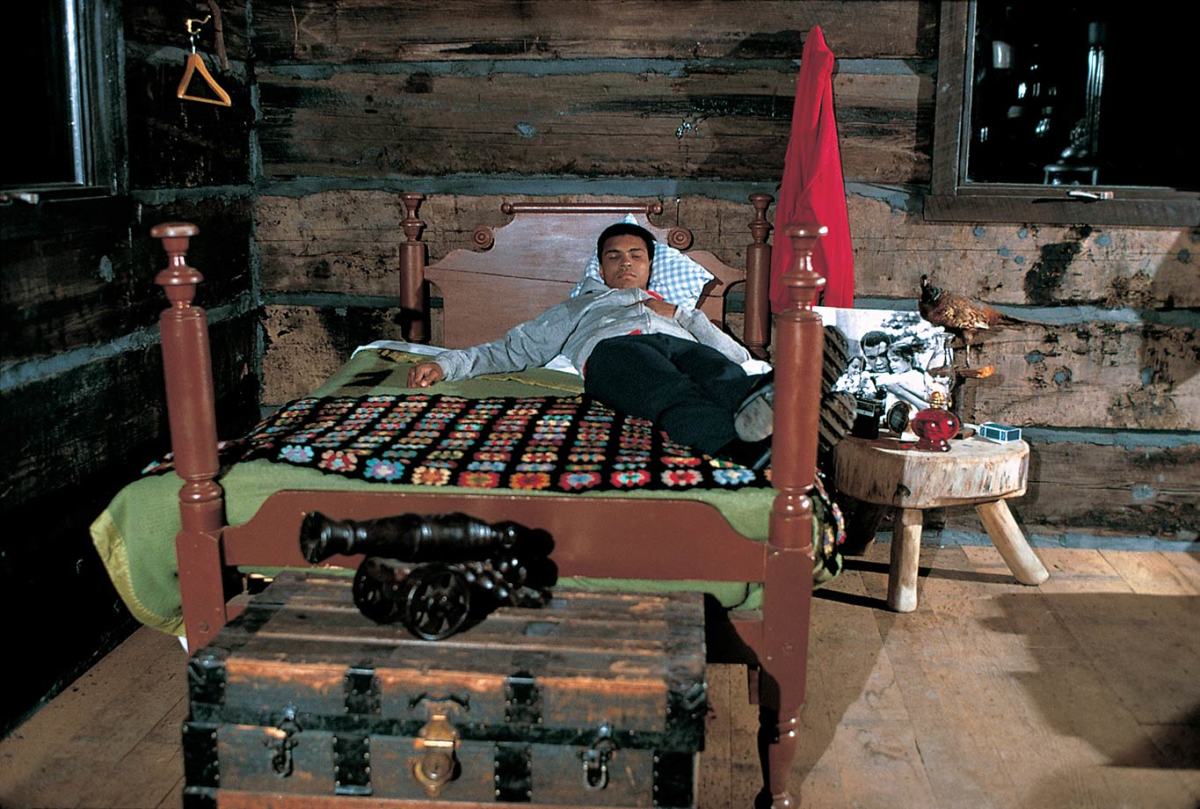
Ali lies on his bed at his cabin during the January 1974 photo shoot.
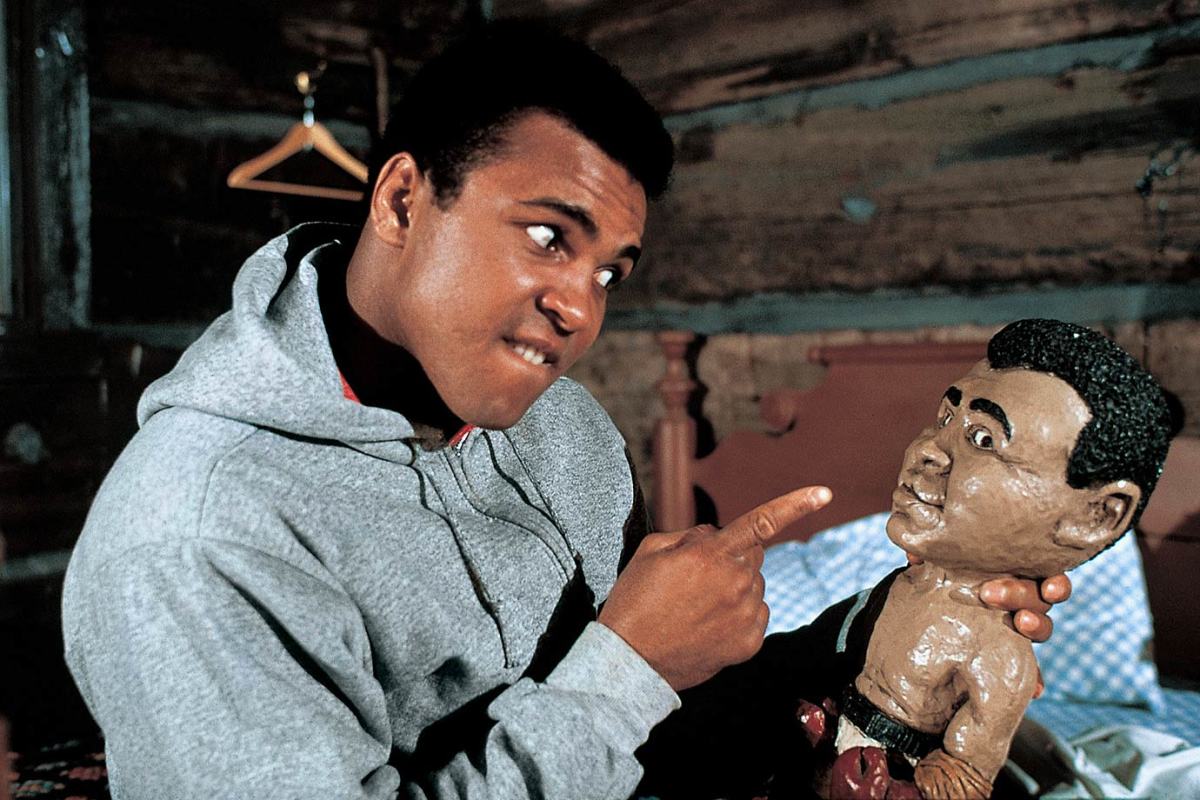
His smaller incarnation stares straight back as Ali plays with a doll of himself during the same 1974 shoot at his training camp cabin.
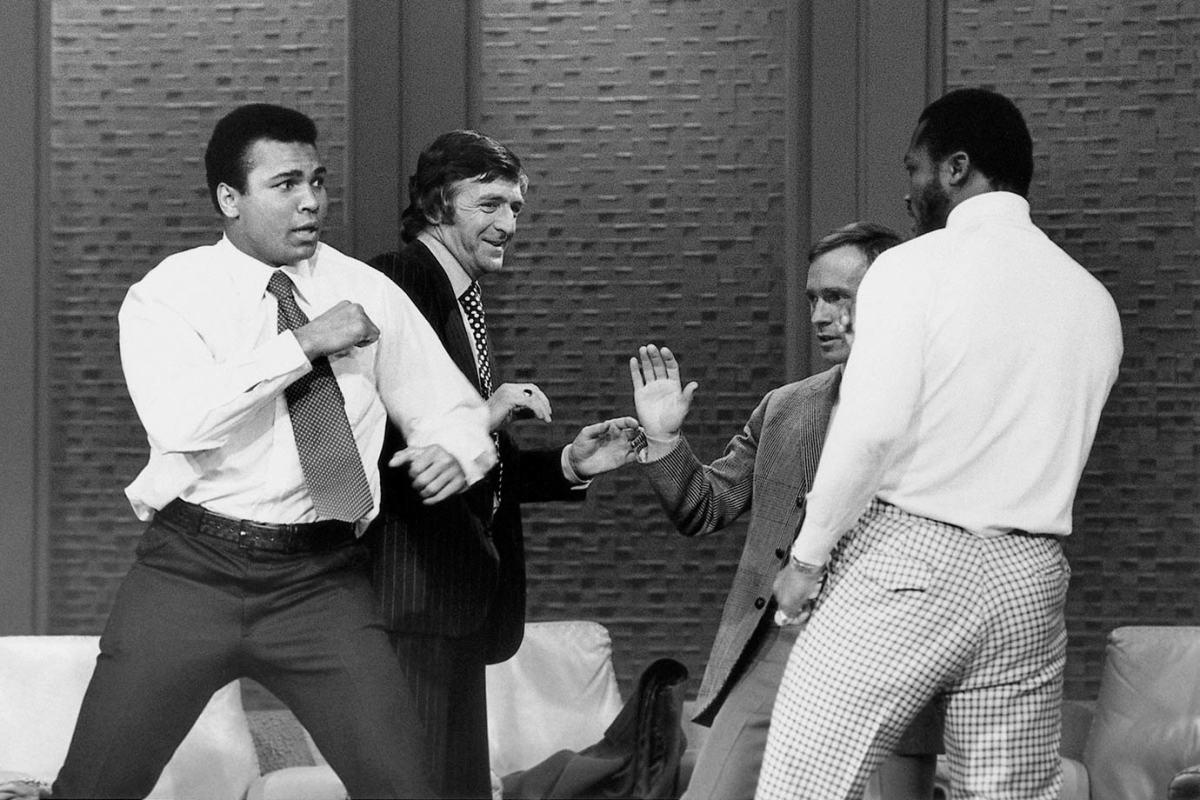
Ali and Joe Frazier fight on the set of The Dick Cavett Show while reviewing their 1971 bout in advance of their 1974 rematch. Ali called Frazier ignorant, to which Frazier took exception. As the studio crew tried to calm Frazier down, Ali held Frazier by the neck, forcing him to sit down and sparking a fight. The television set fight amped up anticipation of their January 1974 bout.
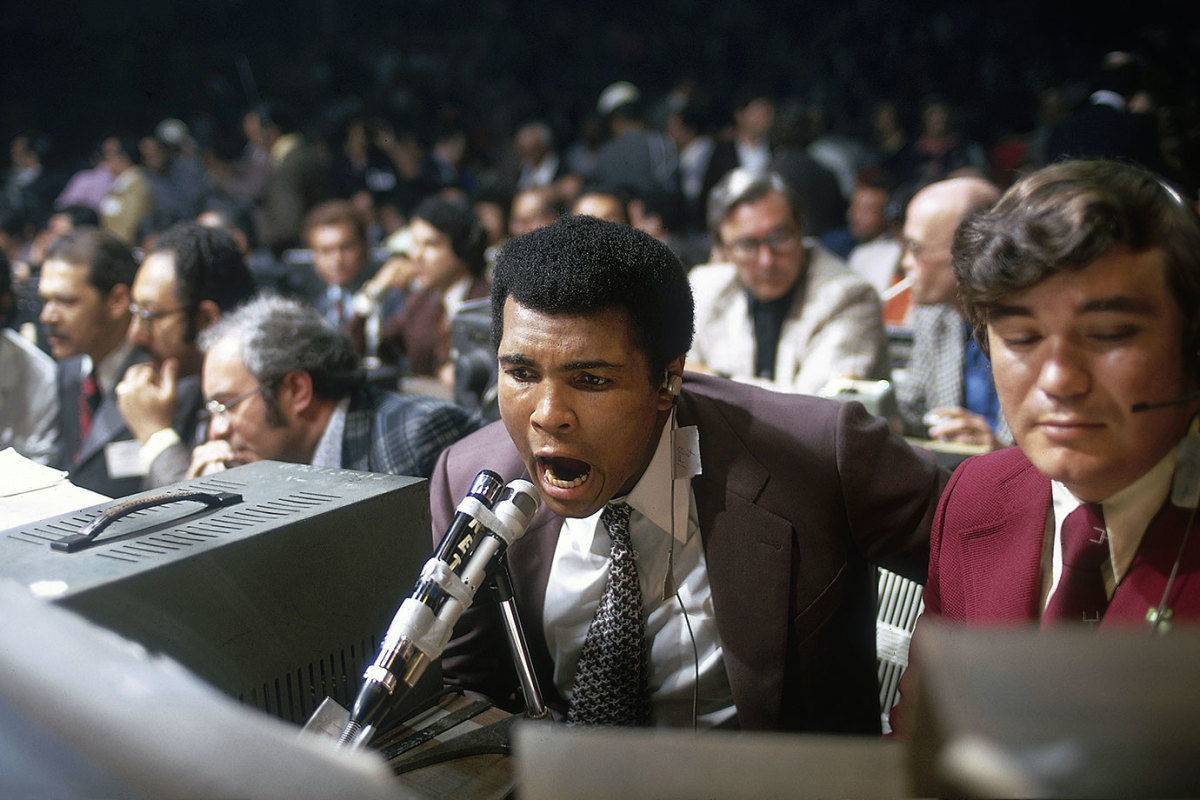
Exploring a different side of the sport, Ali broadcasts the fight between George Foreman and Ken Norton in March 1974. Foreman won the fight by technical knockout in the second round, setting up the showdown with Ali in Zaire.
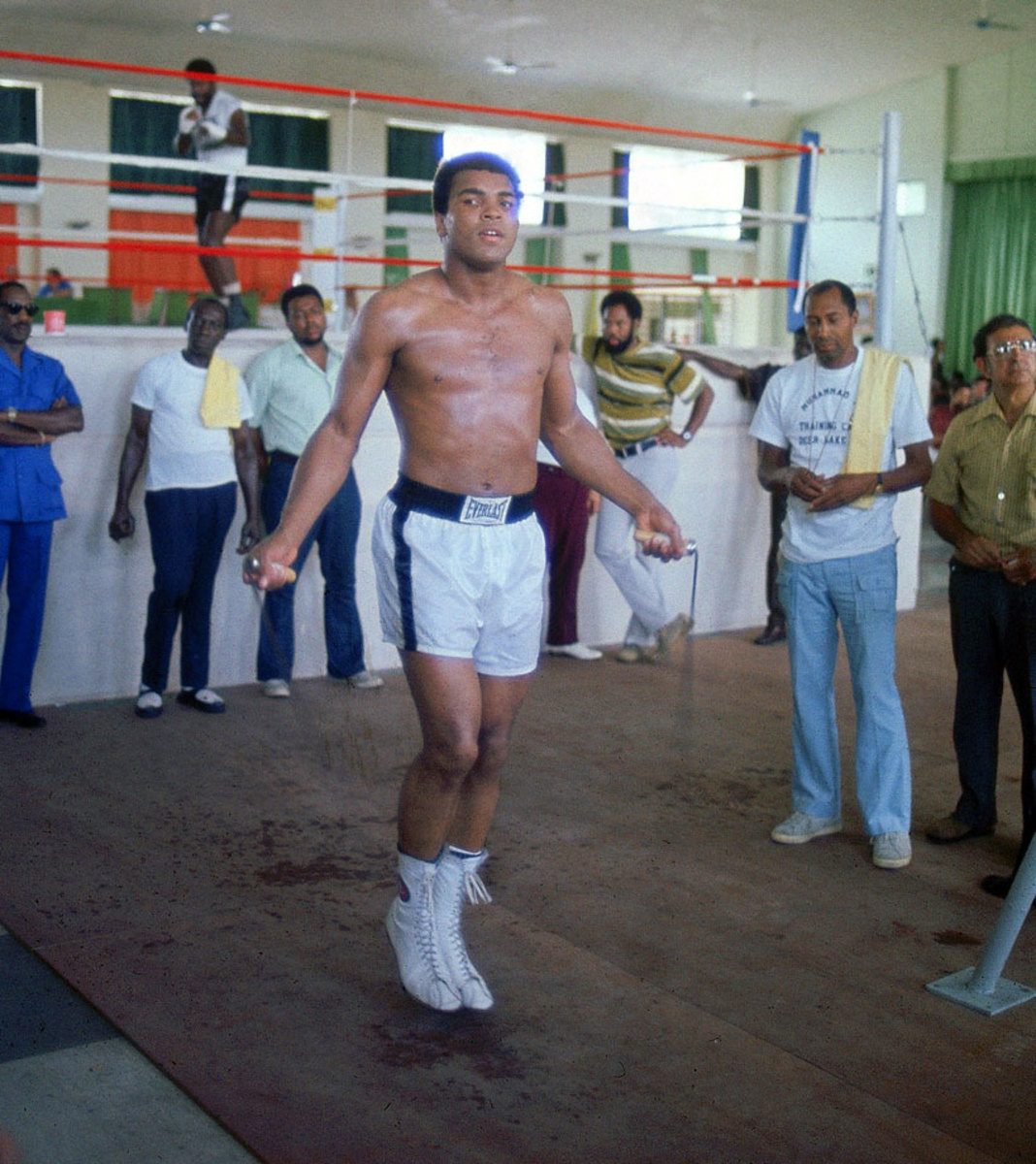
Ali jumps rope at the Salle de Congres in Kinshasa, Zaire, while training for his heavyweight title fight against George Foreman. Both Ali and Foreman spent most of the summer of 1974 training in Zaire to adjust to the climate.
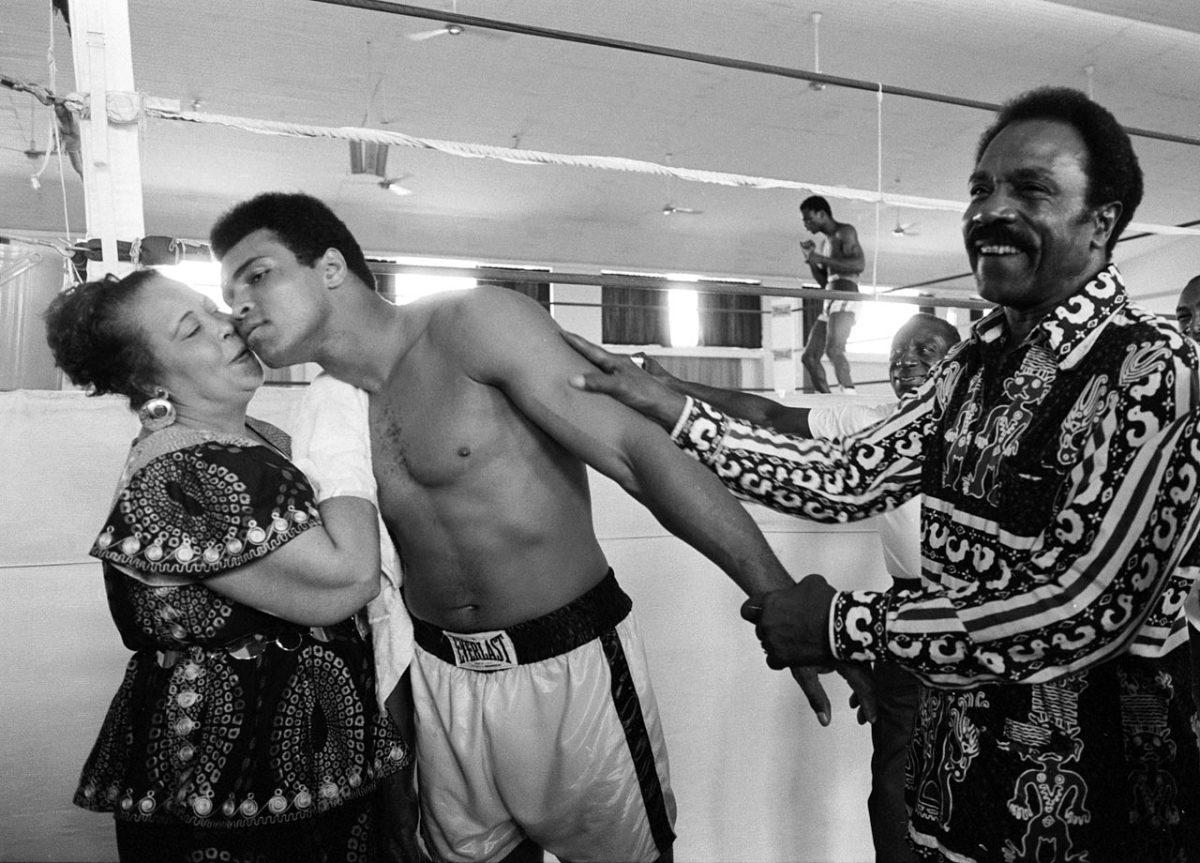
While training before his fight with George Foreman, Ali kisses his mother, Odessa Clay, while his father, Cassius Clay Sr., looks on. Ali's superior strategy and ability to take a punch led him to his upset victory as he absorbed body blows from Foreman before he responded with powerful combinations to Foreman's head.
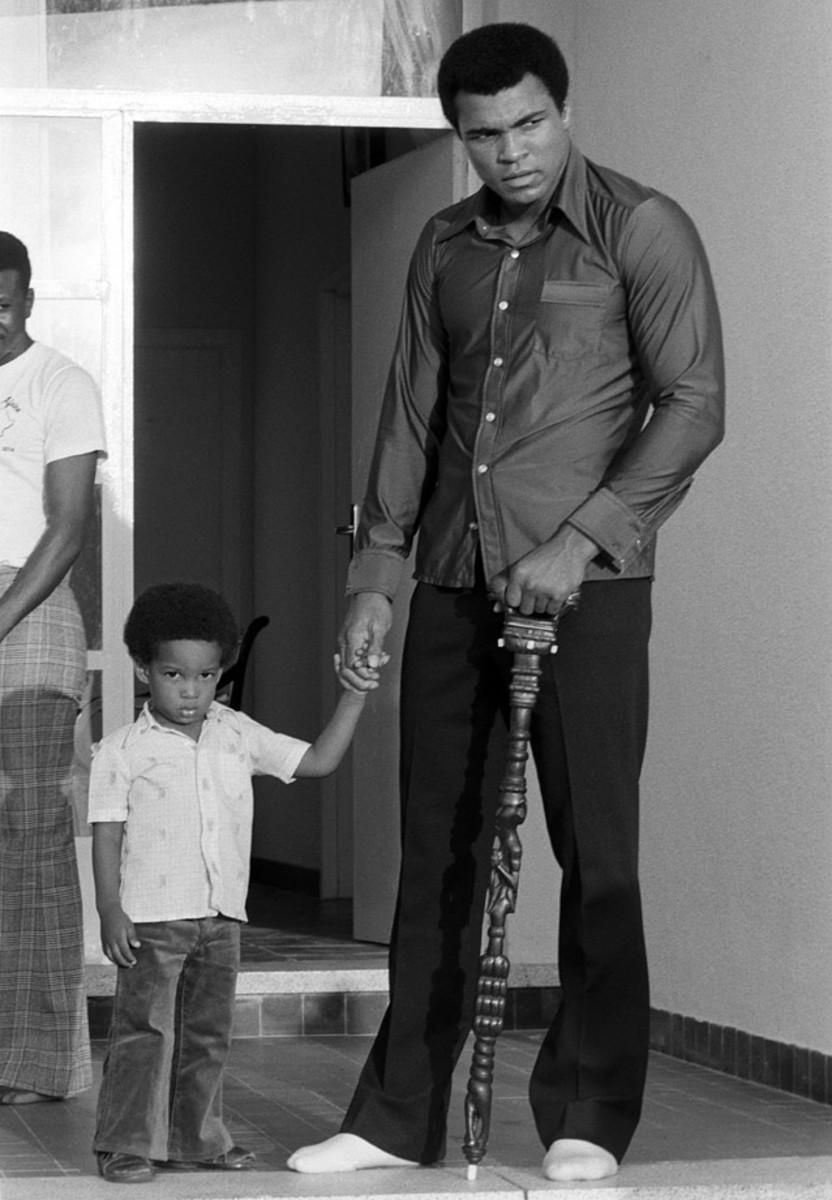
Four days before the fight, Ali holds the hand of his son Ibn in Zaire. Ali successfully courted the favor of the Zaire crowd, prompting chants of "Ali bomaye!" — translated as "Ali, kill him!"
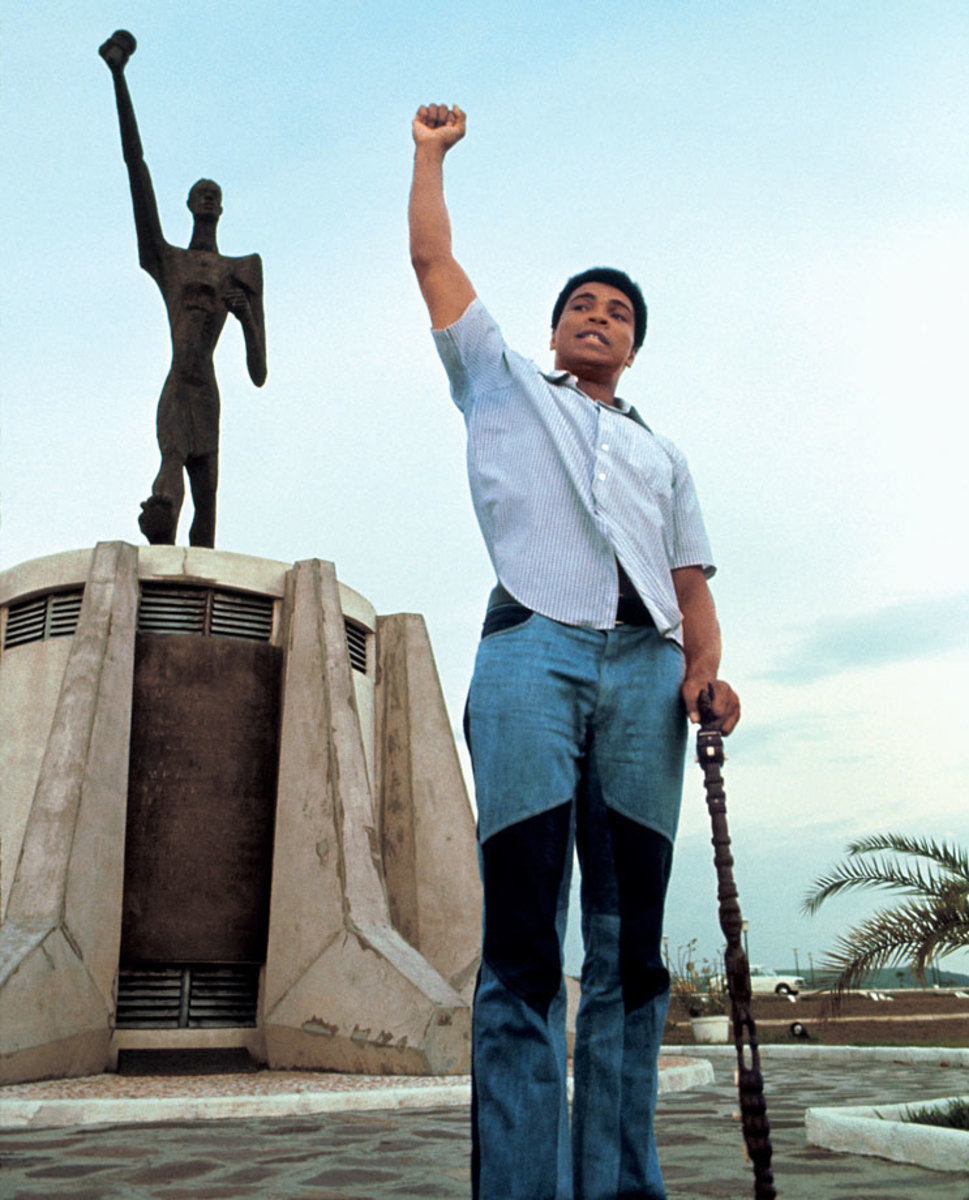
Ali poses in front of the Le Militant statue at the presidential complex that was the site of Ali's January heavyweight title bout with Foreman. The fight was originally set for a month earlier, but Foreman suffered a cut near his eye during training, forcing a delay.
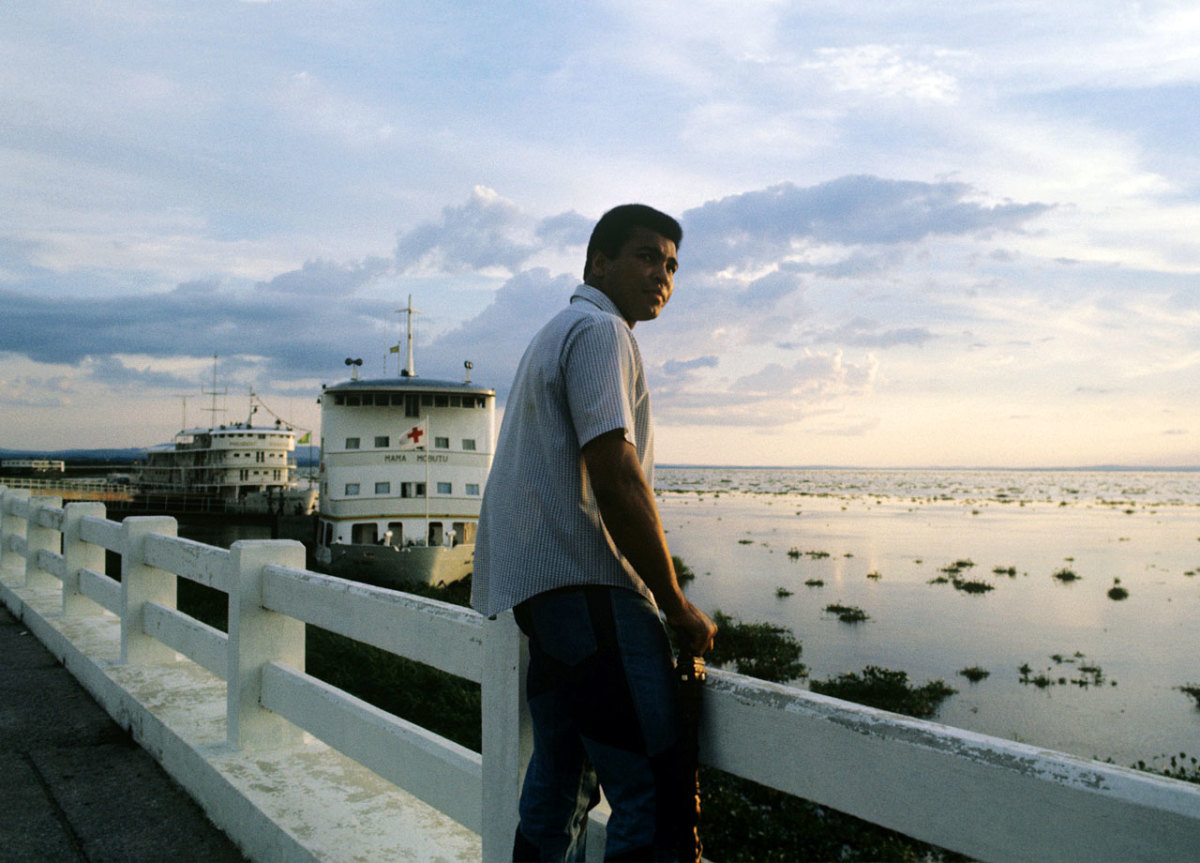
Ali stands against the railing on the River Zaire watching the sunset four days before the Rumble in the Jungle. The fight was sponsored by Zaire to achieve the $5 million purse promoter Don King had promised both Ali and Foreman.
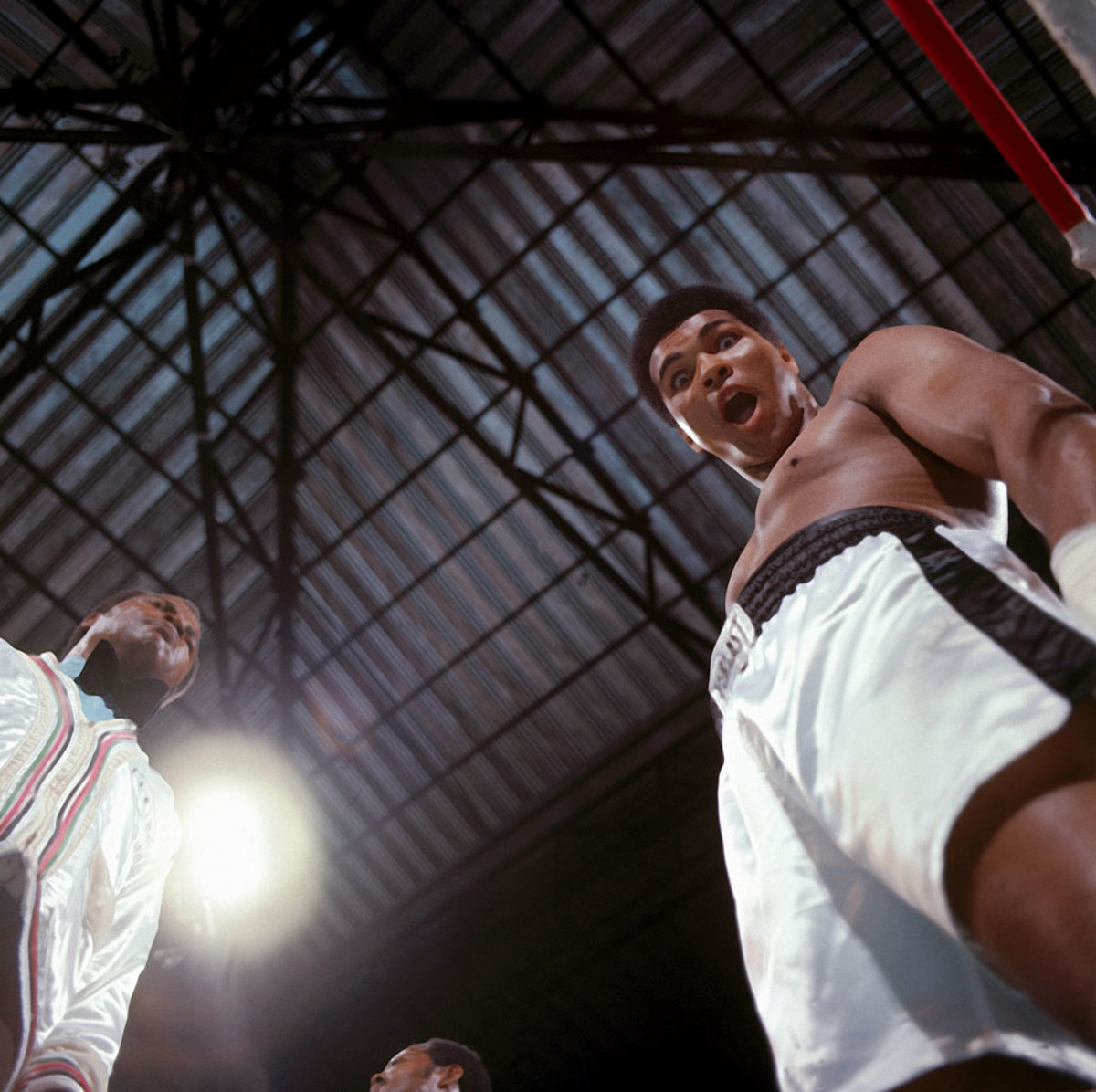
Before employing his famous rope-a-dope strategy against Foreman, Ali makes a face at the camera. Ali allowed Foreman to throw many punches but only into his arms and body, and when Foreman tired himself out from the mostly ineffective punches, Ali took control of the fight.
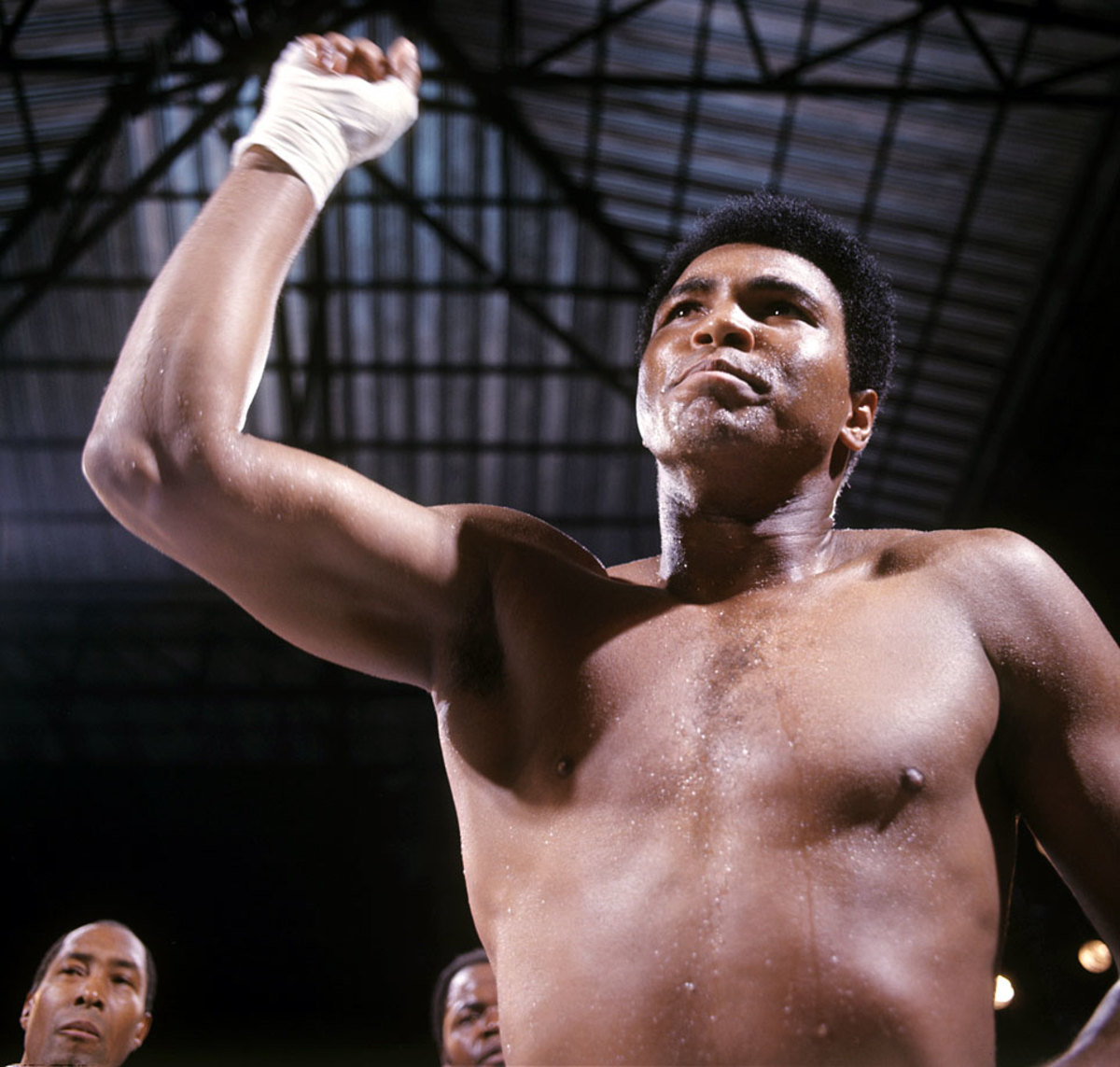
Ali points before his bout with Foreman. The victory over his favored opponent made him the heavyweight champion of the world for the first time since he was stripped of his titles in 1967.
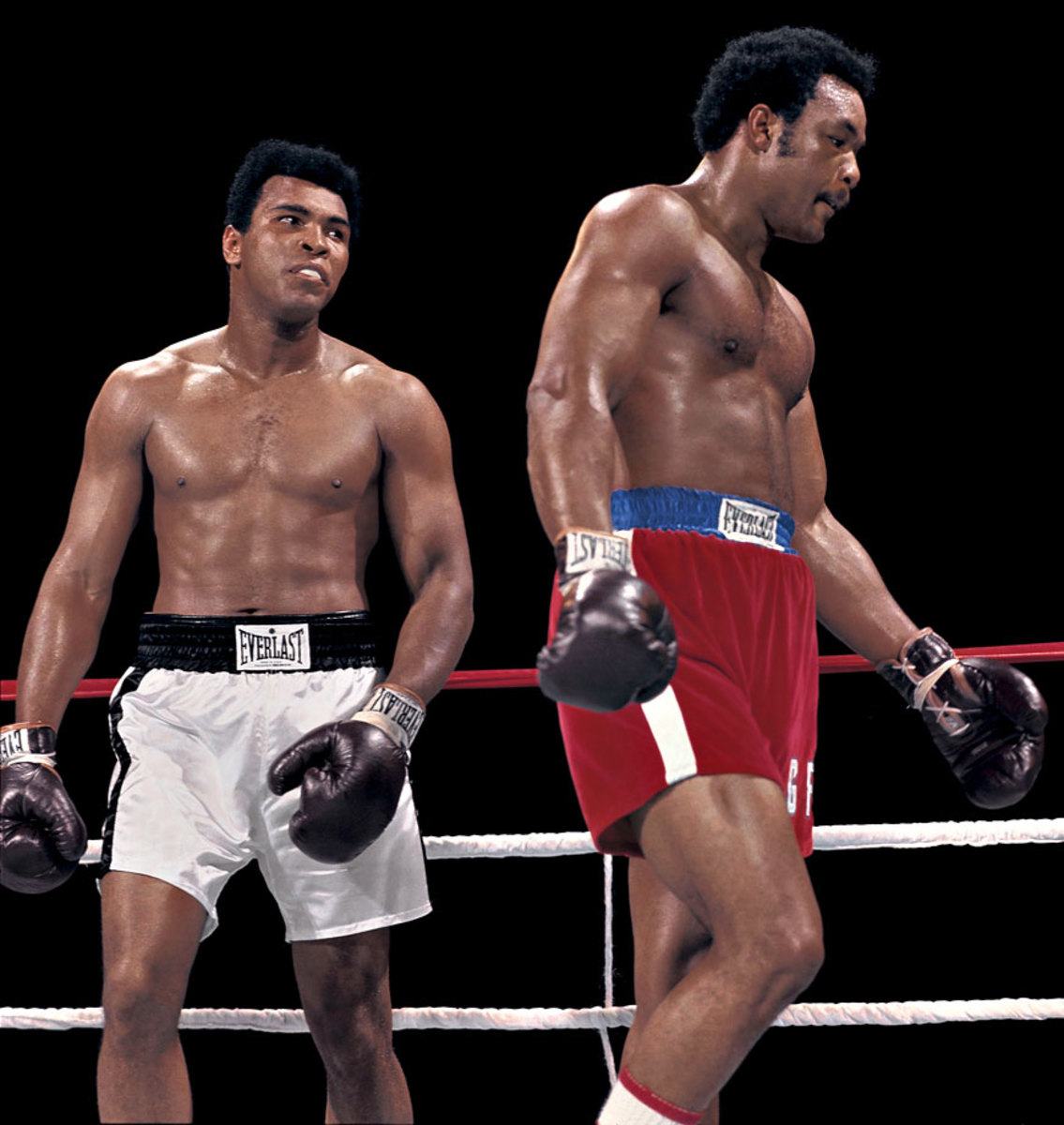
Ali stares at George Foreman during the Rumble in the Jungle. Ali earned his shot at the heavyweight title by defeating Joe Frazier in January 1974, avenging a loss three years earlier.
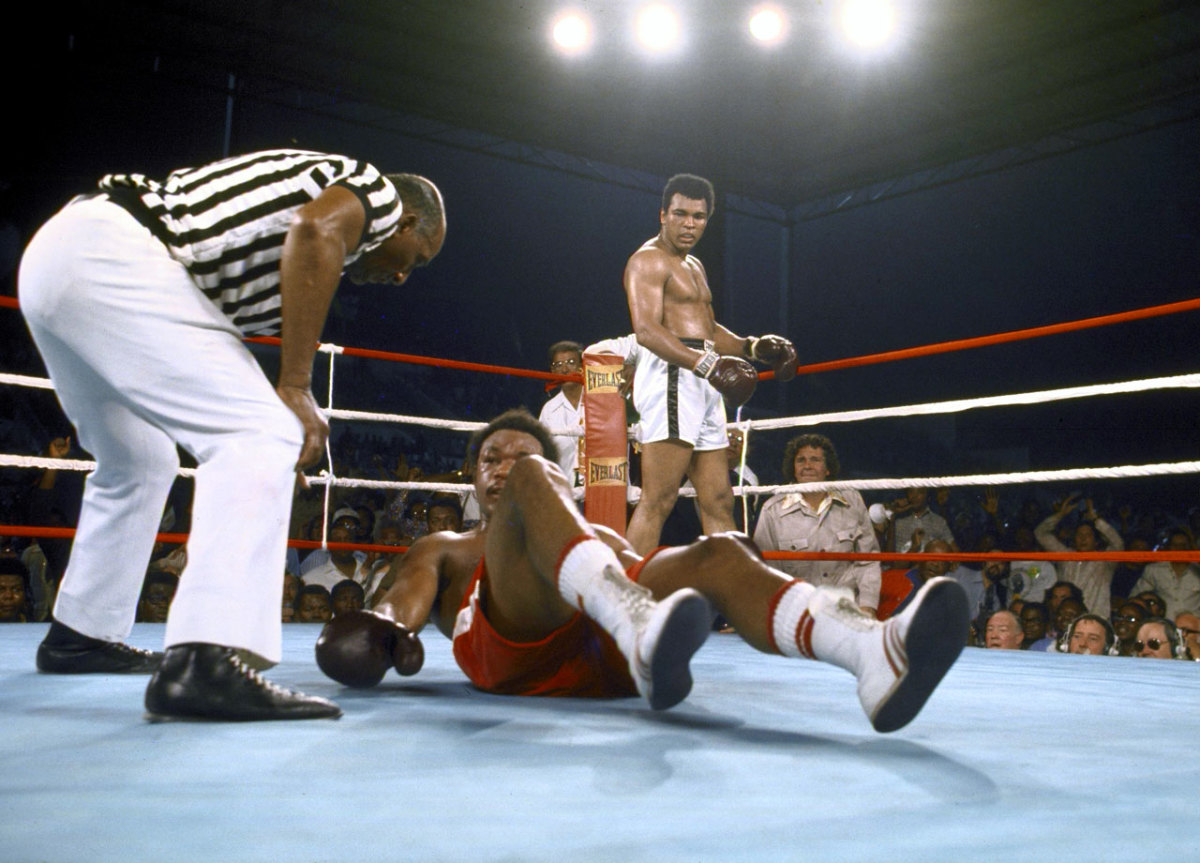
Foreman lies down on the canvas as Ali stands in the background during the Rumble in the Jungle. Ali knocked Foreman down with a five-punch combination in the eighth round, and referee Zack Clayton counted him out.
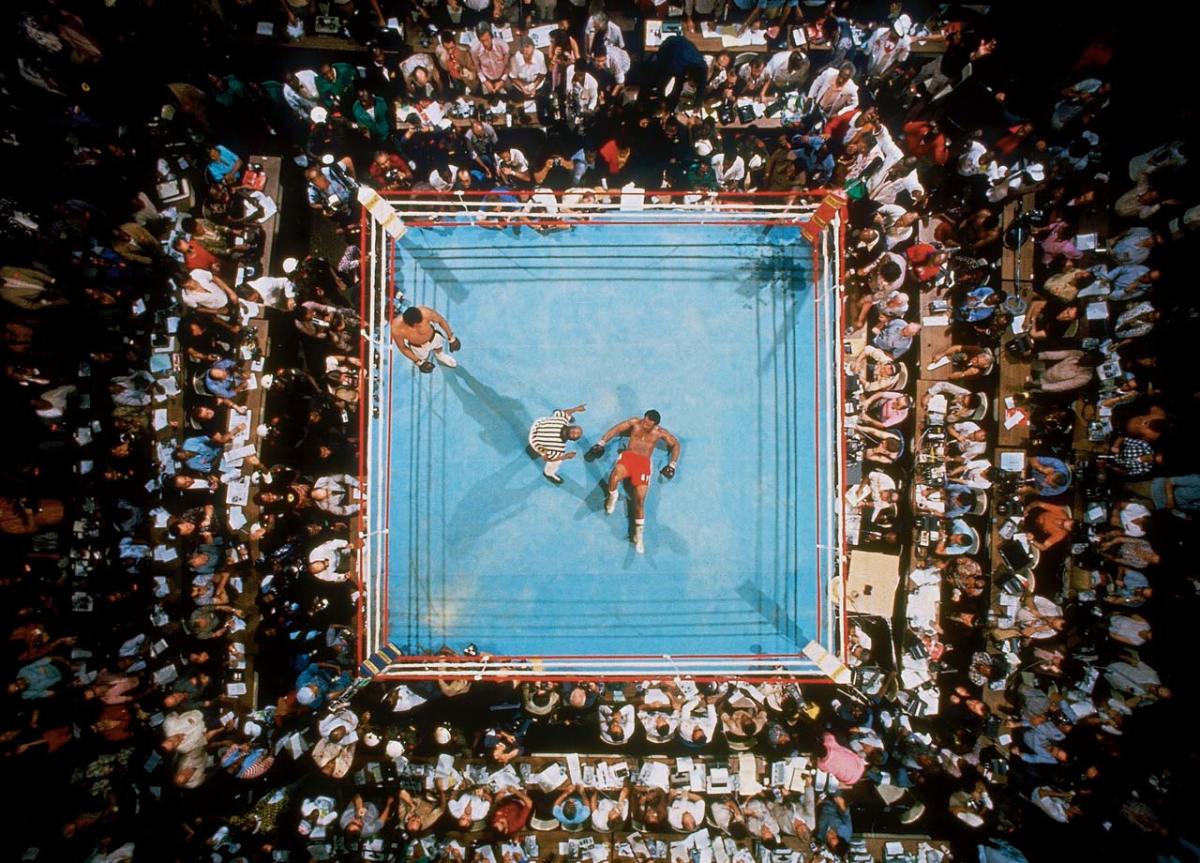
Big George stares at the ceiling as referee Zack Clayton counts him out in the eighth round. The victory made Ali, once again, the heavyweight champion of the world.
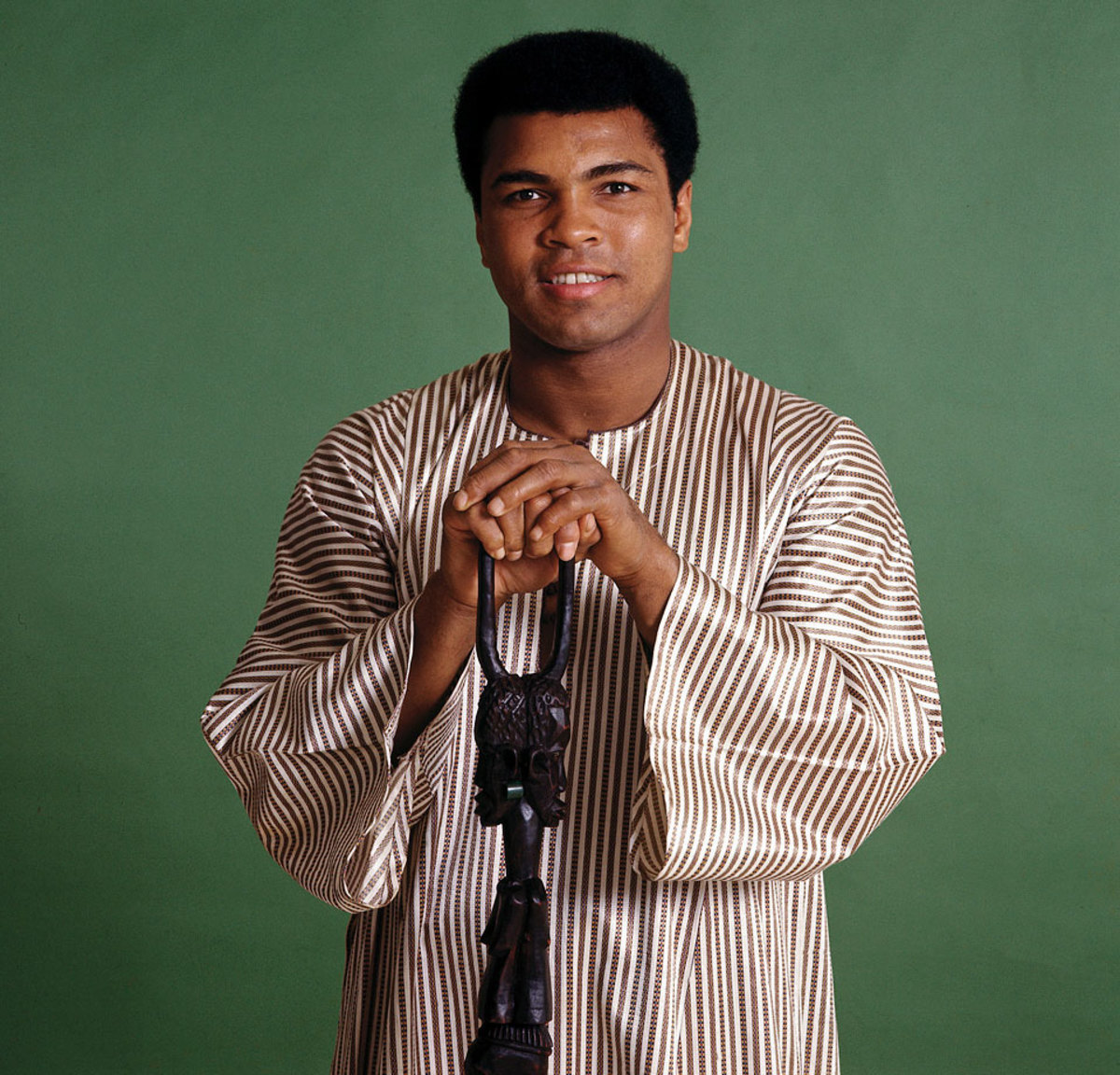
Ali poses for a portrait after being selected as the Sports Illustrated Sportsman of the Year in 1974. Ali wore a dashiki, a men's garment widely worn in West Africa. He also brought the walking stick given to him by Zaire's president.
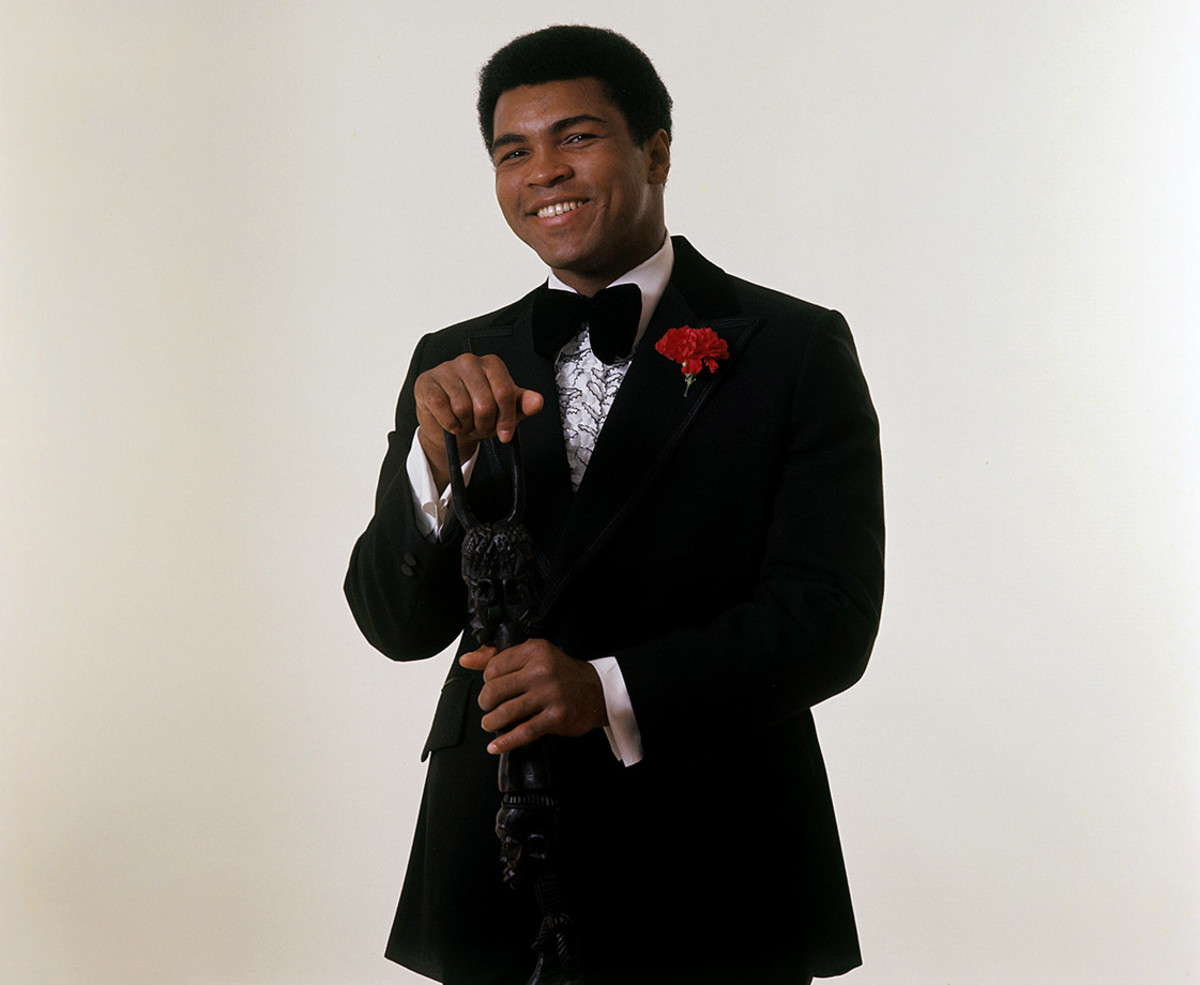
This time Ali wears a tuxedo, but keeps the walking stick, during the November photo shoot for Sports Illustrated's Sportsman of the Year.
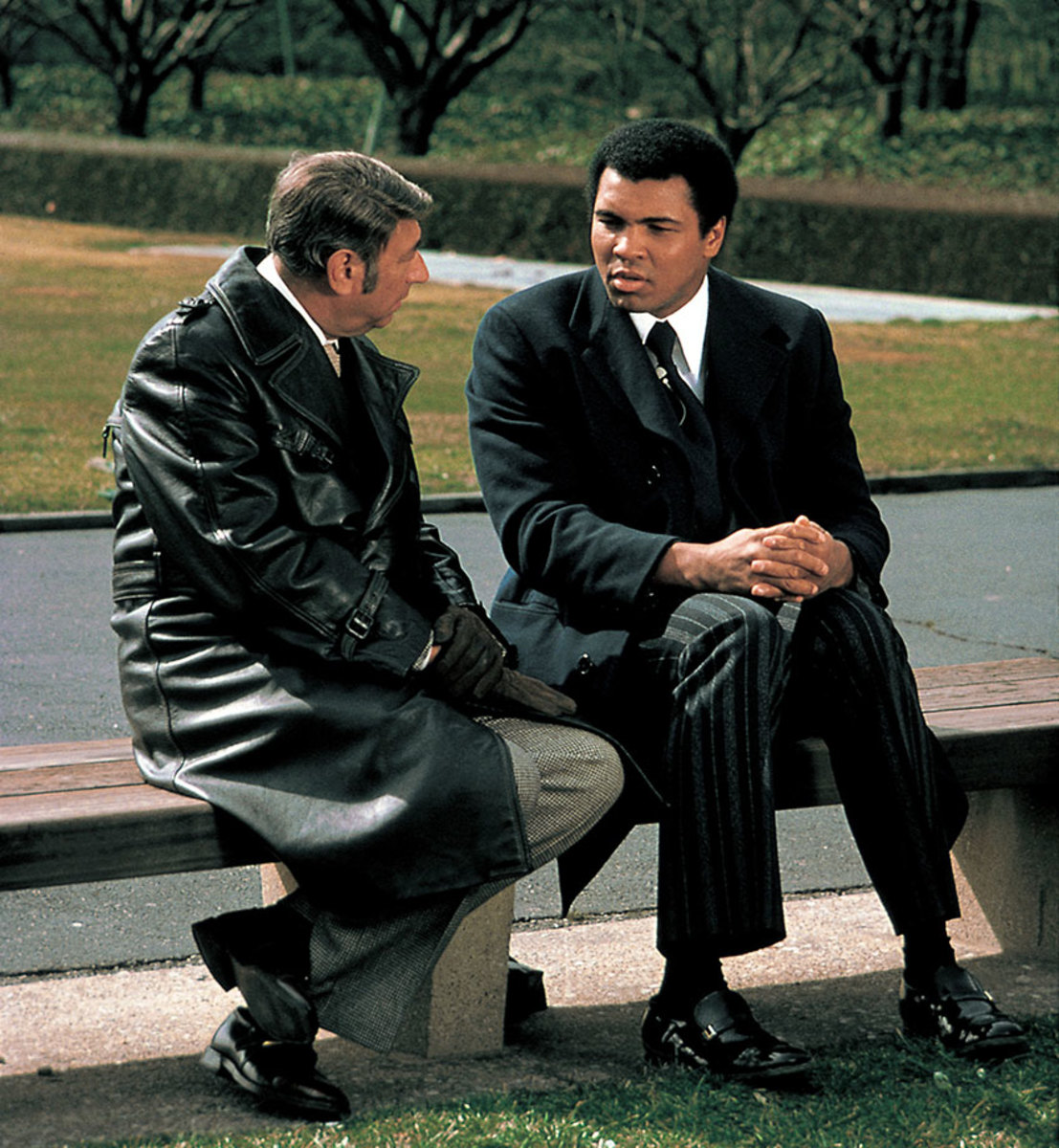
Ali talks with Howard Cosell outside of the United Nations Headquarters for a segment on the Wide World of Sports. Later that day, Ali held a press conference to announce that he would donate part of the proceeds from his fight against Chuck Wepner to help Africans in the Sahel drought.
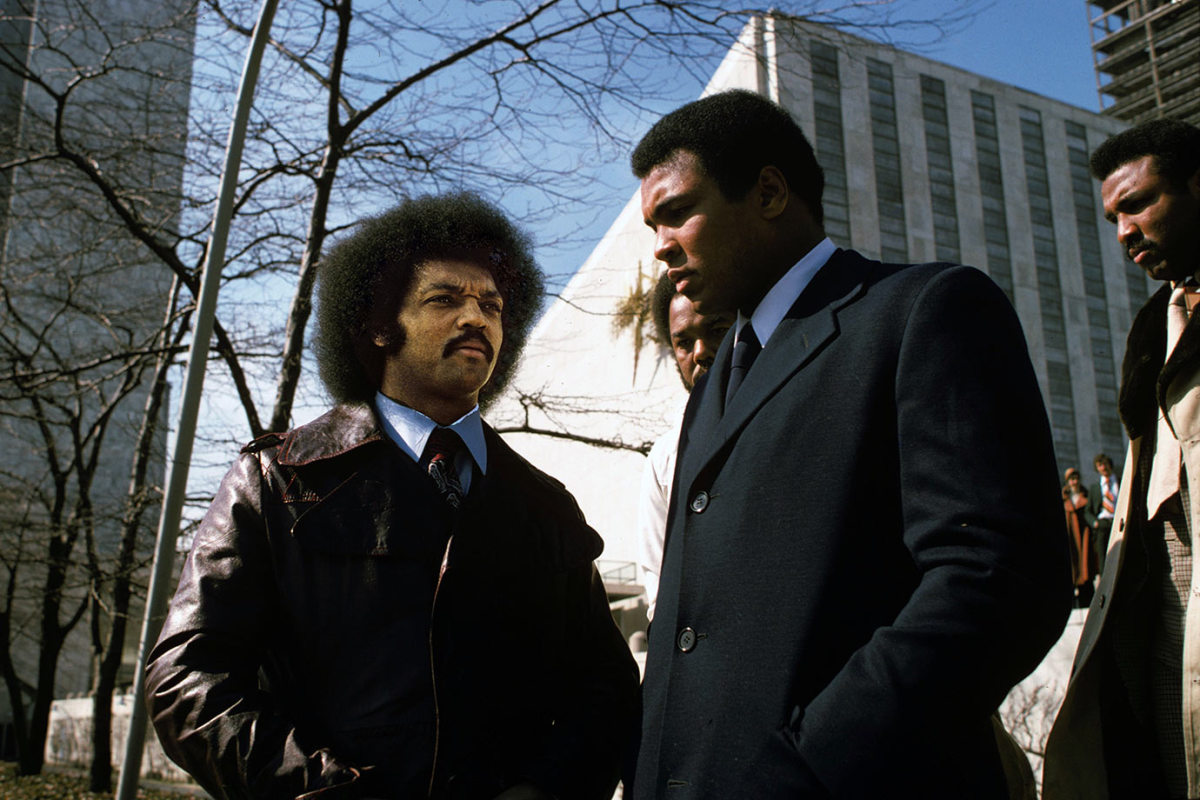
Ali talks with Reverend Jesse Jackson outside of the United Nations Headquarters before a press conference to announce that he would donate part of the proceeds from his fight against Chuck Wepner to help Africans in the Sahel drought.
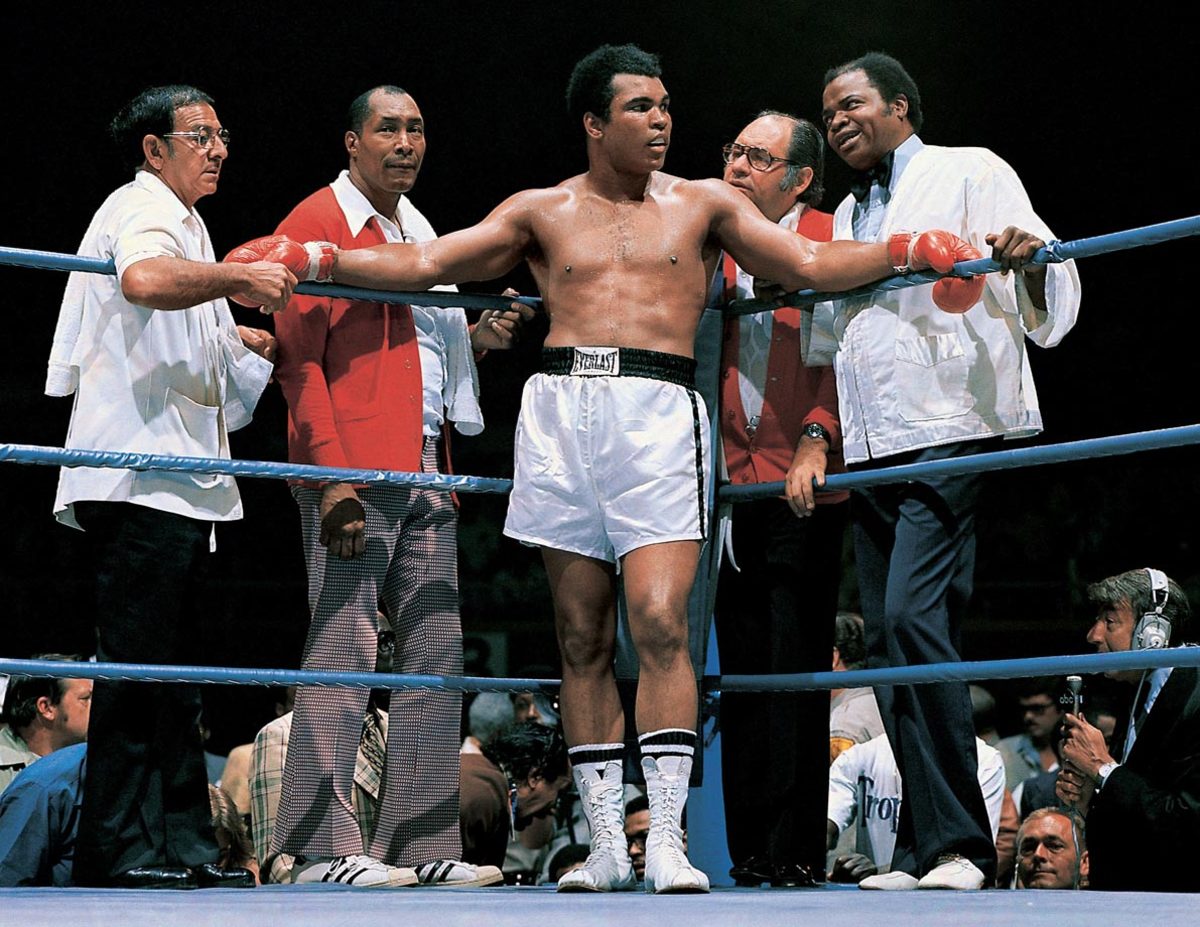
Ali stands with trainer Angelo Dundee, assistant trainer Wali Muhammad, physician Dr. Ferdie Pacheco and assistant trainer Drew Bundini Brown before his bout with Ron Lyle in May 1975. Ali won the fight by technical knockout in the 11th round.
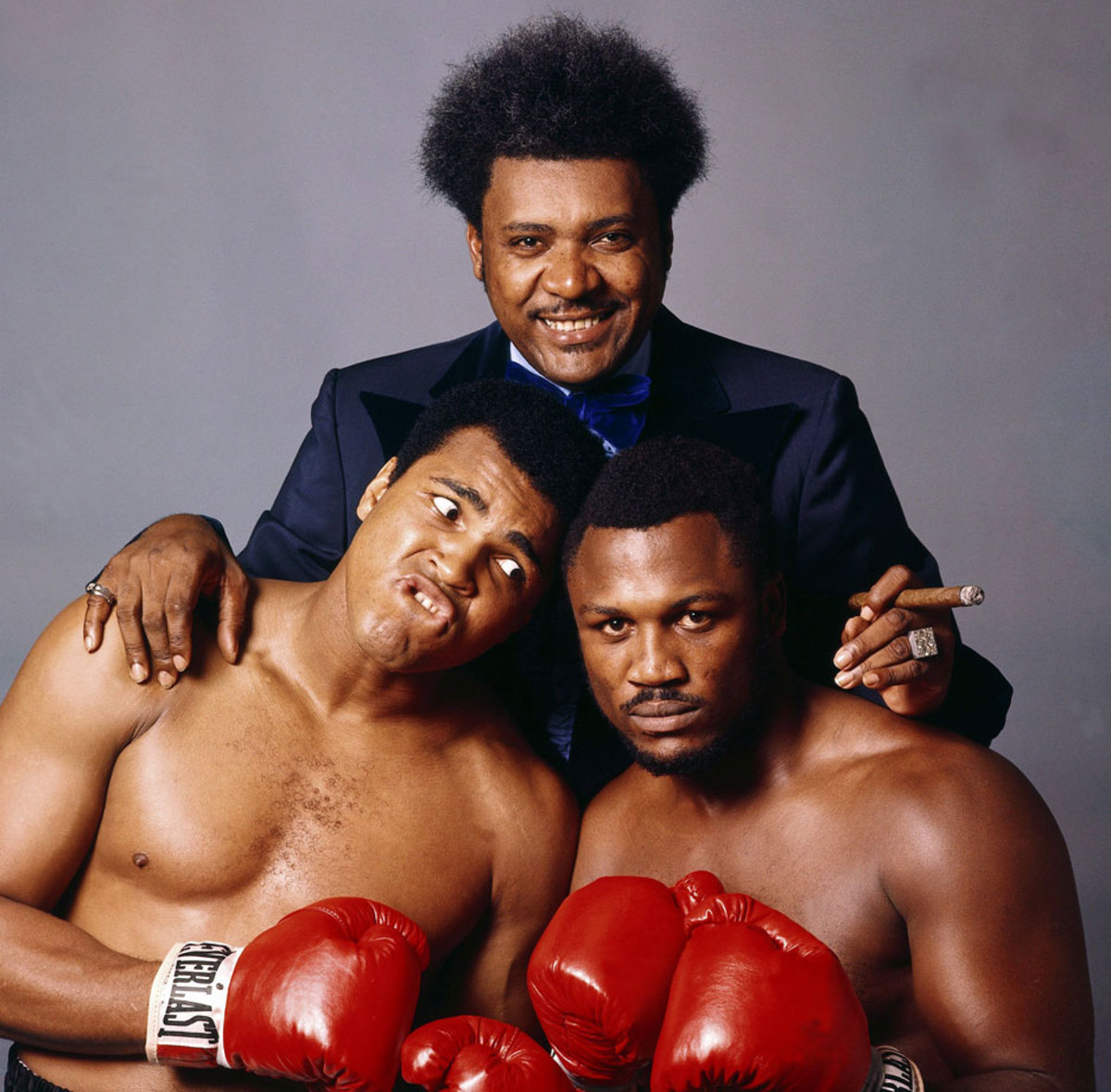
Along with Don King and Joe Frazier, Ali sat for a portrait leading up to the Thrilla in Manila. Ali verbally abused Frazier during the buildup to the fight, telling the media that "it will be a killa and a thrilla and a chilla when I get the gorilla in Manila."
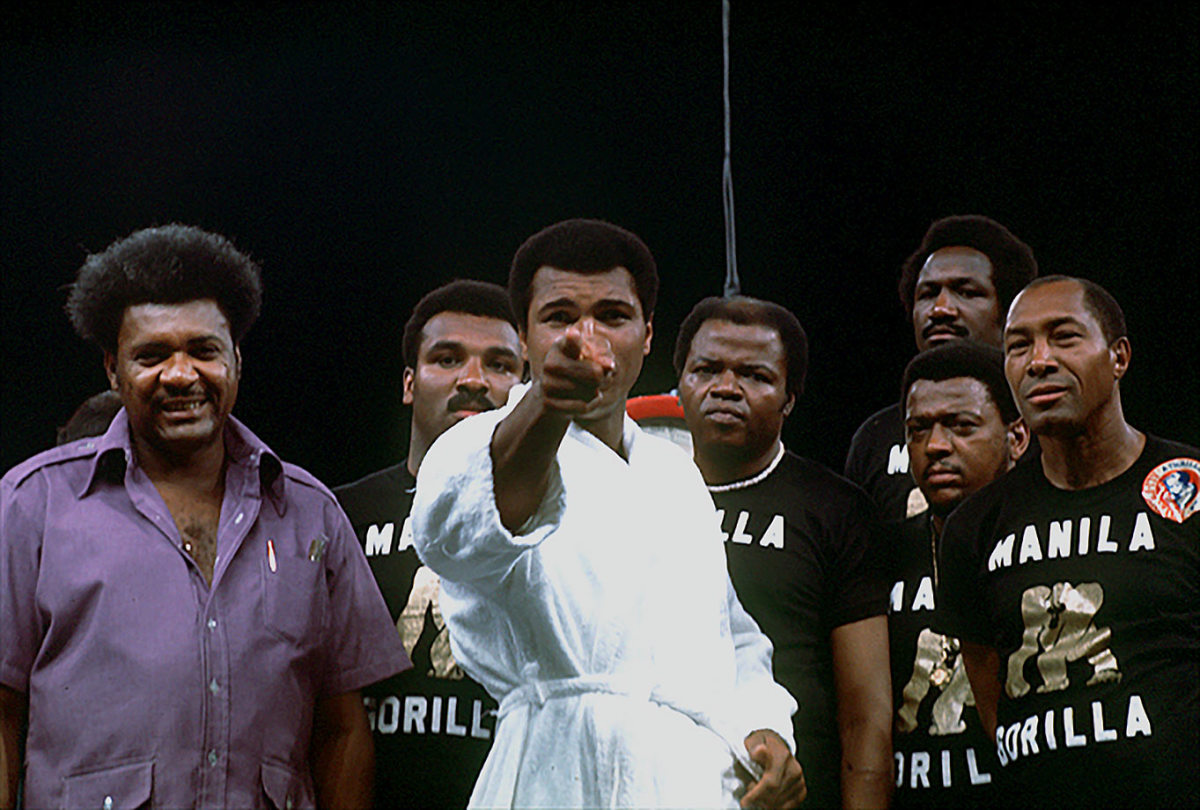
Ali points at the camera with Don King and his training staff behind him before the weigh-in for the Thrilla in Manila in October 1975. Philippine president Ferdinand Marcos offered to sponsor the bout and hold it in Metro Manila to divert attention from the turmoil in the country that had forced the imposition of martial law in 1972.
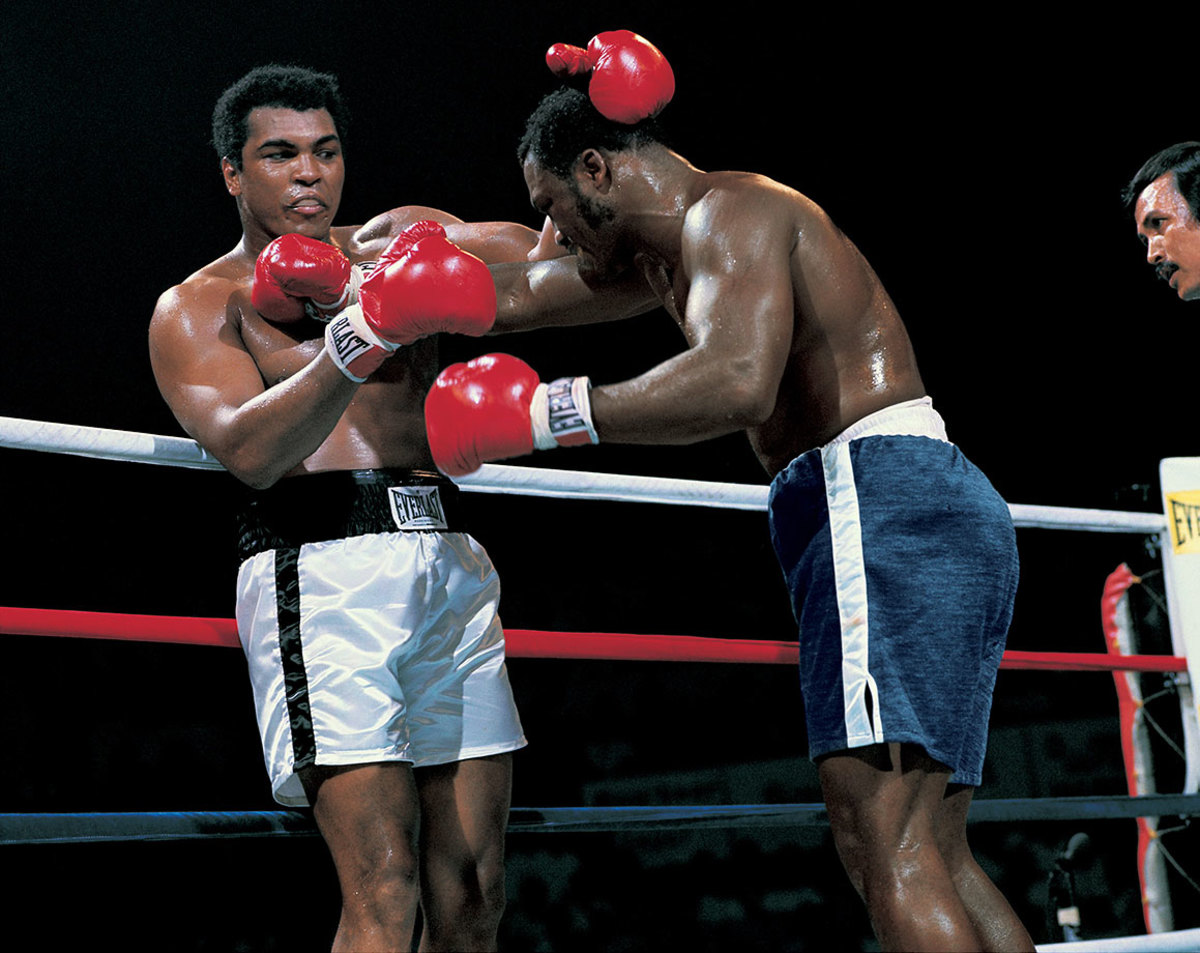
Wrapping up Joe Frazier proved more difficult than Ali expected, having thought Frazier would represent an easy payday and be unable to live up to his billing. The fight turned out to be a brutal affair.
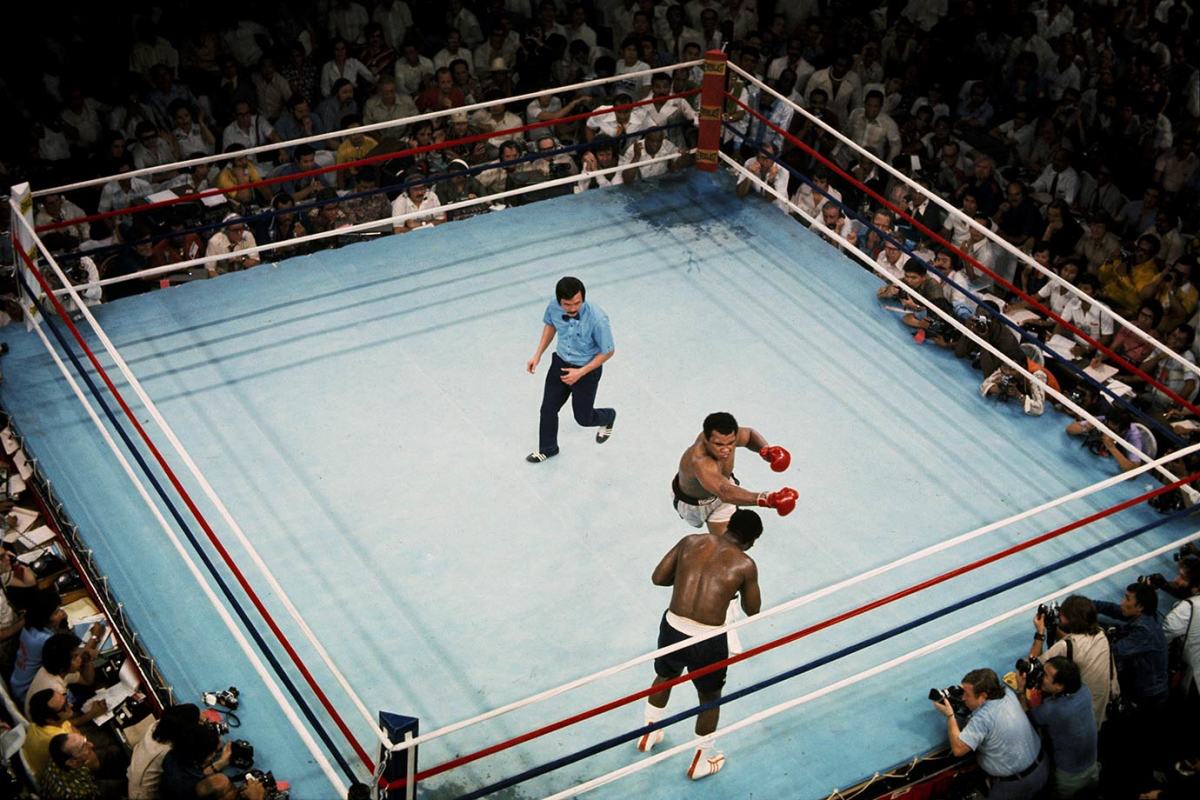
Frazier faces an Ali right hook in their fight in Quezon City, Philippines. The two fighters traded vicious blows during their 14 rounds. "Man, I hit him with punches that'd bring down the walls of a city," Frazier said. Ali withstood the blows to win by TKO in the 15th round.
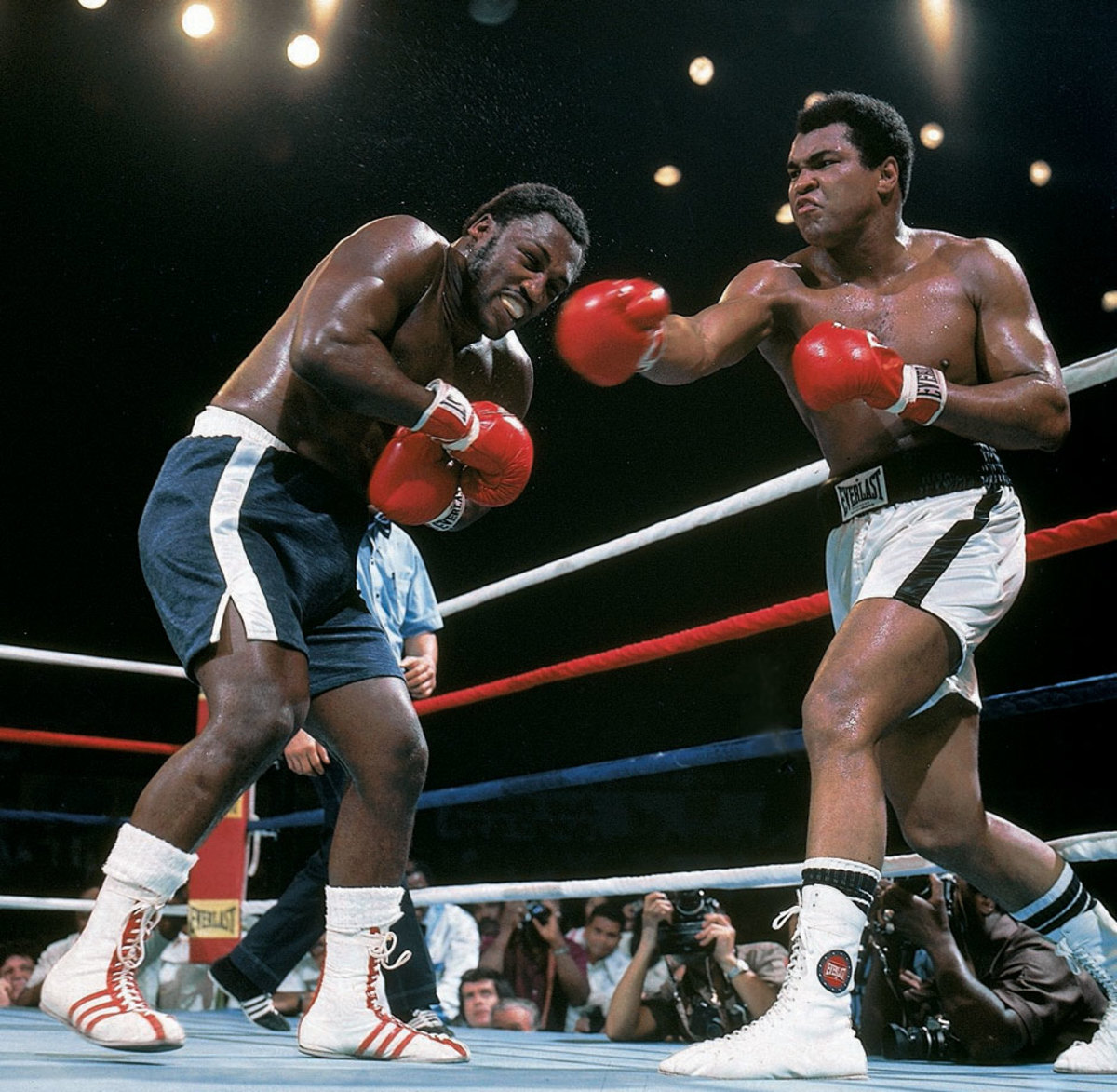
The third fight between Ali and Frazier, Ali won the bruising battle between the two powerful punching heavyweights when Frazier's trainer, Eddie Futch, stopped the fight before the 15th round.
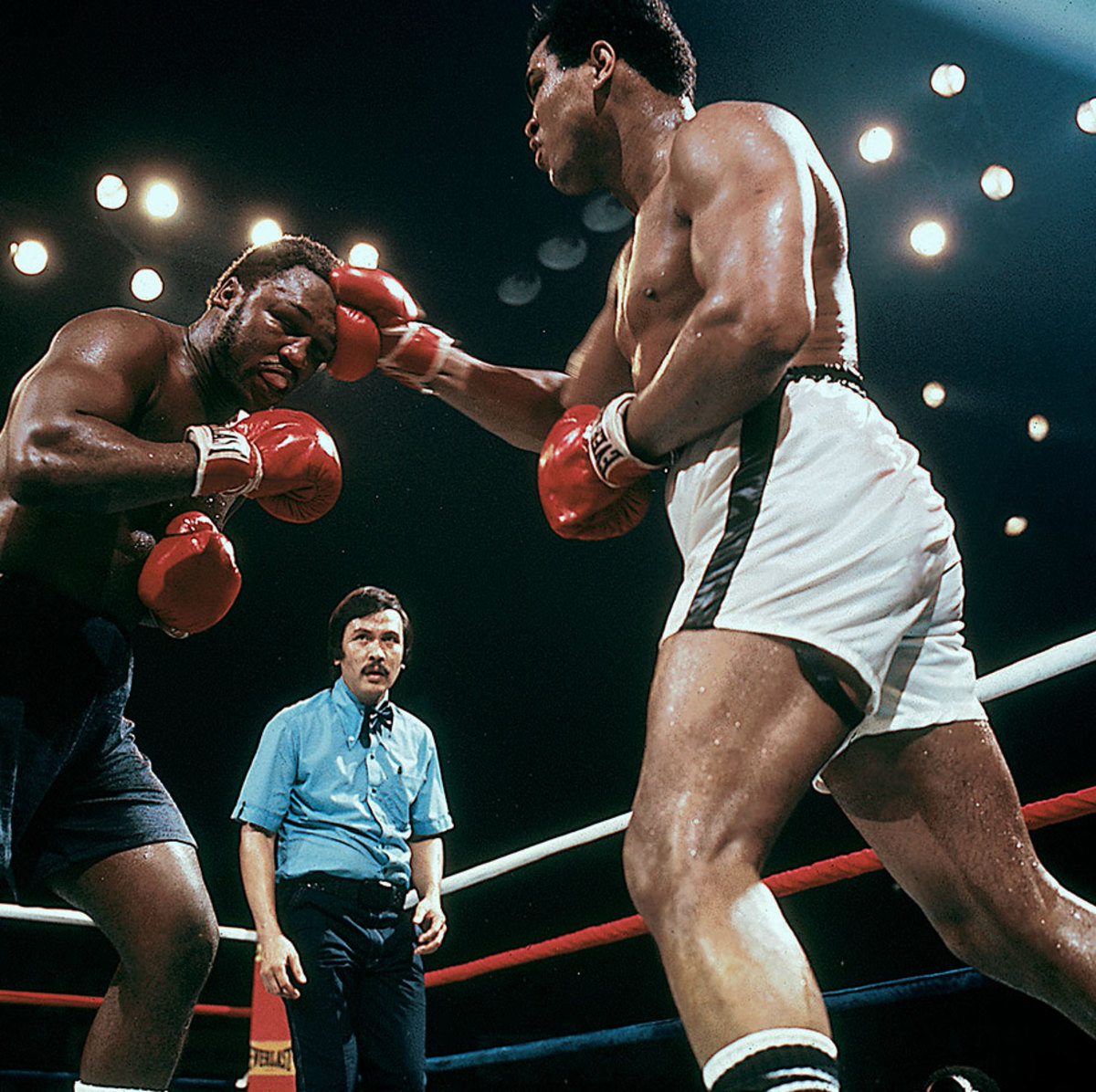
A back and forth exchange, Ali controlled the early rounds of the Thrilla in Manila before Frazier fought back with powerful hooks. Ali finished strong, regaining momentum in the later rounds.
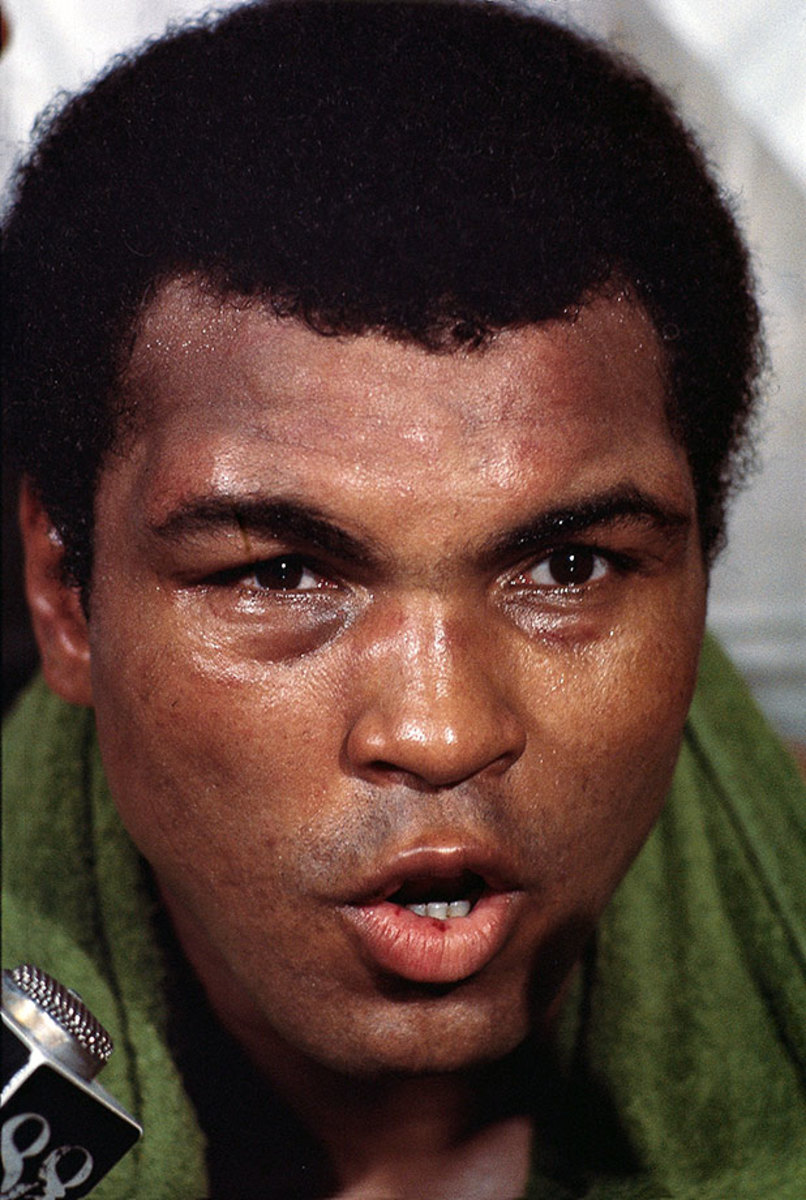
Ali speaks to the press after winning the Thrilla in Manila bout with Frazier.
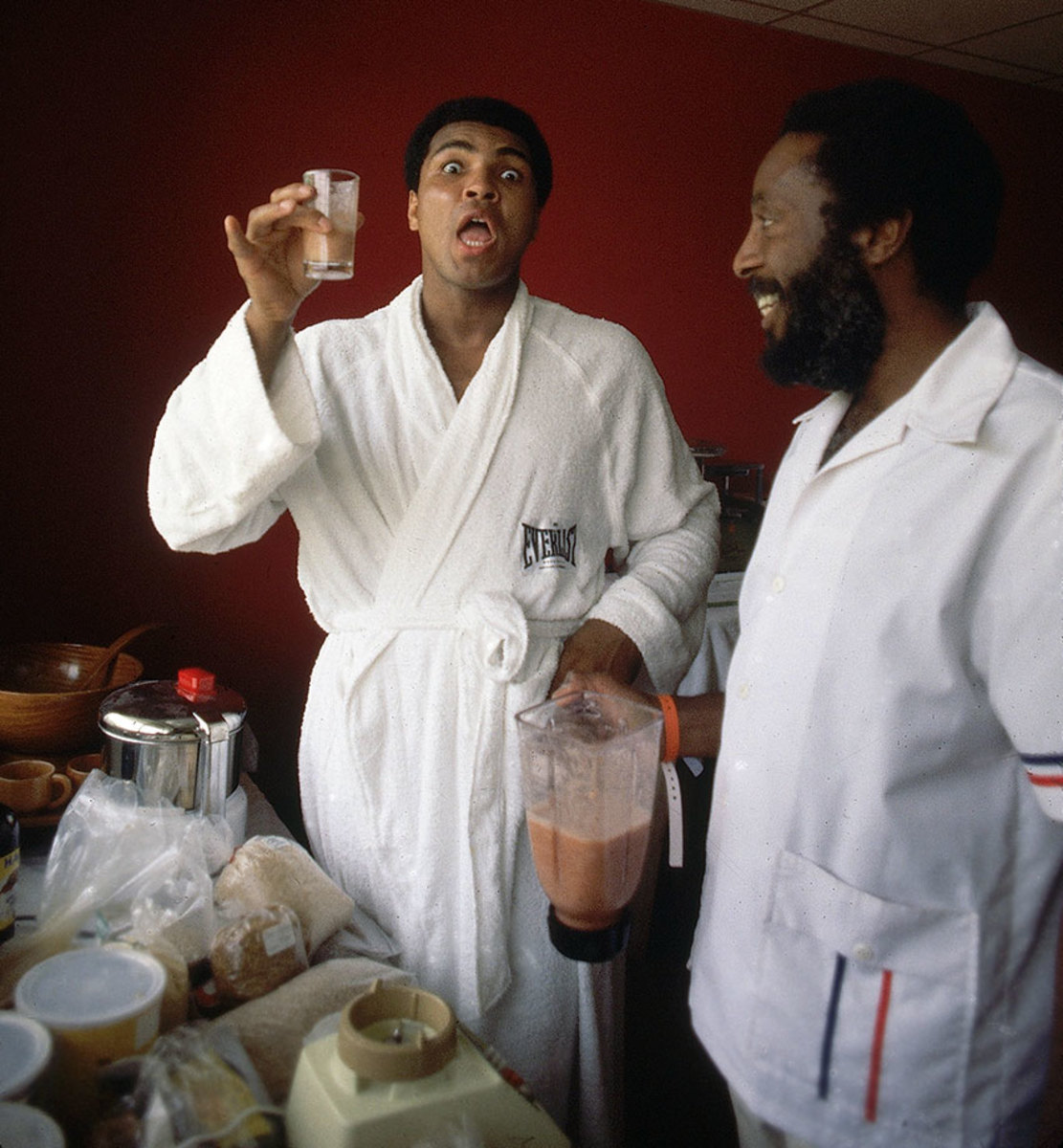
Ali holds a drinking concoction given to him by Dick Gregory, an advocate of a raw fruit and vegetable diet, in 1976.
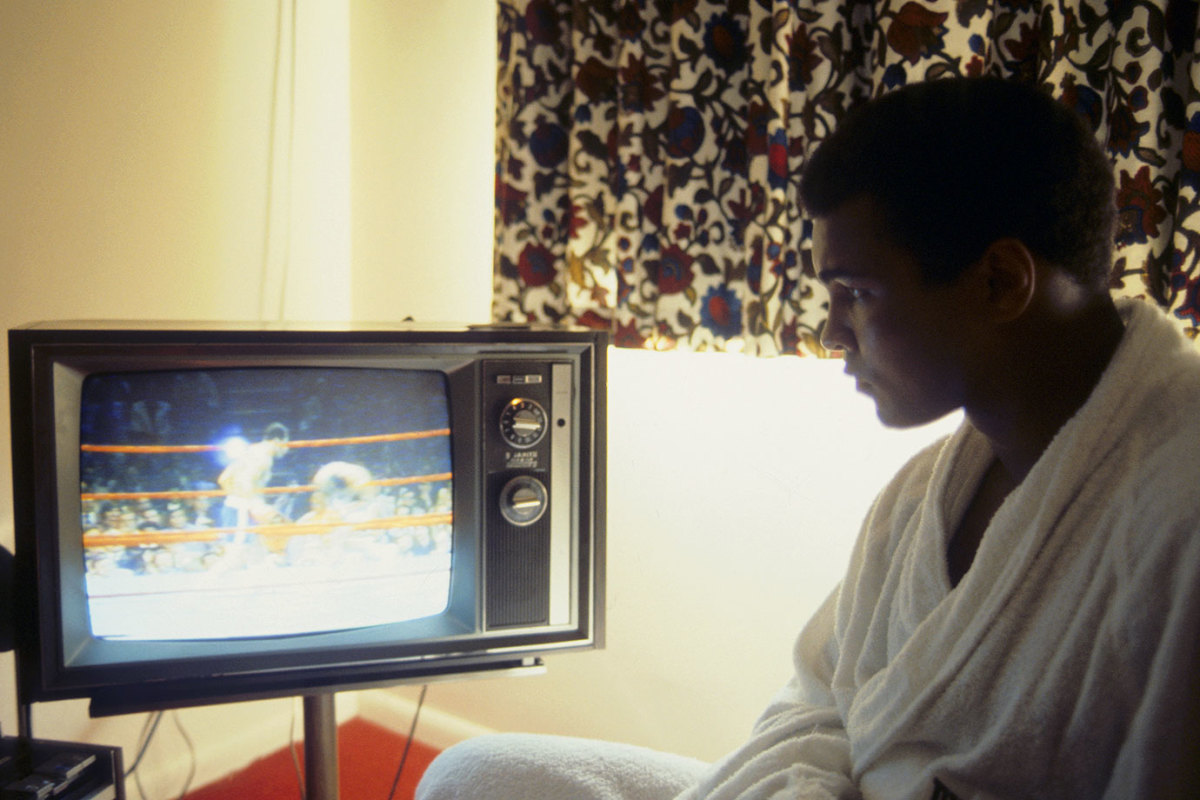
Before his 1976 fight against Ken Norton at Yankee Stadium, Ali watches a fight on television from his hotel room. A police strike at the time of the fight created a dangerous environment outside the stadium that all but eliminated walk-up sales.
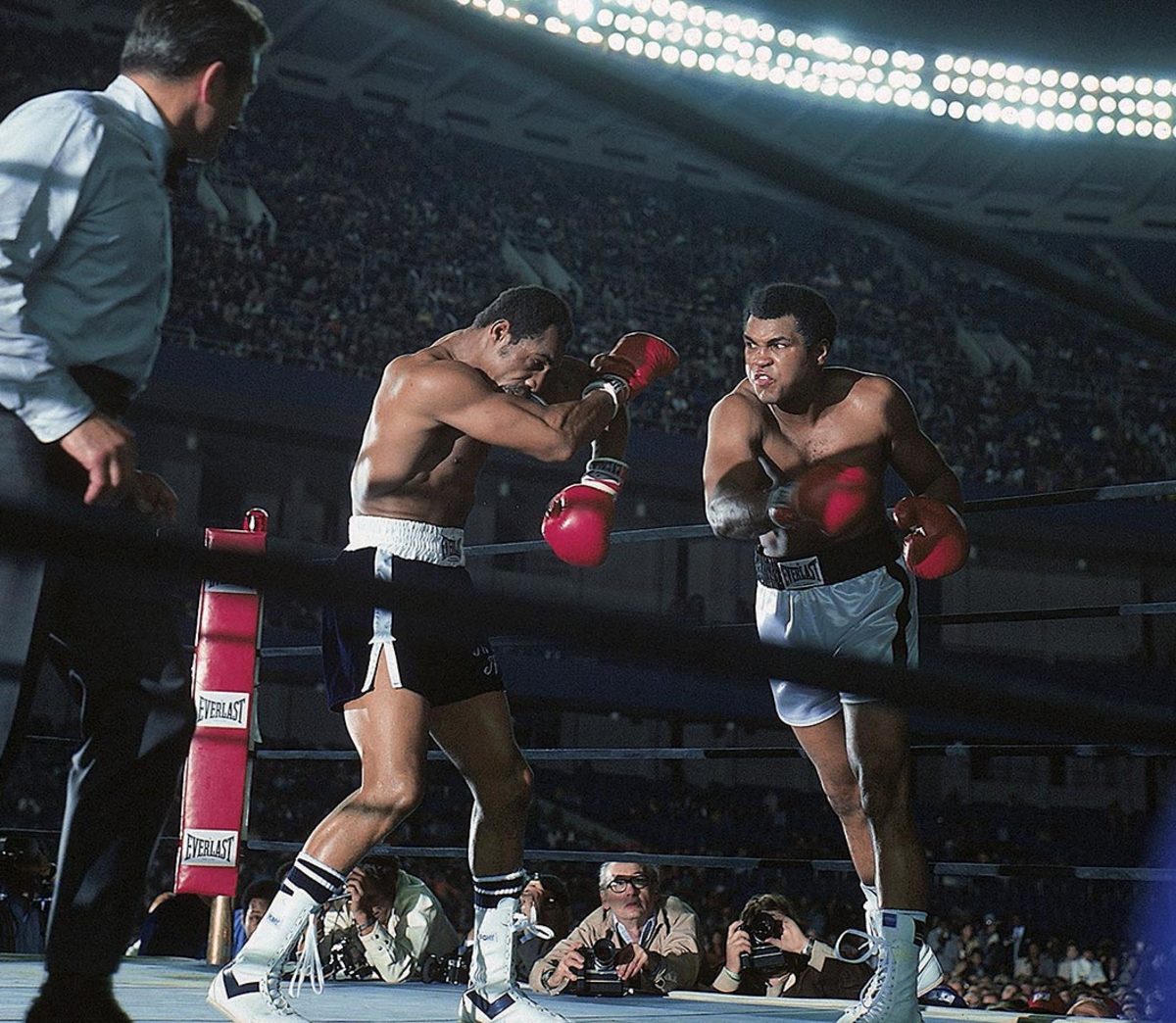
Norton takes a right hook during the heavyweight title fight against Ali. The bout, which Ali won by a unanimous, but controversial, decision, was the last boxing match at Yankee Stadium until 2010.
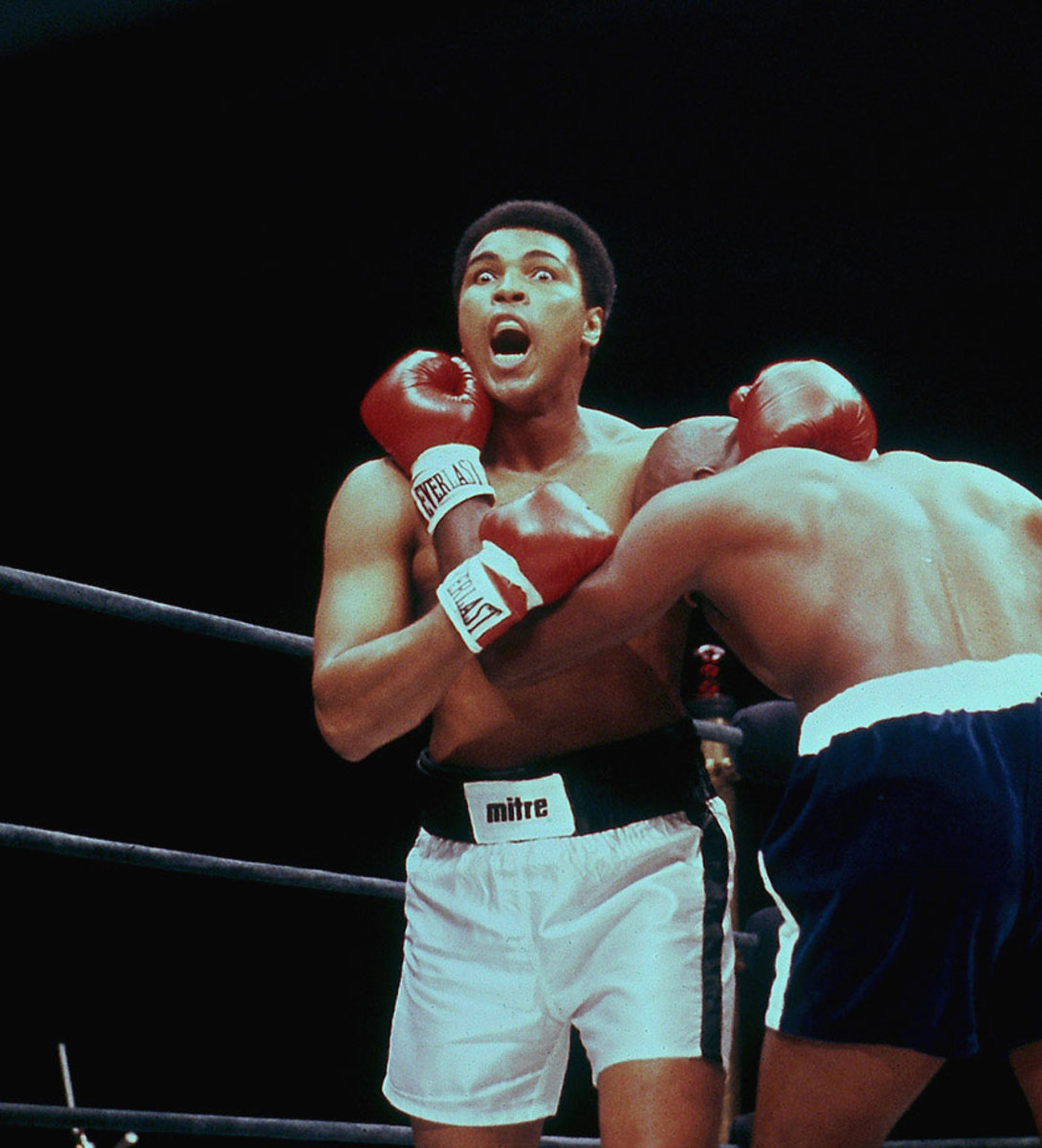
Ali makes a face during his fight with Earnie Shavers in 1977 at Madison Square Garden. Hurt badly by Shavers in the second round, Ali rebounded and outboxed Shavers throughout to build a lead on points before Shavers came on again in the later rounds. Seemingly exhausted going into the 15th and final round, Ali remained victorious by producing a closing flurry that left Shavers wobbling at the bell and the Garden crowd once again in delirium over his Ali magic.
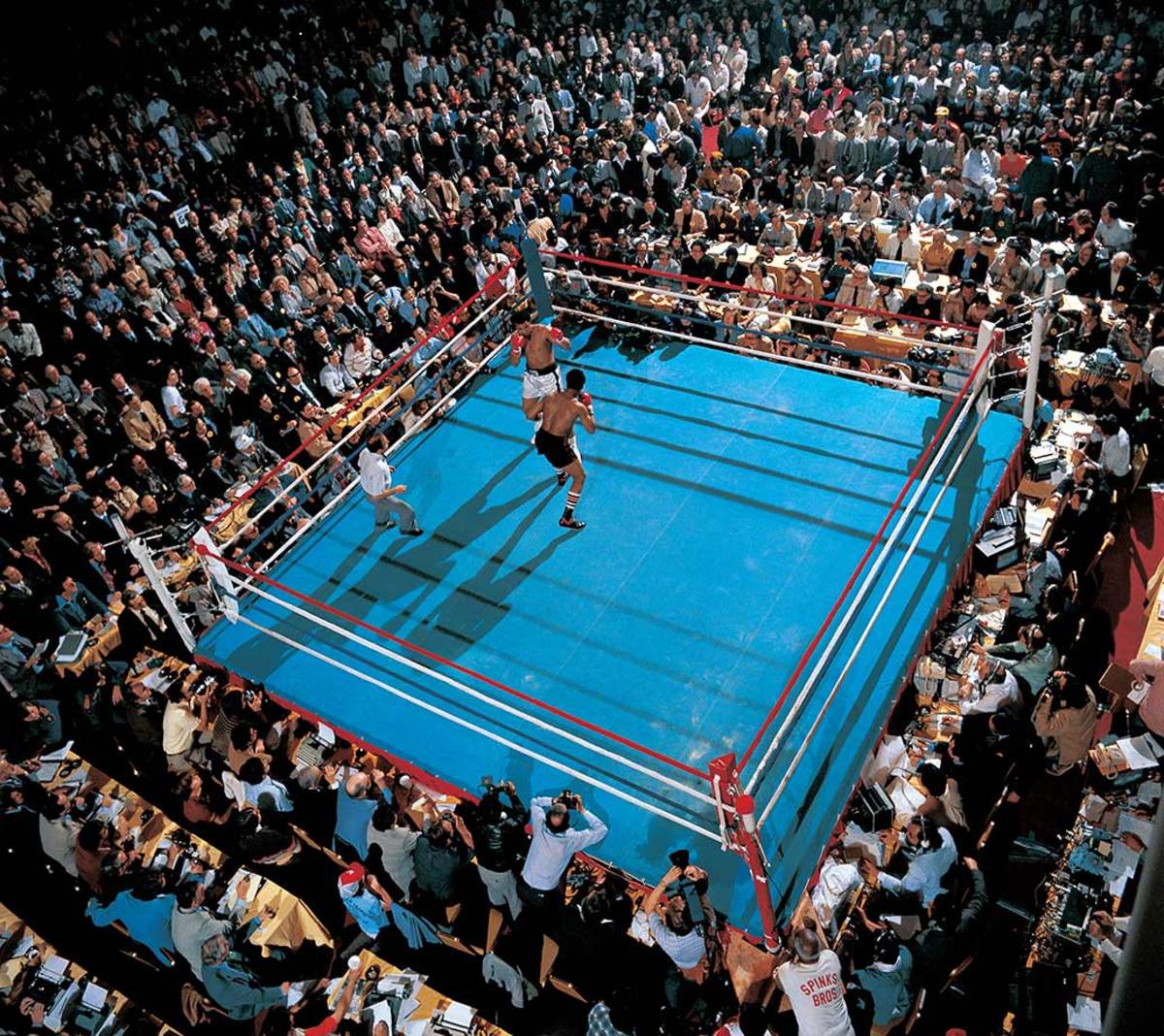
Ali squares off with Leon Spinks at the Las Vegas Hilton Hotel in February 1978. Spinks won the fight in a split decision, ending Ali's 3.5-year reign as the heavyweight champion. It was the only time in Ali's career that he lost his championship title in the ring.
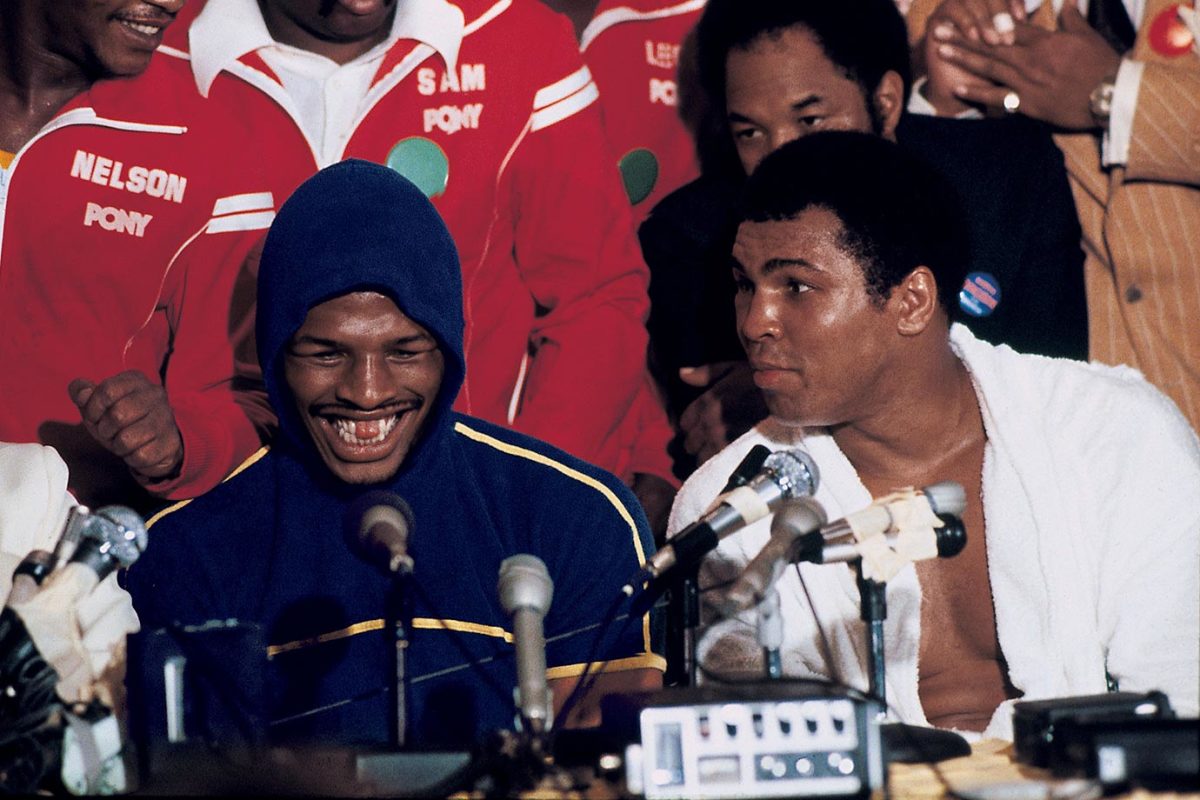
Leon Spinks took center stage over Ali at the press conference after their fight. The victorious Spinks and his gap-toothed grin were featured on the Feb. 19, 1978 cover of Sports Illustrated.
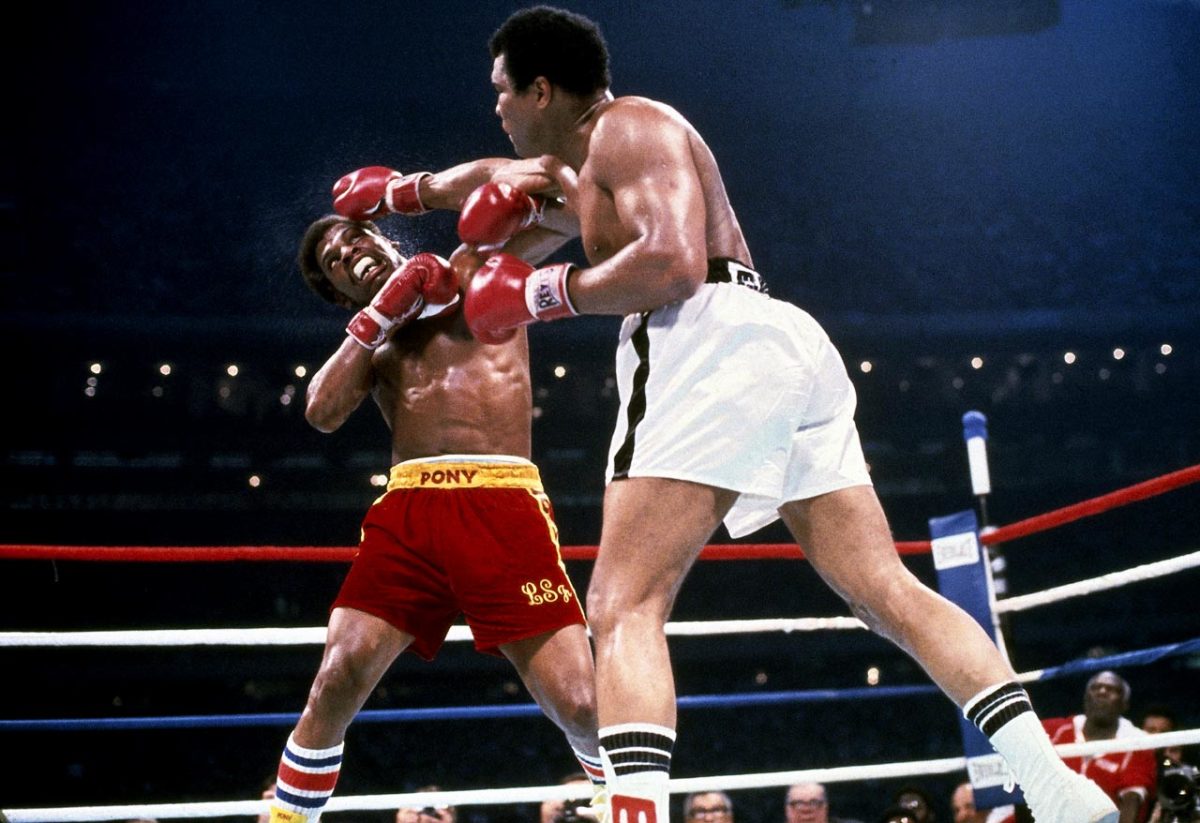
Ali lands a straight right hand to the head of Spinks in the rematch of their title bout in 1978. Ali won on a 15 round decision.
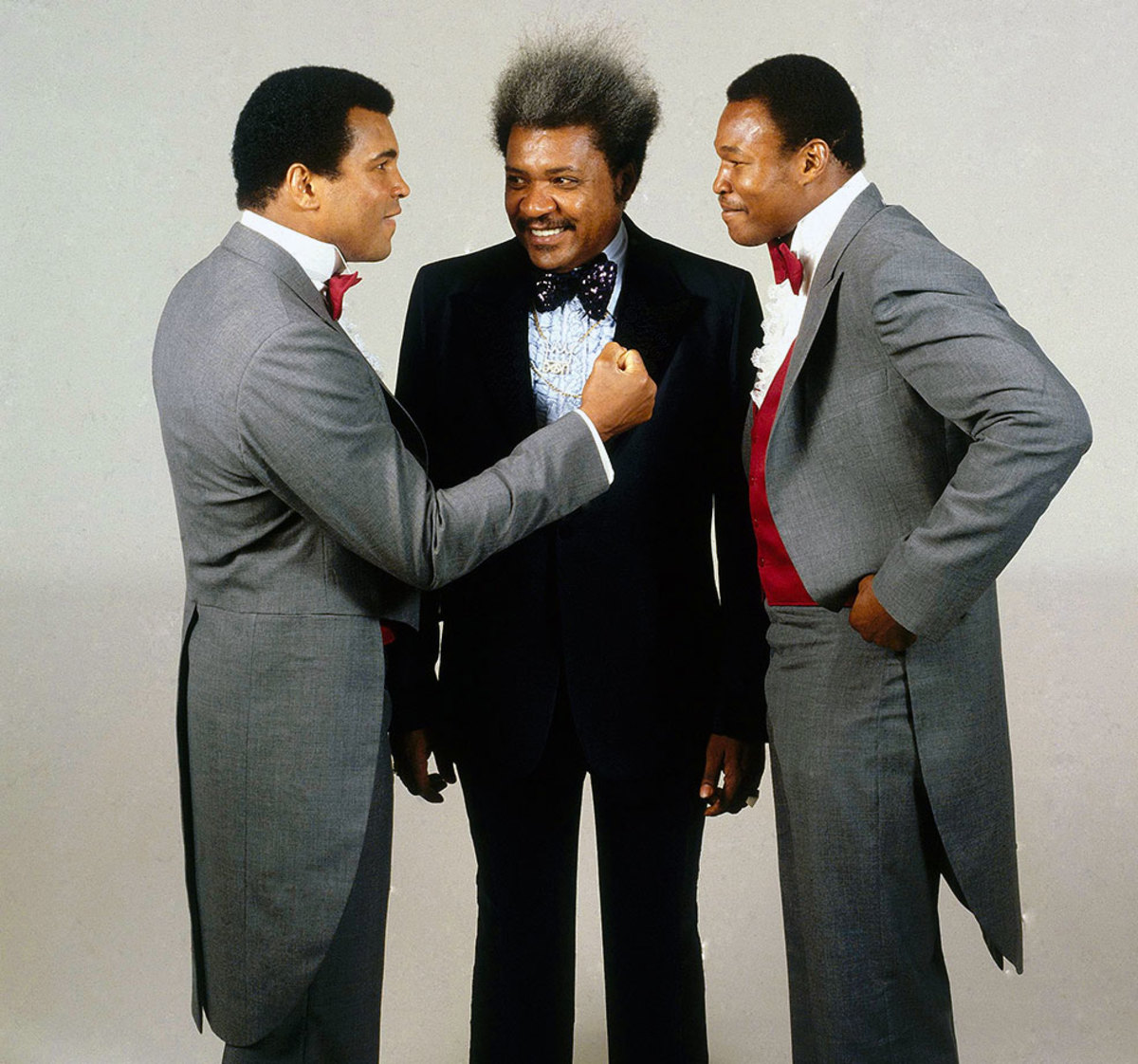
Don King pulled the strings again when Ali faced Larry Holmes before their November 1980 fight. King became a key figure in Ali's career, promoting his biggest fights, the Thrilla in Manila and the Rumble in the Jungle.
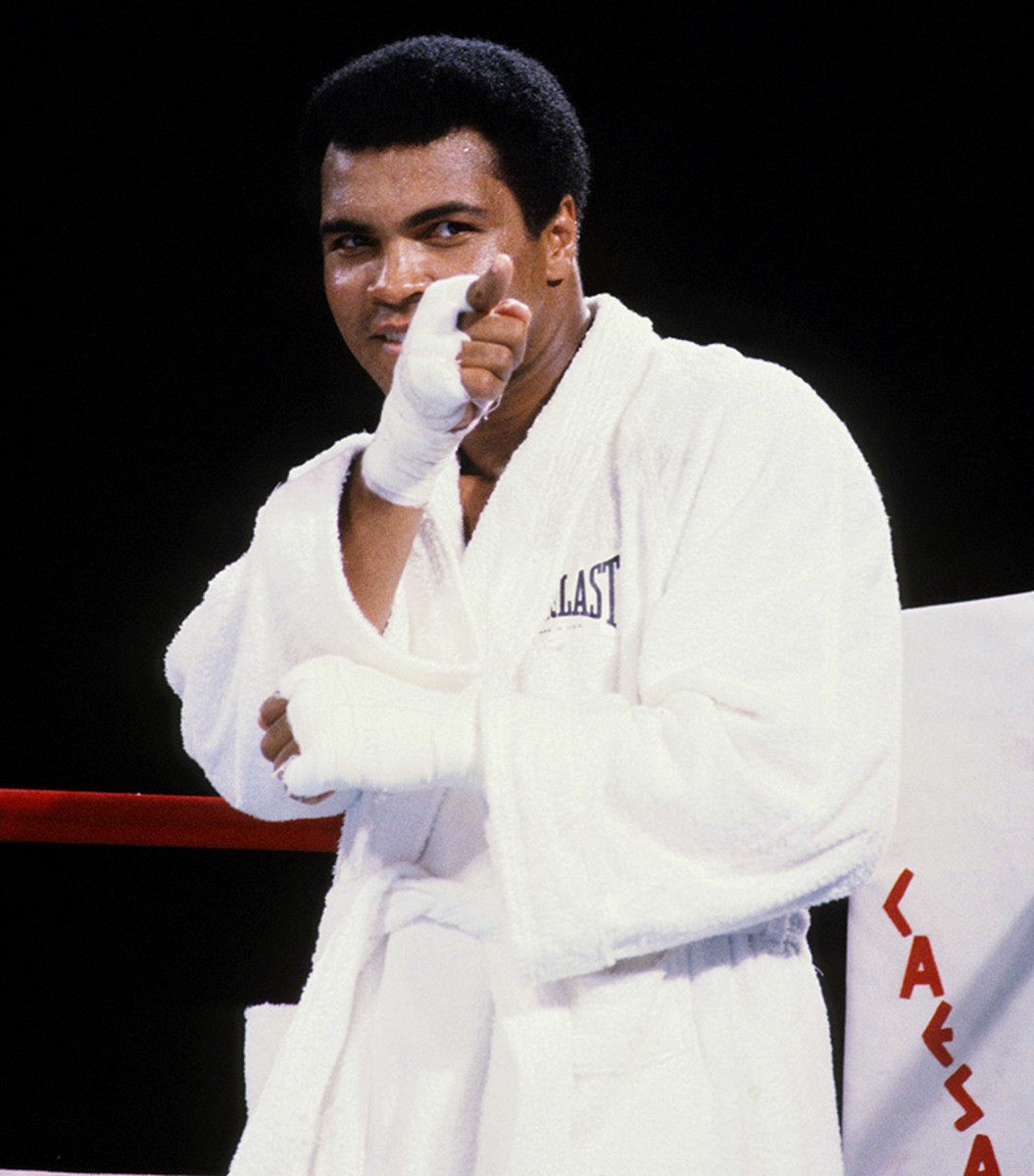
Ali points at Larry Holmes before their bout at Caesars Palace in 1980.
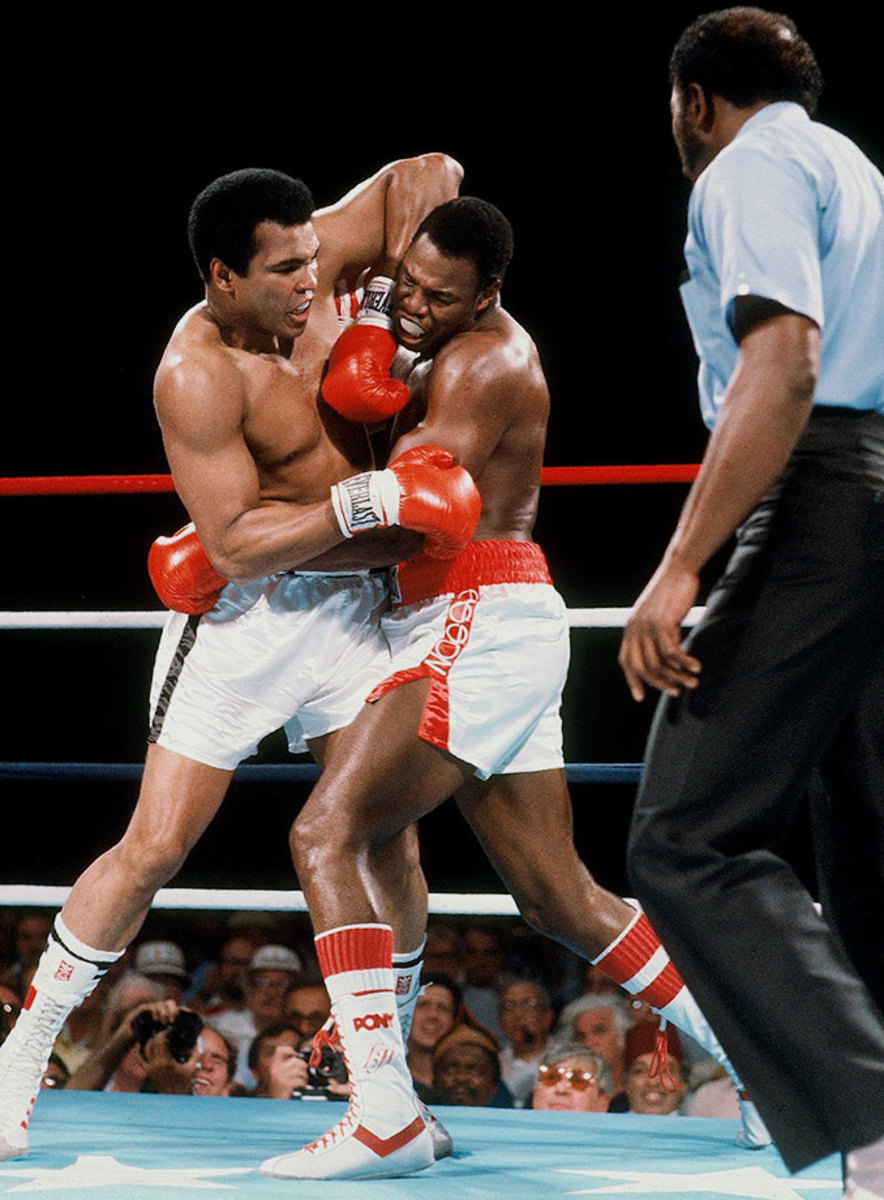
Ali grapples with Holmes during their bout in 1980. Trainer Angelo Dundee stopped the fight in the 11th round, marking the fight as Ali's only career loss by knockout.
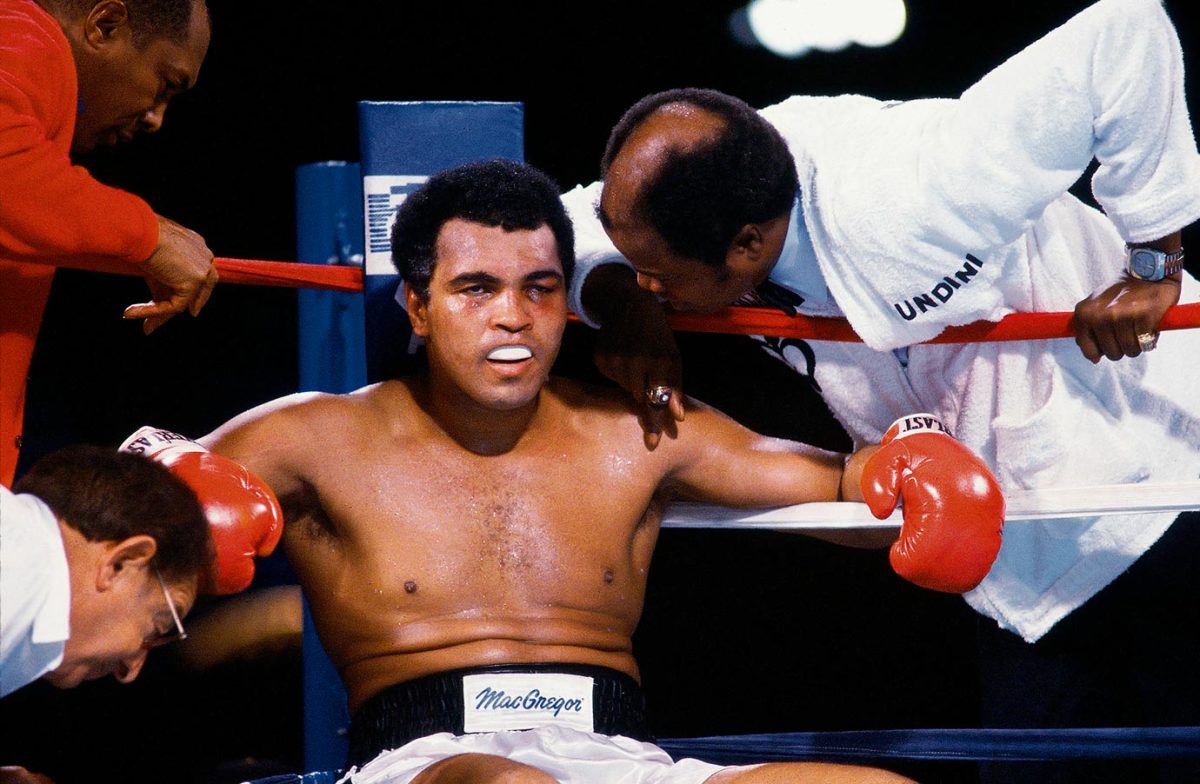
Drew Bundini Brown leans in to speak to Ali, who returned to fight Holmes after a brief retirement. By this time, Ali had already begun developing a vocal stutter and trembling hands and taken thyroid medication to lose weight that left him tired and short of breath.
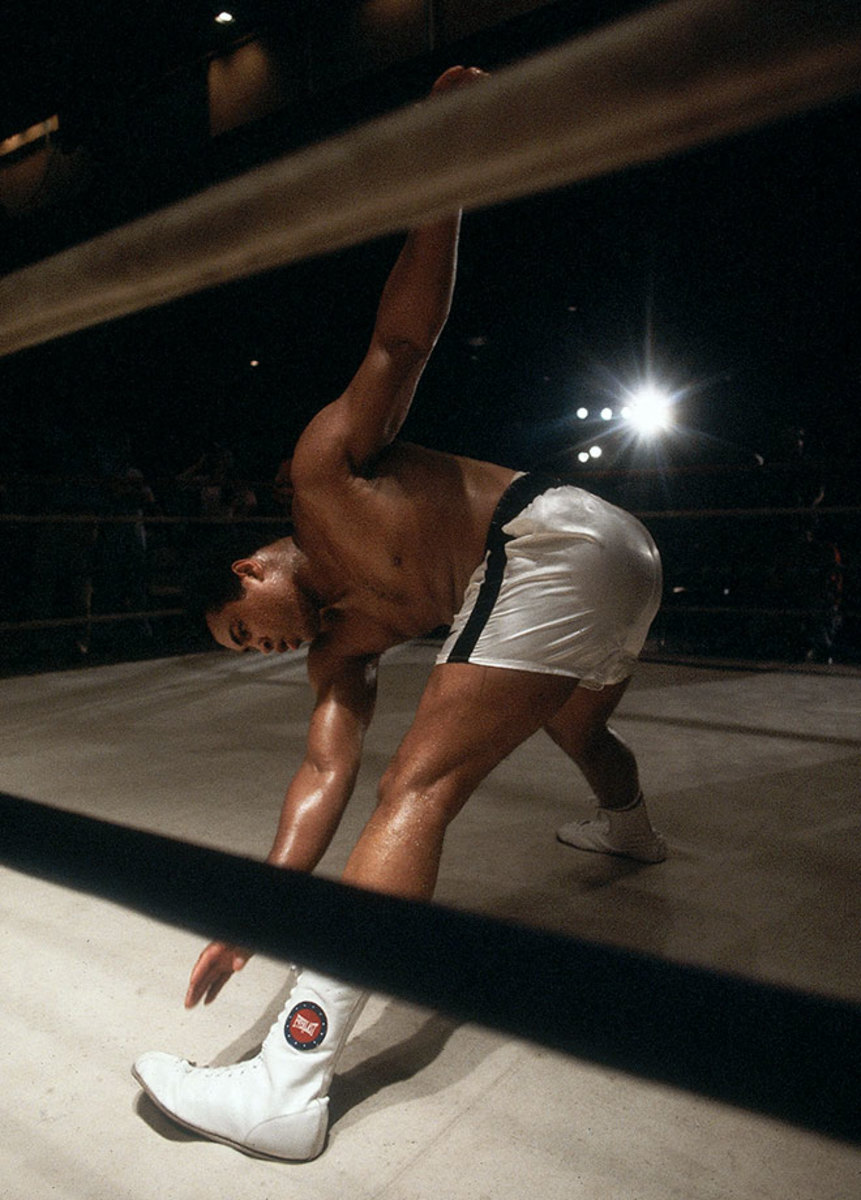
Ignoring pleas for his retirement, Ali stretches before a fight against Trevor Berbick in Nassau, Bahamas. Ali lost to Berbick in a unanimous decision and retired after the bout, the 61st of his career.
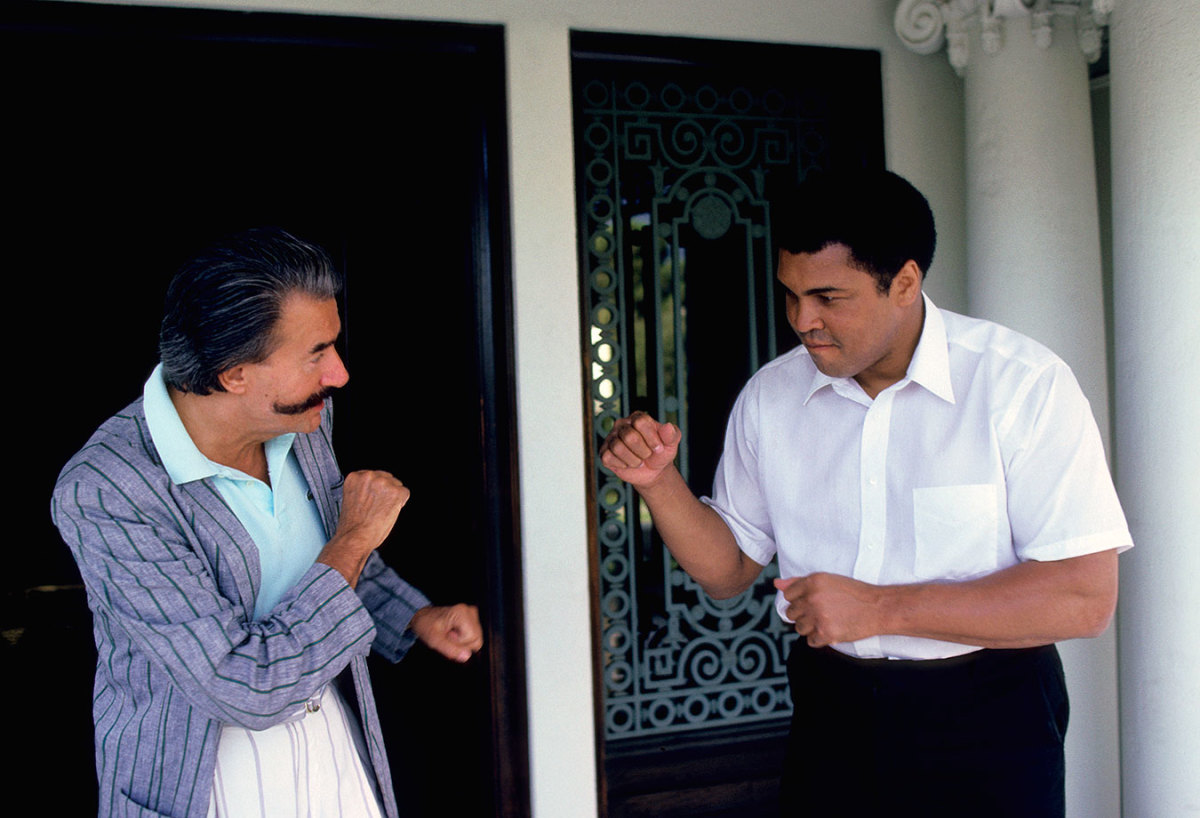
Ali pretends to spar with artist LeRoy Neiman at his home in Los Angeles. Neiman met Ali in 1962 and made many paintings and sketches from throughout Ali's life.
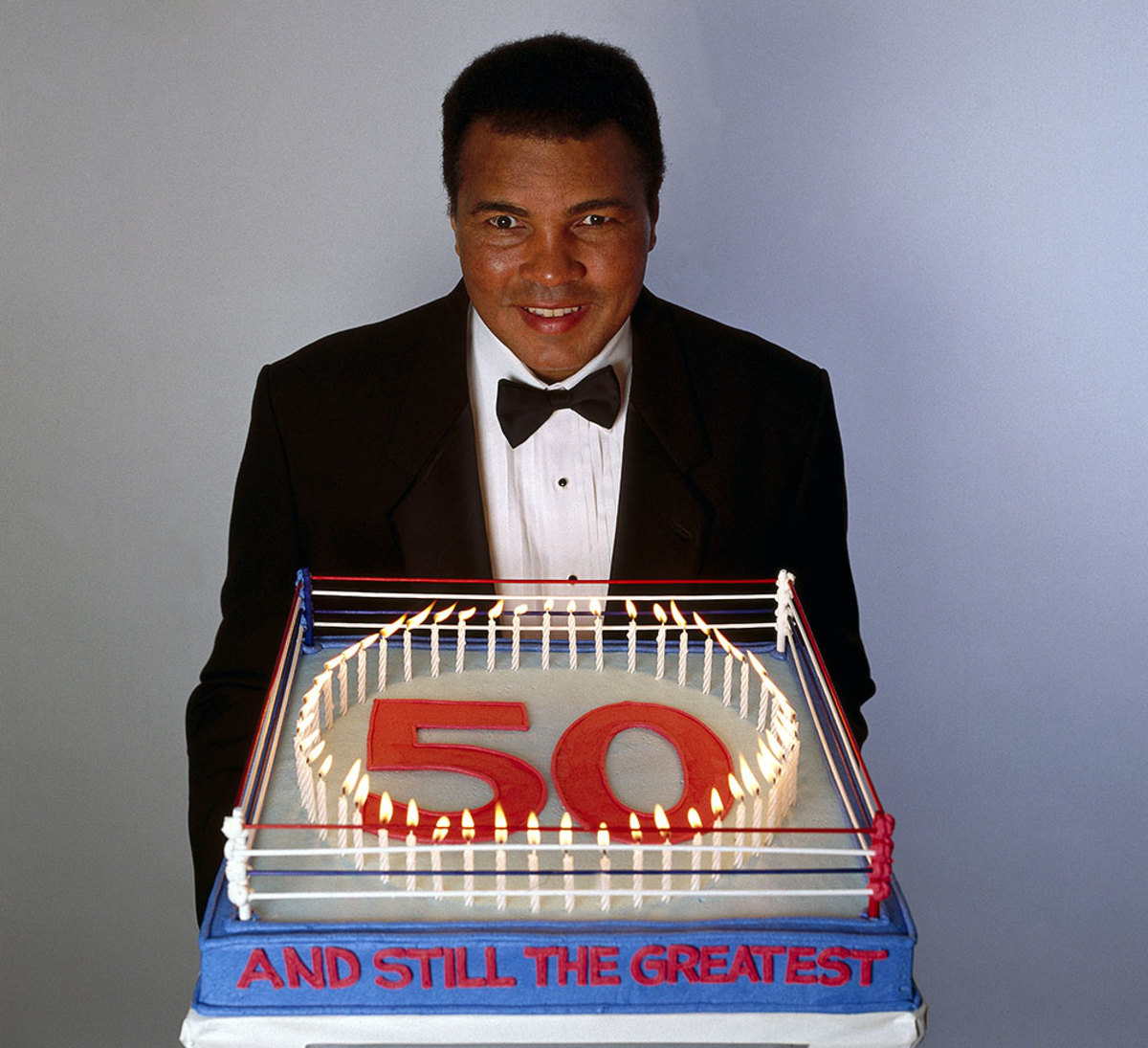
Cake in hand, Ali poses for a 50th birthday portrait in 1991. Although diagnosed with Parkinson's syndrome seven years earlier, Ali was still active, traveling to Iraq during the Gulf War to meet with Saddam Hussein in an attempt to negotiate the release of American hostages.
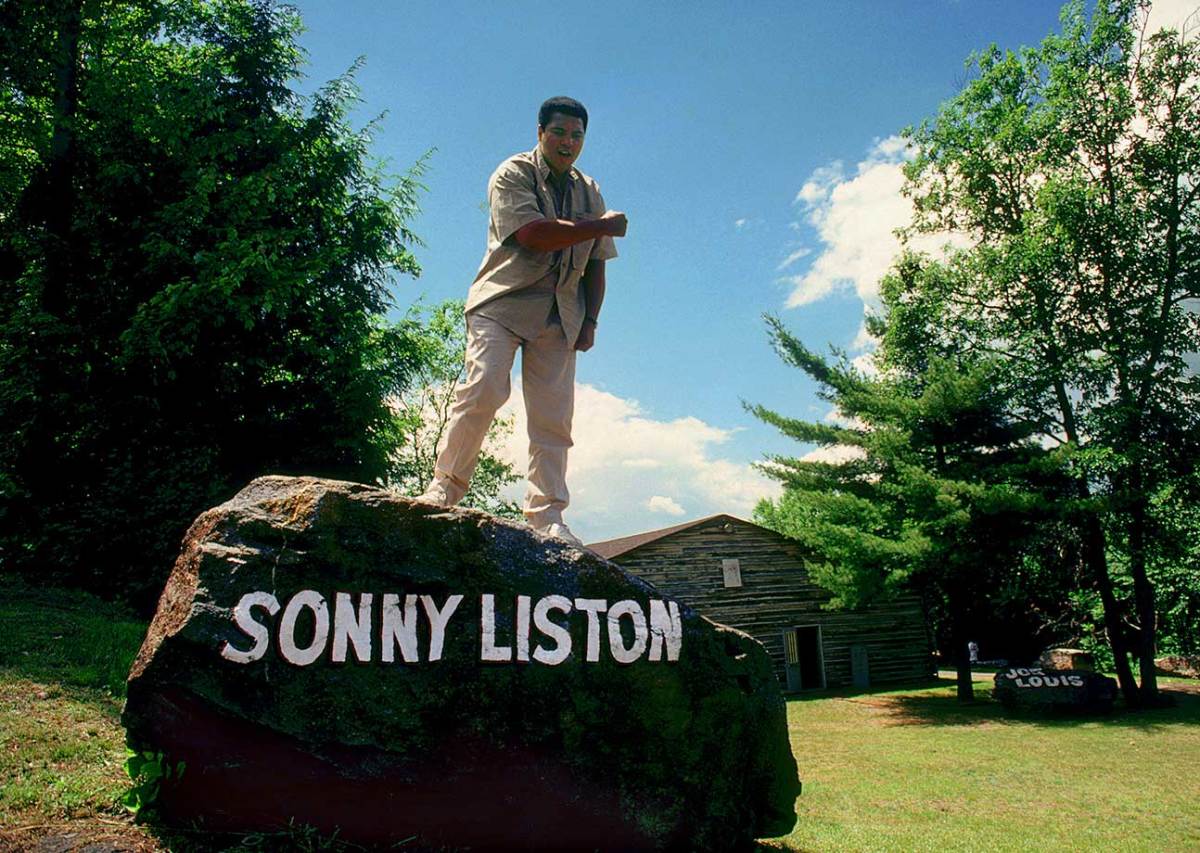
The same year, Ali stands atop of the Sonny Liston rock at his old training camp cabin. Ali and his father painted the names of famous boxers he admired on 18 boulders at the camp.
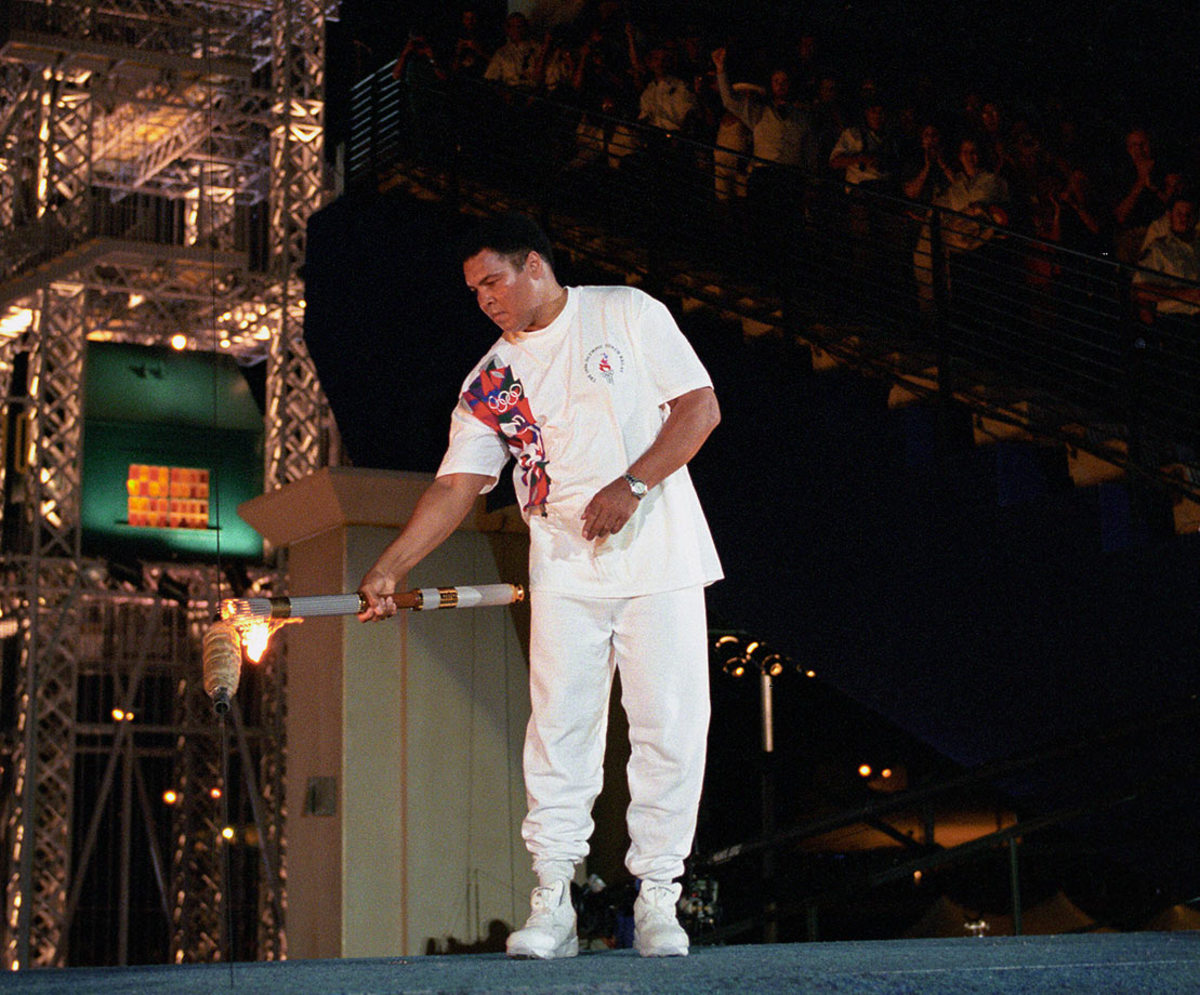
Ali carries the Olympic torch inside Centennial Olympic Stadium at the 1996 Atlanta Olympics. Despite trembling hands, Ali had the honor to light the Olympic flame in the stadium.
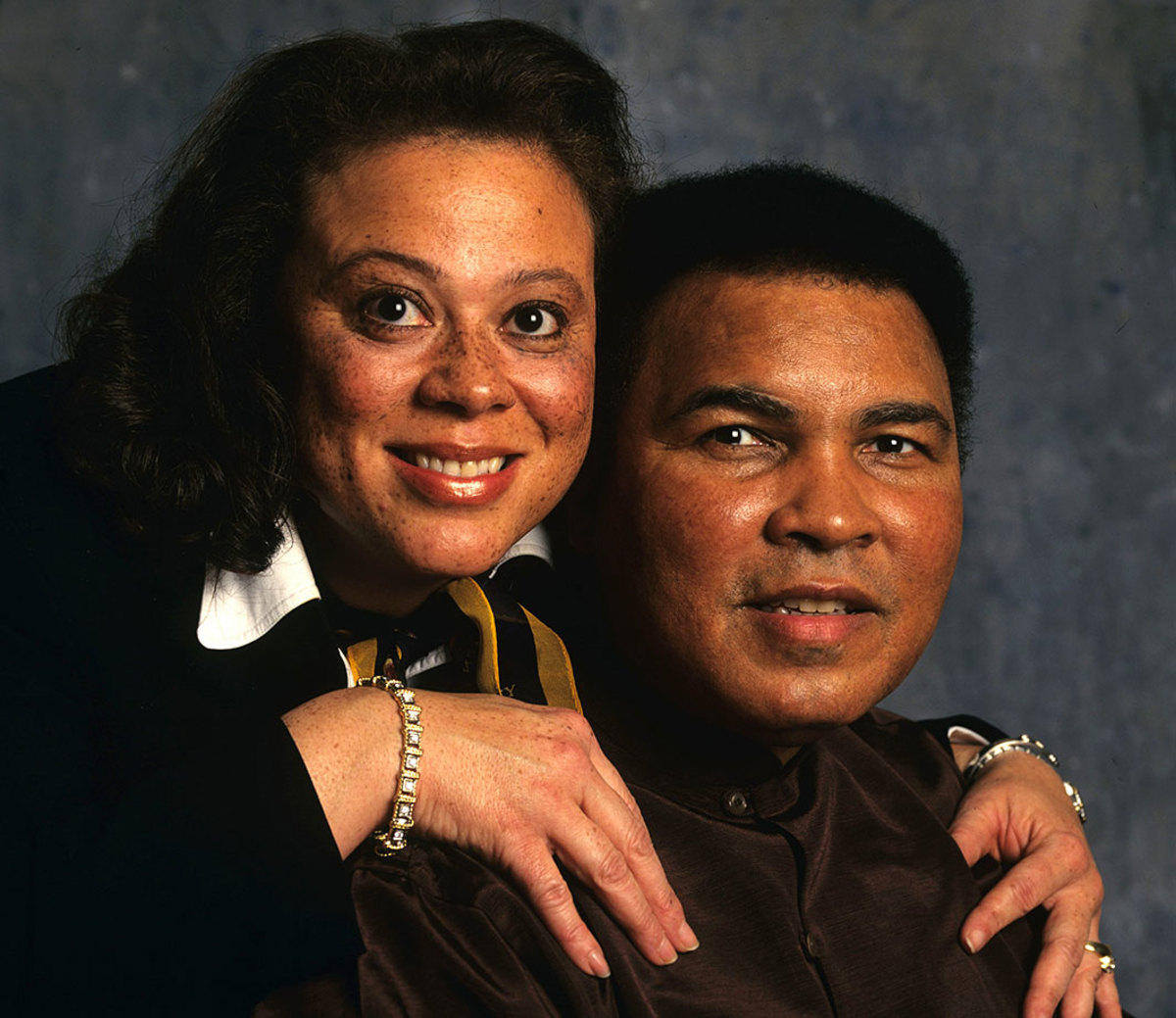
Husband and wife pose for a portrait during a photo shoot in 1997. Muhammad and Lonnie married in 1986 and have an adopted son together, Asaad Amin Ali.
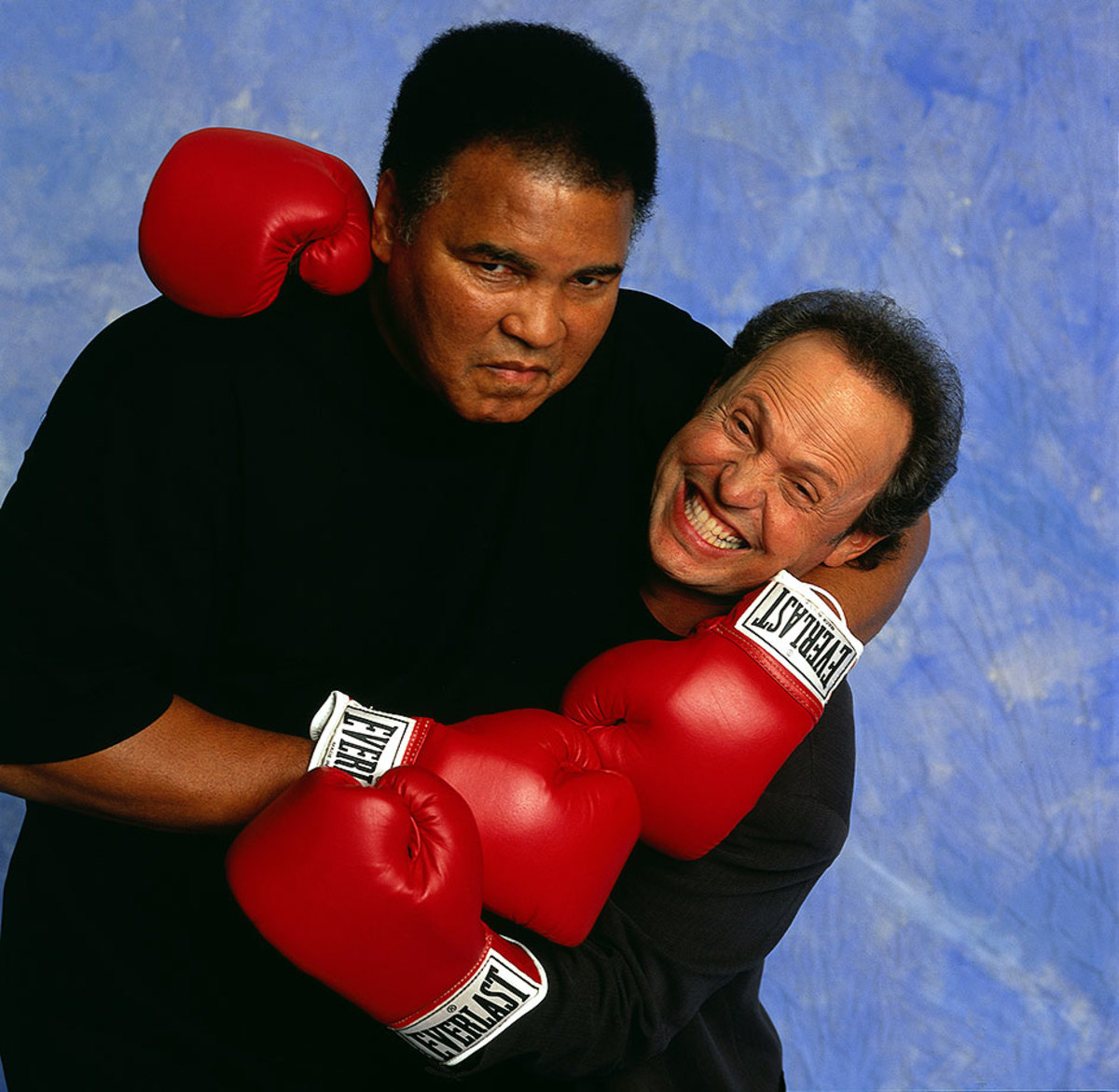
Ali messes around with actor Billy Crystal during a photo shoot in 2000. Crystal's impression of Ali was notorious, and he performed at a tribute to the boxer on his 50th birthday in December 1991.
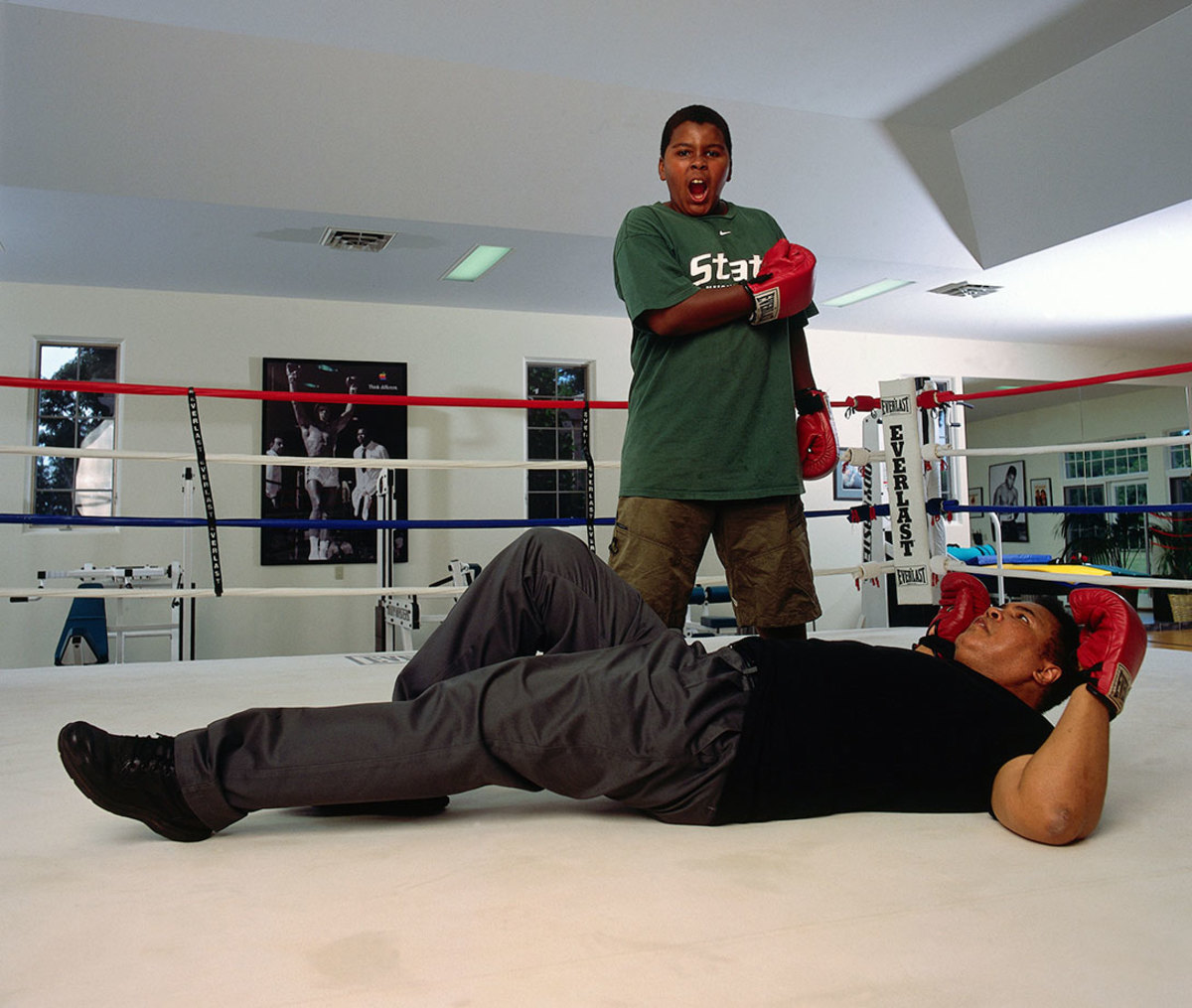
Ali lies on the canvas as his son, Assad Amin Ali, stands over him invoking memories of Ali's victory over Sonny Liston during a photo shoot in the gym at his farm on Kephart Road near Berrien Springs in 2001.
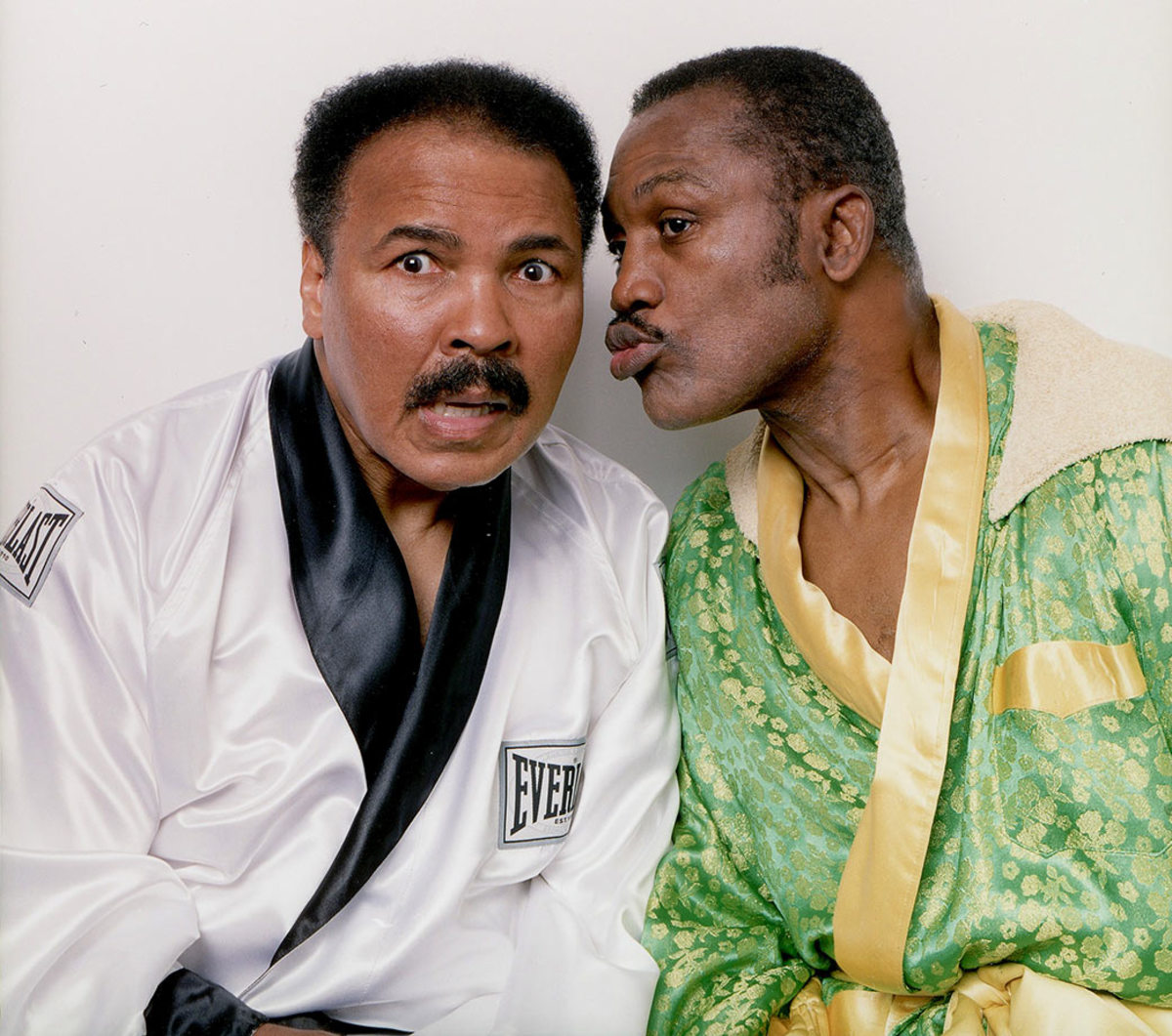
Fierce rivals in the ring, Ali and Joe Frazier pose for a portrait in the boxing robes they wore the night of their first bout at Frazier's Gym in 2003. Ali said after Frazier's death in 2011 that he was "a great champion."
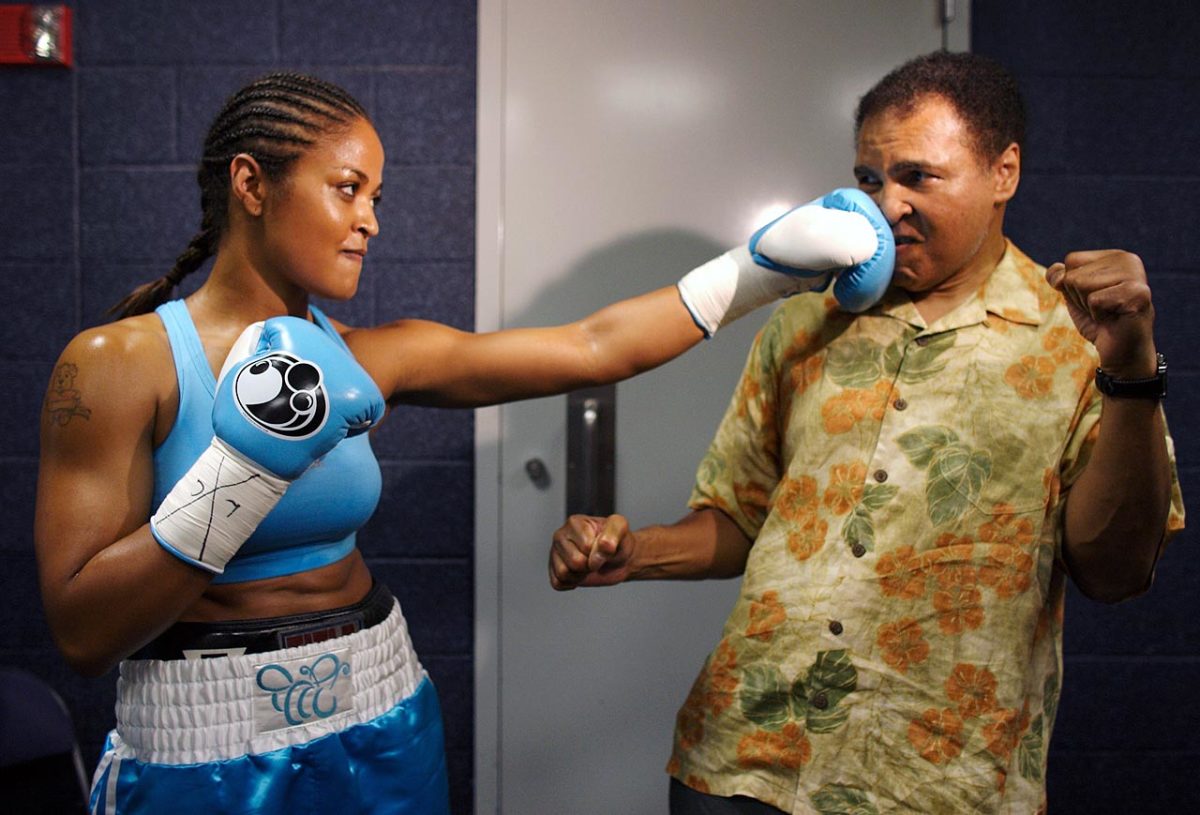
Ali takes a punch from his daughter Laila Ali while sparring before her fight against Erin Toughill in 2005. Laila retired from her own successful boxing career with a professional record of 24-0.
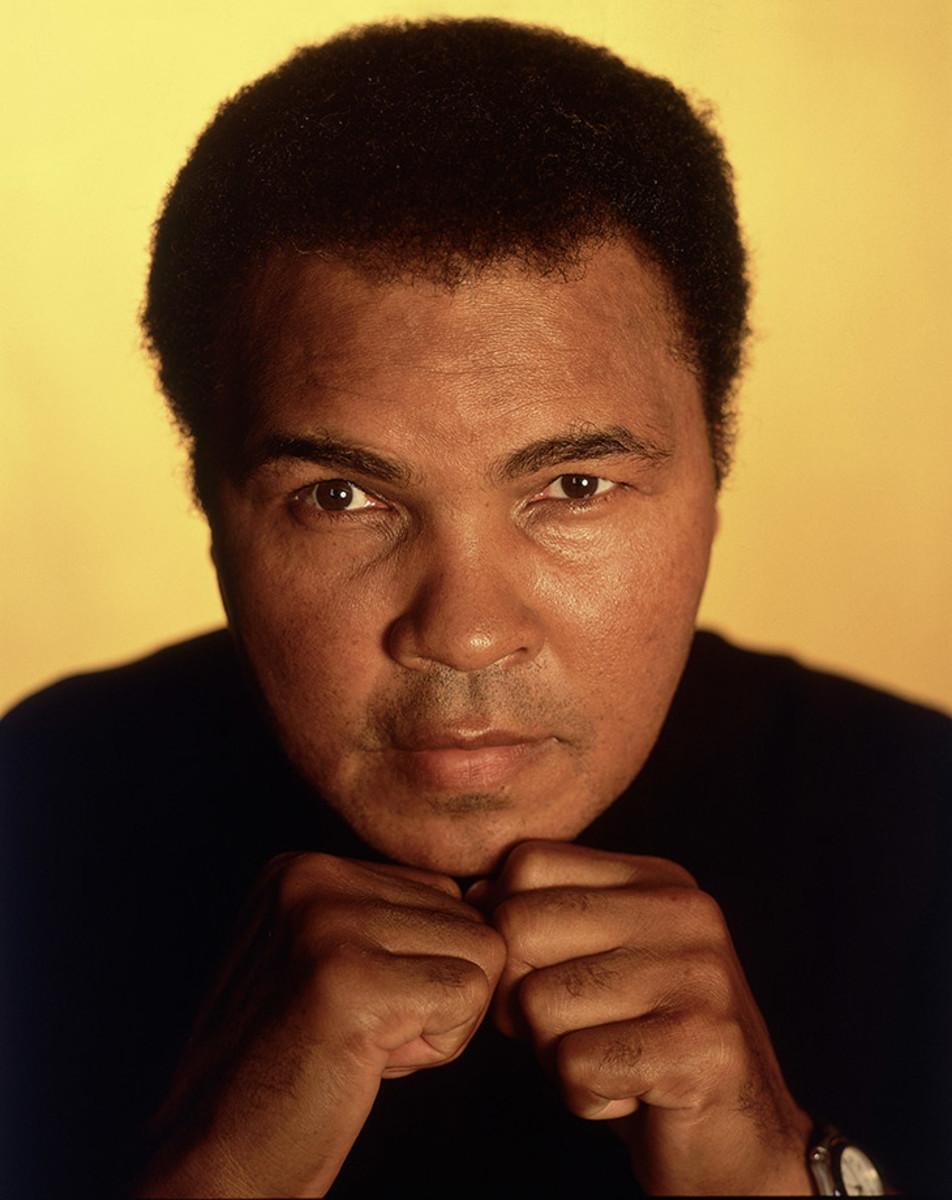
Ali poses with his fists up for a portrait in 2005.
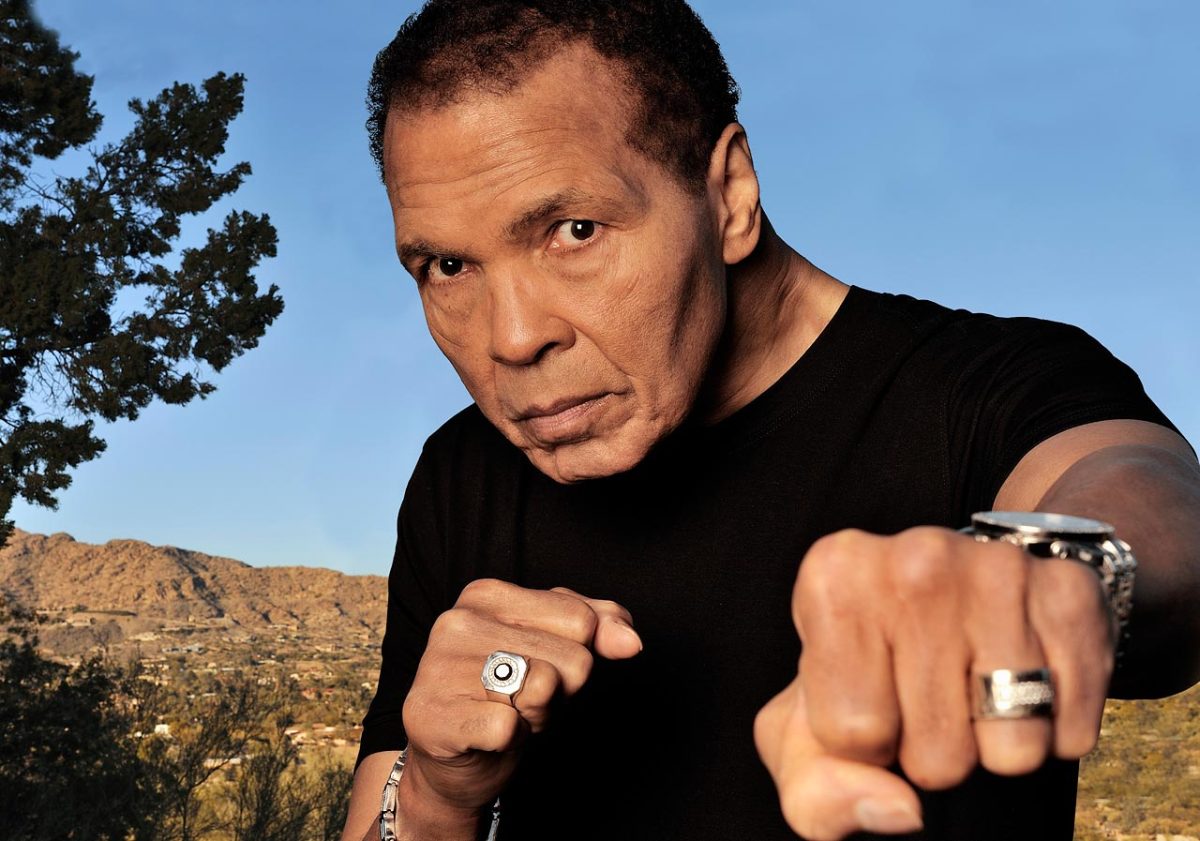
Ali poses with an extended punch in a 2012 photo shoot at his home in Paradise Valley, Ariz., to mark his 70th birthday.
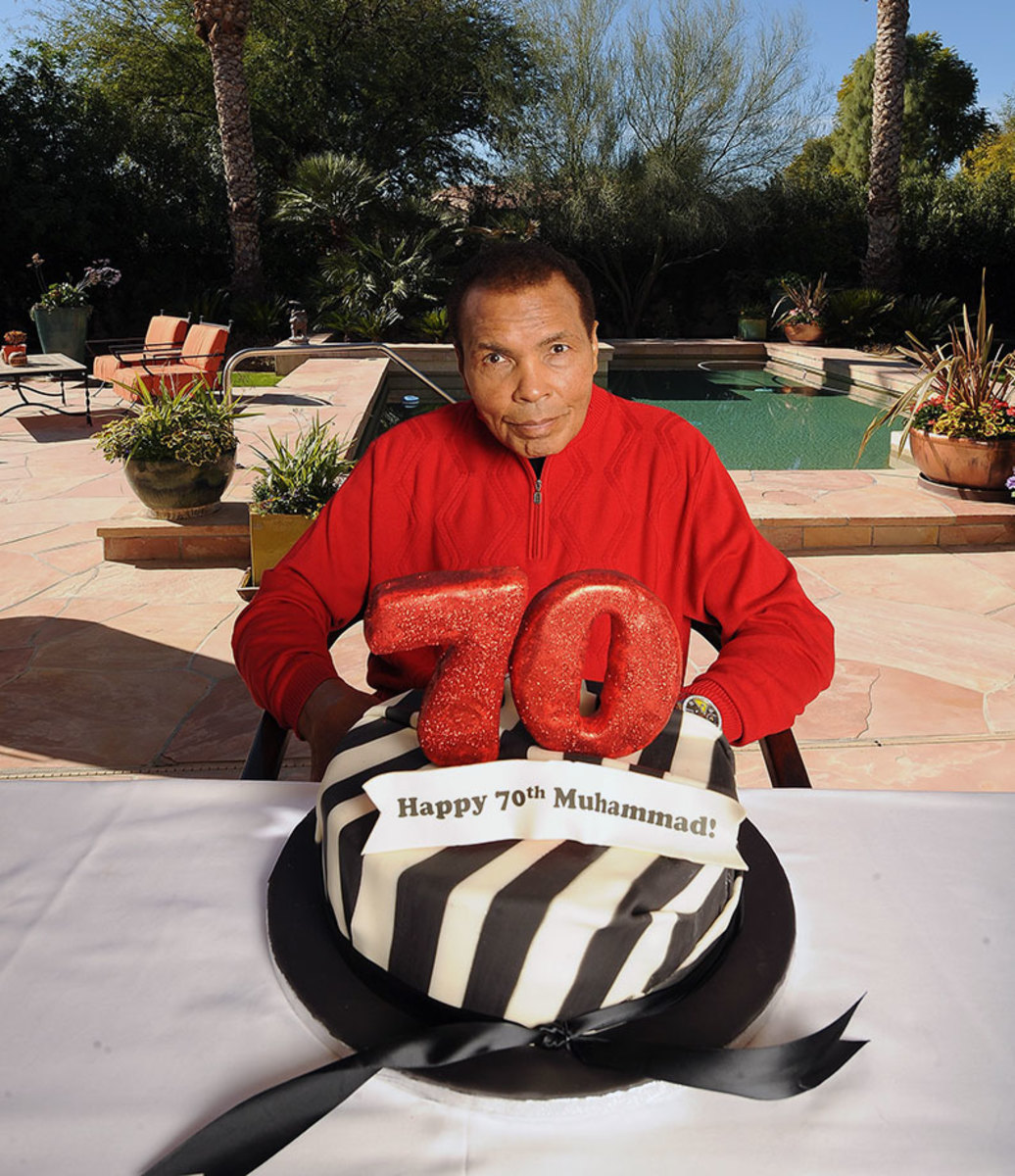
Ali sits in front of a 70th birthday cake in January 2012 at his Arizona home. Later that year he appeared at the opening ceremonies for the 2012 Olympics in London to escort the Olympic flag into the stadium, 52 years after he won gold in Rome.
***
He’s been on the story since 1964, so of course he was the natural choice to write the final chapter. Six years ago, Bill McDonald, the obituary editor of The New York Times, contacted Robert Lipsyte with what most writers would consider an intimidating, near impossible, task: Write the obituary for Muhammad Ali.
The writing stakes were enormous: This was a Page One obituary on arguably the most famous living person. It would be a piece read long after Lipsyte, McDonald and, quite frankly, all of us are gone.
There was no word count given, only the idea that it would be long and on Page One of the Paper of Record. For weeks, Lipsyte walked around the assignment, unable to start it given its importance.
“I have an enormous collection of books and articles on Clay/Ali and my own notebooks go back to February 1964, before the first Liston fight,” Lipsyte said on Saturday. “That’s when I met him. Since then I’ve always considered myself on the story, unquestionably my most significant personally and maybe professionally, too. So, I was most concerned about not leaving something crucial out of the obit, about missing some piece of the puzzle, some fact or someone’s interesting observation. It felt like a major responsibility.”
Muhammad Ali: Best quotes from the boxing legend
Lipsyte was one of the youngest reporters at Ali’s first title fight in 1964 against Sonny Liston (“The Times’s real boxing reporter didn’t think it was worth his time, thank goodness,” he said) and both careers unspooled at the same time. The two were of similar age (Lipsyte is four years older) and Lipsyte found Ali endlessly interesting. I asked him what emotions he felt writing about one of the subjects that defined his professional career.
“I feel sad now, but I didn’t feel sad while writing the obit because the tone had to be factual, impersonal, the Times’s version of the last word,” Lipsyte said. “I could quote terrific writers like Dave Kindred, Jack Newfield and Tom Hauser in places an informed opinion was necessary that shouldn’t be mine. Or Red Smith, who represented the established press. So I kept a kind of writing game face on although I’m sure the real emotions I felt for him along the way informed the copy.
“[Ali’s] evolution from a barely literate, clownish prodigy who found security in a cultish group to a more complex and thoughtful man was a powerful journey to trail, and I’m grateful for the chance. I hope he found pleasures in the last few years when he was barely mobile and mute. I think his legacy was in how he made so many of us brave.”
Here is the obit, and as you’ll see, the 78-year-old Lipsyte was up to the task.
•••
Ali was the subject of some of the most remarkable journalism during his life. His death also produced some beautiful writing. Below, in no order, are pieces from Saturday that stayed with me.
• The New Yorker editor and Ali biographer David Remnick, on Ali’s legacy
• Newark Star Ledger columnist emeritus Jerry Izenberg, on his lifelong friendship with Ali
• Ali biographer Thomas Hauser, writing for The Guardian:
• Via The Los Angeles Times photo blog: In 1981, Muhammad Ali talked a man out of jumping from the ninth floor of a building
• The Hall of Fame writer Dave Kindred, on covering Ali
• ESPN’s Jeremy Schaap, whose father Dick wrote many seminal pieces on Ali, narrated and wrote this video obit
• Alex Belth, writing for Deadspin, compiled some of the greatest features on Ali
Muhammad Ali's 10 greatest fights
• Sportsnet’s (Canada) Stephen Brunt, on growing up with Ali
• Dave Zirin, writing for The Nation, on Ali and social justice
• The Undefeated’s Marc Spears, on two hours with Ali
• The New York Times writer Harvey Araton, on Ali as a connector of generations
• Esquire’s Ali tribute
• “My dinner with Ali” (reprinted by Deadspin on Saturday)
• The Ringer’s Bryan Curtis, on Ali and sportswriters
• From ESPN’s Tommy Tomlinson: “How my Dad and I learned to love Muhammad Ali”
• The AP's always-excellent Tim Dahlberg, on covering Ali
• ESPN’s T.J. Quinn, on Ali rejecting white society for most of his career
• MTV News writer Jamil Smith, on the patience of Ali
President Obama pays tribute to Muhammad Ali
• William Nack, writing for ESPN, on the end of Ali’s journey
• From Time.com: Behind the greatest photo of Muhammad Ali
• Ron Borges, writing for Boston Herald, on a life covering Ali
• Check out this photo of Ali in Africa from former New York Times writer and Columbia University professor Howard French
• Keith Olbermann, for The Ringer, on four encounters with Ali
• Deadspin’s Daniel Roberts, on what we’ve lost with Ali’s death
• The Sunday Times’s (United Kingdom) 16-page wrap on Ali
• The front page of Louisville’s The Courier-Journal
• Philly.com’s Dick Jerardi, on hanging with Ali at Deer Lake
• New York Daily News cartoonist and columnist Bill Gallo, on his Ali reflections
• Slate’s “Hang Up And Listen” podcast interviewed Lipsyte on Saturday
• New York Magazine’s Mark Jacobson, on meeting Ali at 21
The Sports Illustrated coverage:
• William Nack, in 1996, on Frazier and Ali’s complicated relationship
• Richard Hoffer’s obit on Ali
• Mark Kram’s legendary feature on the Thrilla in Manila, the greatest story (in my opinion) in the history of Sports Illustrated
• The 100 greatest photos of Ali
• Senior writer Tim Layden profiled Ali last year
• Here is every Sports Illustrated cover featuring Muhammad Ali
• A first-person article then-Cassius Clay wrote for SI before his fight with Liston in 1964
• Charles Pierce on Ali, the contradiction
• Rick Reilly, on Ali the prankster
• Here is all of SI’s coverage on Ali and the video obit
Some fun must-watch stuff:
• Here’s Ali and Clint Eastwood talking with David Frost in 1969
• Here’s Muhammad Ali and Joe Frazier on The Dick Cavett Show in 1974
• Here’s Ali pranking kids on Candid Camera in 1974
 Add us as a preferred source on Google
Richard Deitsch is a writer & editor for Sports Illustrated. He has worked at nearly every division of SI and now primarily covers sports media, women’s sports & the Olympics.