%22%3E%0A%3Cpath%20d%3D%22M0%200.683105H4.9762L10.6354%207.70833V0.683105H15.9043V16.5874H11.1843L5.28112%209.2451V16.5874H0.0121963V0.683105H0Z%22%20fill%3D%22white%22%2F%3E%0A%3Cpath%20d%3D%22M17.2964%2010.4526V10.4038C17.2964%206.69607%2019.9552%203.87866%2023.6752%203.87866C28.0781%203.87866%2030.1272%206.94%2030.1272%2010.7209C30.1272%2010.9893%2030.1272%2011.3064%2030.1028%2011.5869H22.1262C22.4921%2012.6724%2023.3581%2013.2456%2024.468%2013.2456C25.3949%2013.2456%2026.1755%2012.8188%2026.9927%2011.9772L29.7613%2014.1848C28.5294%2015.7703%2026.7853%2016.8924%2024.1021%2016.8924C20.0406%2016.8924%2017.2842%2014.3189%2017.2842%2010.4648L17.2964%2010.4526ZM25.4315%209.31833C25.3217%208.13527%2024.6143%207.45226%2023.6996%207.45226C22.7848%207.45226%2022.2238%208.18405%2022.0652%209.31833H25.4315Z%22%20fill%3D%22white%22%2F%3E%0A%3Cpath%20d%3D%22M36.5166%2015.1847V16.5873H31.3574V0H36.5166V5.708C37.3581%204.79325%2038.3095%203.89071%2040.1999%203.89071C43.2003%203.89071%2045.542%206.50078%2045.542%2010.2939V10.3427C45.542%2014.27%2043.1759%2016.8923%2040.2487%2016.8923C38.3583%2016.8923%2037.3215%2016.0751%2036.5166%2015.1847ZM40.5414%2010.4037V10.3549C40.5414%209.11084%2039.6511%208.13512%2038.468%208.13512C37.285%208.13512%2036.3946%209.11084%2036.3946%2010.3549V10.4037C36.3946%2011.6355%2037.285%2012.6357%2038.468%2012.6357C39.6511%2012.6357%2040.5414%2011.6599%2040.5414%2010.4037Z%22%20fill%3D%22white%22%2F%3E%0A%3Cpath%20d%3D%22M46.8086%204.1835H51.9677V6.68379C52.6751%205.00067%2053.8094%203.91517%2055.8585%204.00055V9.47681H55.3096C53.1264%209.47681%2051.9677%2010.6843%2051.9677%2013.4285V16.5874H46.8086V4.1835Z%22%20fill%3D%22white%22%2F%3E%0A%3Cpath%20d%3D%22M55.789%2013.0623V13.0135C55.789%2010.5376%2057.6307%209.14717%2060.5091%209.14717C61.558%209.14717%2062.8996%209.3789%2063.4363%209.59844V9.3911C63.4363%208.25682%2062.7289%207.5982%2061.1433%207.5982C59.8749%207.5982%2058.8016%207.86653%2057.7161%208.3056L56.8014%204.87837C58.2284%204.32952%2059.8749%203.96362%2062.0215%203.96362C64.5462%203.96362%2066.1805%204.48808%2067.266%205.57357C68.193%206.50051%2068.5589%207.70797%2068.5589%209.50087V16.5627H63.3997V15.3064C62.5337%2016.2334%2061.3751%2016.8554%2059.8261%2016.8554C57.4356%2016.8554%2055.7646%2015.4894%2055.7646%2013.0379L55.789%2013.0623ZM63.4973%2012.0012V11.4767C63.2046%2011.3669%2062.7533%2011.2694%2062.3142%2011.2694C61.2897%2011.2694%2060.7287%2011.8792%2060.7287%2012.6598V12.7086C60.7287%2013.4404%2061.2531%2013.916%2061.9117%2013.916C62.8265%2013.916%2063.4973%2013.1842%2063.4973%2012.0134V12.0012Z%22%20fill%3D%22white%22%2F%3E%0A%3Cpath%20d%3D%22M69.2422%2015.0876L70.9863%2012.1604C72.4865%2013.0873%2074.1696%2013.5508%2075.5722%2013.5508C76.0723%2013.5508%2076.3162%2013.441%2076.3162%2013.1483V13.0995C76.3162%2012.8556%2076.0844%2012.697%2074.8404%2012.3677C71.7059%2011.5993%2069.7788%2010.7578%2069.7788%208.18431V8.13552C69.7788%205.40349%2071.962%203.89111%2075.1819%203.89111C77.2309%203.89111%2079.2434%204.41556%2080.7435%205.31811L79.1092%208.39165C77.792%207.65985%2076.2064%207.23297%2075.1575%207.23297C74.6574%207.23297%2074.4257%207.36714%2074.4257%207.62326V7.67205C74.4257%207.91598%2074.694%208.07454%2075.9503%208.40384C79.0848%209.17223%2080.9753%2010.0382%2080.9753%2012.5873V12.6361C80.9753%2015.3437%2078.9506%2016.9049%2075.5844%2016.9049C73.1817%2016.9049%2070.9985%2016.295%2069.2178%2015.112L69.2422%2015.0876Z%22%20fill%3D%22white%22%2F%3E%0A%3Cpath%20d%3D%22M82.144%200H87.3032V8.00095L89.962%204.18343H95.5725L91.6818%209.23281L95.6334%2016.5995H90.1084L88.3155%2013.1967L87.291%2014.5139V16.5995H82.1318V0.0121969L82.144%200Z%22%20fill%3D%22white%22%2F%3E%0A%3Cpath%20d%3D%22M95.4873%2013.0623V13.0135C95.4873%2010.5376%2097.329%209.14717%20100.207%209.14717C101.256%209.14717%20102.598%209.3789%20103.135%209.59844V9.3911C103.135%208.25682%20102.427%207.5982%20100.842%207.5982C99.5731%207.5982%2098.4998%207.86653%2097.4143%208.3056L96.4996%204.87837C97.9266%204.32952%2099.5731%203.96362%20101.72%203.96362C104.244%203.96362%20105.879%204.48808%20106.964%205.57357C107.891%206.50051%20108.257%207.70797%20108.257%209.50087V16.5627H103.098V15.3064C102.232%2016.2334%20101.073%2016.8554%2099.5244%2016.8554C97.1338%2016.8554%2095.4629%2015.4894%2095.4629%2013.0379L95.4873%2013.0623ZM103.196%2012.0012V11.4767C102.903%2011.3669%20102.452%2011.2694%20102.012%2011.2694C100.988%2011.2694%20100.427%2011.8792%20100.427%2012.6598V12.7086C100.427%2013.4404%20100.951%2013.916%20101.61%2013.916C102.525%2013.916%20103.196%2013.1842%20103.196%2012.0134V12.0012Z%22%20fill%3D%22white%22%2F%3E%0A%3Cpath%20d%3D%22M0.0121992%2027.7428V27.6941C0.0121992%2022.9496%203.71996%2019.4004%208.46443%2019.4004C11.9648%2019.4004%2014.331%2021.1079%2015.6726%2023.535L11.2818%2026.1085C10.6964%2024.9742%209.85483%2024.1814%208.39124%2024.1814C6.59834%2024.1814%205.41528%2025.7548%205.41528%2027.6575V27.7063C5.41528%2029.7797%206.64713%2031.2311%208.39124%2031.2311C9.89142%2031.2311%2010.733%2030.4139%2011.3916%2029.2308L15.7702%2031.7067C14.4285%2034.0729%2012.2088%2035.9999%208.24489%2035.9999C3.84192%2035.9999%200%2032.6825%200%2027.755L0.0121992%2027.7428Z%22%20fill%3D%22white%22%2F%3E%0A%3Cpath%20d%3D%22M16.1475%2029.4871V29.4383C16.1475%2025.9379%2019.0503%2022.9375%2023.1483%2022.9375C27.2464%2022.9375%2030.1003%2025.8891%2030.1003%2029.3895V29.4383C30.1003%2032.9387%2027.1976%2035.939%2023.0995%2035.939C19.0015%2035.939%2016.1475%2032.9875%2016.1475%2029.4871ZM25.1363%2029.4871V29.4383C25.1363%2028.2064%2024.2216%2027.2307%2023.0873%2027.2307C21.953%2027.2307%2021.0871%2028.2064%2021.0871%2029.3895V29.4383C21.0871%2030.6701%2021.9896%2031.6459%2023.1361%2031.6459C24.2826%2031.6459%2025.1363%2030.6701%2025.1363%2029.4871Z%22%20fill%3D%22white%22%2F%3E%0A%3Cpath%20d%3D%22M31.3447%2023.2421H36.5039V25.7424C37.2113%2024.0593%2038.3456%2022.9738%2040.3946%2023.0591V28.5354H39.8457C37.6626%2028.5354%2036.5039%2029.7429%2036.5039%2032.4871V35.646H31.3447V23.2421Z%22%20fill%3D%22white%22%2F%3E%0A%3Cpath%20d%3D%22M41.3584%2023.2424H46.5175V24.9743C47.3103%2023.9498%2048.5666%2022.9497%2050.3107%2022.9497C52.9207%2022.9497%2054.5551%2024.6816%2054.5551%2027.4746V35.6585H49.3959V29.1334C49.3959%2028.0723%2048.7617%2027.4502%2047.9933%2027.4502C47.225%2027.4502%2046.5175%2028.0601%2046.5175%2029.1334V35.6585H41.3584V23.2546V23.2424Z%22%20fill%3D%22white%22%2F%3E%0A%3Cpath%20d%3D%22M56.1177%2019.0586H61.2768V24.9008C62.0696%2023.8762%2063.3258%2022.9493%2065.07%2022.9493C67.68%2022.9493%2069.3144%2024.6812%2069.3144%2027.4742V35.6581H64.1552V29.133C64.1552%2028.0719%2063.521%2027.4498%2062.7404%2027.4498C61.9598%2027.4498%2061.2646%2028.0597%2061.2646%2029.133V35.6581H56.1055V19.0708L56.1177%2019.0586Z%22%20fill%3D%22white%22%2F%3E%0A%3Cpath%20d%3D%22M70.7656%2031.4256V23.2417H75.9248V29.7669C75.9248%2030.8402%2076.559%2031.45%2077.3396%2031.45C78.1202%2031.45%2078.8154%2030.8402%2078.8154%2029.7669V23.2417H83.9745V35.6456H78.8154V33.9869C78.0226%2035.0114%2076.7663%2035.9383%2075.0222%2035.9383C72.4122%2035.9383%2070.7778%2034.2064%2070.7778%2031.4134L70.7656%2031.4256Z%22%20fill%3D%22white%22%2F%3E%0A%3Cpath%20d%3D%22M84.7178%2034.1462L86.4619%2031.219C87.9621%2032.1459%2089.6452%2032.6094%2091.0478%2032.6094C91.5478%2032.6094%2091.804%2032.4996%2091.804%2032.2069V32.1581C91.804%2031.9142%2091.5722%2031.7556%2090.3282%2031.4263C87.1937%2030.6579%2085.2666%2029.8164%2085.2666%2027.2429V27.1941C85.2666%2024.4621%2087.4498%2022.9497%2090.6697%2022.9497C92.7187%2022.9497%2094.7311%2023.4742%2096.2313%2024.3767L94.597%2027.4502C93.2798%2026.7184%2091.6942%2026.2916%2090.6453%2026.2916C90.1453%2026.2916%2089.9135%2026.4257%2089.9135%2026.6819V26.7306C89.9135%2026.9746%2090.1818%2027.1331%2091.4381%2027.4624C94.5726%2028.2308%2096.4631%2029.0968%2096.4631%2031.6459V31.6947C96.4631%2034.4023%2094.4384%2035.9635%2091.0844%2035.9635C88.6816%2035.9635%2086.4985%2035.3536%2084.7178%2034.1706V34.1462Z%22%20fill%3D%22white%22%2F%3E%0A%3Cpath%20d%3D%22M97.6225%2019.0586H102.782V27.0595L105.441%2023.242H111.051L107.16%2028.2914L111.112%2035.6581H105.587L103.794%2032.2553L102.769%2033.5725V35.6581H97.6104V19.0708L97.6225%2019.0586Z%22%20fill%3D%22white%22%2F%3E%0A%3Cpath%20d%3D%22M110.493%2029.5115V29.4627C110.493%2025.7549%20113.152%2022.9375%20116.871%2022.9375C121.274%2022.9375%20123.323%2025.9988%20123.323%2029.7798C123.323%2030.0481%20123.323%2030.3652%20123.299%2030.6457H115.323C115.688%2031.7312%20116.554%2032.3045%20117.664%2032.3045C118.591%2032.3045%20119.372%2031.8776%20120.189%2031.036L122.958%2033.2436C121.726%2034.8292%20119.982%2035.9512%20117.298%2035.9512C113.237%2035.9512%20110.48%2033.3778%20110.48%2029.5236L110.493%2029.5115ZM118.628%2028.3772C118.518%2027.1941%20117.811%2026.5111%20116.896%2026.5111C116.03%2026.5111%20115.42%2027.2429%20115.262%2028.3772H118.628Z%22%20fill%3D%22white%22%2F%3E%0A%3Cpath%20d%3D%22M124.553%2023.2421H129.712V25.7424C130.419%2024.0593%20131.554%2022.9738%20133.603%2023.0591V28.5354H133.054C130.871%2028.5354%20129.712%2029.7429%20129.712%2032.4871V35.646H124.553V23.2421Z%22%20fill%3D%22white%22%2F%3E%0A%3Cpath%20d%3D%22M133.689%2034.1462L135.434%2031.219C136.934%2032.1459%20138.617%2032.6094%20140.019%2032.6094C140.52%2032.6094%20140.776%2032.4996%20140.776%2032.2069V32.1581C140.776%2031.9142%20140.544%2031.7556%20139.3%2031.4263C136.165%2030.6579%20134.238%2029.8164%20134.238%2027.2429V27.1941C134.238%2024.4621%20136.421%2022.9497%20139.641%2022.9497C141.69%2022.9497%20143.703%2023.4742%20145.203%2024.3767L143.569%2027.4502C142.251%2026.7184%20140.666%2026.2916%20139.617%2026.2916C139.117%2026.2916%20138.885%2026.4257%20138.885%2026.6819V26.7306C138.885%2026.9746%20139.154%2027.1331%20140.41%2027.4624C143.544%2028.2308%20145.435%2029.0968%20145.435%2031.6459V31.6947C145.435%2034.4023%20143.41%2035.9635%20140.056%2035.9635C137.653%2035.9635%20135.47%2035.3536%20133.689%2034.1706V34.1462Z%22%20fill%3D%22white%22%2F%3E%0A%3Cpath%20fill-rule%3D%22evenodd%22%20clip-rule%3D%22evenodd%22%20d%3D%22M155.368%204.36764C161.191%20-1.45588%20170.632%20-1.45588%20176.456%204.36764C182.279%2010.1912%20182.279%2019.6324%20176.456%2025.4559L165.912%2036L155.368%2025.4559C149.544%2019.6324%20149.544%2010.1912%20155.368%204.36764ZM158.009%207.55761C157.948%207.86849%20157.916%208.39718%20157.916%209.14566V10.4189C157.916%2011.1832%20157.948%2011.7198%20158.013%2012.0267C158.078%2012.3317%20158.278%2012.6168%20158.617%2012.8762C158.956%2013.1376%20159.403%2013.3316%20159.958%2013.4623C160.512%2013.593%20161.1%2013.6584%20161.837%2013.6584C162.573%2013.6584%20163.217%2013.591%20163.769%2013.4524C164.322%2013.3158%20164.761%2013.1178%20165.086%2012.8604C165.411%2012.6029%20165.605%2012.3178%20165.666%2012.0069C165.728%2011.6961%20165.759%2011.1674%20165.759%2010.4189V9.14566C165.759%208.38134%20165.728%207.84473%20165.662%207.53781C165.597%207.23287%20165.397%206.94971%20165.058%206.68834C164.72%206.42696%20164.272%206.23291%20163.718%206.10223C163.163%205.97154%20162.536%205.90619%20161.839%205.90619C161.102%205.90619%20160.459%205.97352%20159.906%206.11213C159.352%206.24875%20158.914%206.44677%20158.589%206.70418C158.265%206.9616%20158.071%207.24673%20158.009%207.55761ZM163.276%2024.8638C166.876%2024.8638%20168.557%2024.2064%20168.557%2021.862V21.858V21.3155C168.557%2019.6581%20167.516%2018.971%20164.252%2018.3136C163.278%2018.1136%20162.908%2017.9136%20162.908%2017.3136V16.9414C162.908%2016.6543%20163.177%2016.5117%20163.413%2016.5117C163.749%2016.5117%20163.918%2016.7137%20163.918%2016.9414V18.1136H168.391V17.3988C168.391%2015.4563%20167.347%2014.4266%20163.177%2014.4266C160.15%2014.4266%20157.896%2015.3414%20157.896%2017.3711V17.7433C157.896%2019.5155%20158.805%2020.3155%20162.201%2021.0303C162.28%2021.0472%20162.355%2021.063%20162.427%2021.0781C163.329%2021.2674%20163.647%2021.3341%20163.647%2021.9174V22.2897C163.647%2022.6619%20163.546%2022.8045%20163.142%2022.8045C162.67%2022.8045%20162.637%2022.5471%20162.637%2022.262V21.2897H157.894V21.7471C157.894%2024.149%20159.476%2024.8638%20163.276%2024.8638ZM169.424%2024.5569H173.925V14.7355H169.424V24.5569ZM170.955%2013.5019H173.925V6.06064H171.092V9.411L169.193%206.06064H166.359V13.5019H169.193V10.1199L170.955%2013.5019ZM162.269%2012.152C162.204%2012.2688%20162.055%2012.3262%20161.825%2012.3262L161.827%2012.3282C161.604%2012.3282%20161.459%2012.2767%20161.398%2012.1758C161.336%2012.0748%20161.305%2011.8074%20161.305%2011.3758V7.90068C161.305%207.51852%20161.352%207.28684%20161.445%207.20962C161.538%207.13239%20161.675%207.09279%20161.851%207.09279C162.059%207.09279%20162.198%207.14031%20162.265%207.23734C162.332%207.33239%20162.366%207.55416%20162.366%207.90068V11.3203C162.366%2011.7579%20162.334%2012.0352%20162.269%2012.152Z%22%20fill%3D%22white%22%2F%3E%0A%3C%2Fg%3E%0A%3Cdefs%3E%0A%3CclipPath%20id%3D%22clip0_15191_23649%22%3E%0A%3Crect%20width%3D%22181%22%20height%3D%2236%22%20fill%3D%22white%22%2F%3E%0A%3C%2FclipPath%3E%0A%3C%2Fdefs%3E%0A%3C%2Fsvg%3E%0A)
Dave Feit: Unanswered Questions for the 2026 Nebraska Football Season
In this story:
As the start of the 2026 Nebraska season draws close, there are a lot of things we know. So far, I've covered Reasons for Optimism, provided a Reality Check, and dug deep into the numbers to predict how the new "five-in-five" rules will impact the number of underclassmen who will see the field this fall.
Even with everything we know about this team, several big question marks remain. I went through and identified the ones that will have the biggest impact on the season and the future of the program.
Can Rob Aurich fix Nebraska's putrid red zone defense?
Saturday, Sept. 6, 2025. Nebraska is hosting the Akron Zips at Memorial Stadium.
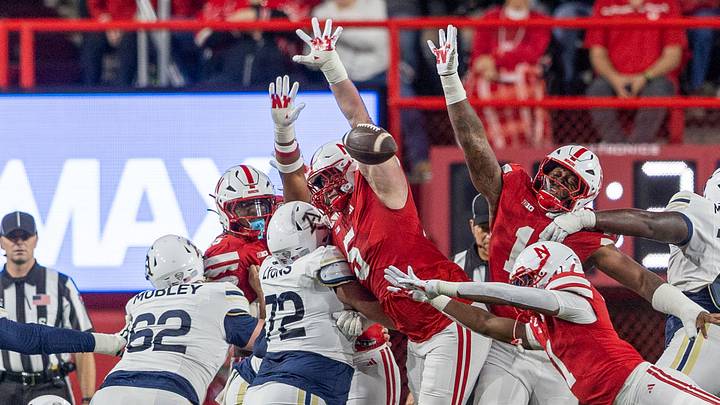
Midway through the third quarter, the Zips have fourth-and-eight from the Nebraska 16. Akron's Owen Wiley lines up for a 33-yard field goal attempt. Just before halftime, Wiley attempted a kick from 46 yards out. He had the distance, but the ball doinked off the left upright. This is a much more makeable attempt.
As the ball is snapped, Nebraska's Riley Van Poppel bulls his way through the Zips' line. He sticks up his left paw and blocks the kick! At the time, this was a notable play because it helped preserve Nebraska's first shutout since the 2009 Holiday Bowl. In looking back at the 2025 season, the play has a bigger significance.
The blocked field goal was the only time in 2025 that Nebraska stopped a team from scoring when they entered the red zone. Nebraska's defense (in this context, I cannot in good conscience refer to them as "Blackshirts") allowed 38 red zone trips in their 13 games. Thirty of them ended with a touchdown. Seven ended with a made field goal.
Only Rice - who allowed points each of the 42 times an opponent entered the red zone - was worse inside the 20. Rice went 5-8 in 2025.
As I see it, the key to getting red zone stops is improving Nebraska's porous run defense. Of the 30 red zone touchdowns allowed, 24 of them came on the ground.
If Aurich, Nebraska's new defensive coordinator, can fix the Blackshirts inside the red zone, the Huskers should have a better season. If not, it could be another long year.
Will Nebraska's offense establish - and maintain - an identity?
Longtime readers will know that I absolutely abhor the "identity" conversation. Too often the "NU's offense lacks an identity" discourse pops up after the offense struggles in a game or when fans can't easily define what they're trying to do into a high-level classification like "spread", "option", "West Coast", or the catch-all of "pro-style."* Sometimes, the identity conversation is code for "I think Nebraska should run the ball more."
*Quick - tell me the offensive identities of Georgia, Ohio State, or Texas. For most college football fans, their response is typically "uh… pro style?" For most of the teams in the Top 10, their offensive identity is best described as "we have better players than you do."
However, in some cases - such as Nebraska under Matt Rhule - the identity conversation is more of a "what do you want to be when you grow up" discussion. A quick (and incomplete) recap of the twists and turns of NU's offense under Rhule shows that they still have a lot of maturing to do:
- 2023: Rhule wanted to hire Jake Peetz - a Nebraska native and NU alum who coached under Rhule in the NFL - as his offensive coordinator. Peetz decided to stay in the NFL. Rhule then hired Marcus Satterfield. Jeff Sims was plucked from the transfer portal to run the offense. Between injuries and ineffectiveness Sims played in five games, throwing one touchdown and six interceptions. Without Sims, Satterfield pivoted to running a glorified Wildcat attack with Heinrich Haarberg and Chubba Purdy. Nebraska turned the ball over 31 times. The team scored 15 points per game against P4 teams.
- 2024: Five-star legacy quarterback Dylan Raiola fell into Matt Rhule's lap and Rhule gave him the starting job as a true freshman. After a four-game stretch where the offense struggled to score points, Satterfield was demoted to tight ends coach, replaced by Dana Holgorsen. NU scored 21 ppg against P4 teams, 24 ppg after Holgorsen arrived.
- 2025: Raiola and Holgorsen were back. Dylan was sacked a lot and broke his leg in the ninth game. He was replaced by TJ Lateef, who was more mobile… until he got hurt. Running back Emmett Johnson was an All-American gaining 1,821 all-purpose yards. The team scored 22 ppg against P4 teams, 19 ppg after Raiola was lost.
At the start of his fourth season, I cannot say for certain what Matt Rhule wants Nebraska's offense to look like or be good at. Sure, I can find multiple quotes* about running the ball, power football, quarterbacks who can move, and so on. I can draw conclusions from his first portal QB (Sims) and most recent (Anthony Colandrea), as well as his two coordinator hires. But until we see it on the field – over the course of a season – Nebraska’s identity is a question mark.
*Prior to his first season, Rhule was asked by KETV what he wanted his offensive identity to be. He said, "First of all, we want to protect the football. We want to run the football. With power, especially when we need to, and then we'd like to be explosive." I'm willing to give a pass for 2023, as the Sims injury (and an inexperienced QB room behind him) put Satterfield in handcuffs. But does that sound like what Nebraska did - or even tried to do - in the last two seasons?
To me, "identity" is more than just naming the formation(s) you like to use. Identity is your bread and butter. Identity is the play that everybody in the stadium knows you're going to call when you need four yards. Identity is the thing that opposing coaches gameplan to stop, but you keep calling those plays because that is who you are, and that is what works.
I don't know if Nebraska can get to that point in 2026, but I feel like we should start to see an identity form.
Short of making the playoffs, is there a record that will satisfy the majority of Husker fans?
The majority of (serious*) record prognostications I have seen predict Nebraska's record somewhere between 5-7 and 8-4. But even if Nebraska hits the upper end of that range (8-4), my gut says that fans will still be disappointed.
*With all due respect the folks who love to say "16-0, BAY-BEE!" as a performative bit and/or proof of their super fandom, or the annual game-by-game polling that invariably ends up with Nebraska going 9-3 (or better), I'll stick with the opinions of people who aren't pretending the flaws of this team do not exist. Nebraska WILL lose multiple games this year.
Nobody will be happy if Nebraska misses a bowl game. A record of 6-6 or 7-5 will (rightfully) come with a lot of criticism. A playoff berth (which is on the table at 9-3 or better) should be universally viewed as a great season. But 8-4? There are more grey areas in that record than you think.
When discussing record predictions and "what does a good season look like?" questions, I believe there are two indisputable truths:
- No season exists in a vacuum. There are a ton of conditional factors that contribute to what makes or breaks a season. An 8-4 season looks different depending on the answers to these questions: Did Nebraska beat Iowa and/or other rivals? Did they beat a ranked opponent? Did NU get blown out or otherwise embarrassed? Did the wins and losses age well? How did Nebraska finish down the stretch? That last one leads us to:
- The mood of the fan base is directly tied to the result of the last game. I've said many times that Husker fans love to ride the emotional rollercoaster of a season. We're over the top optimistic after wins and want to fire everybody after a loss. Unless Matt Rhule can flip the script on his coaching record in November (20-29 overall, 3-11 at NU) and against ranked teams (2-23 overall, 0-9 at NU), expect November's gauntlet (at Illinois, Rutgers, Ohio State, and at Iowa) to leave Husker fans with a bad taste in their mouths.
I hate to say that the answer to "was this a successful season?" will be decided on Black Friday, but the reality is the majority of Nebraska's Big Ten seasons have come down to the game for the generic trophy with the rotating corporate sponsor.
As for me, I'll sign up for pretty much any crazy 8-4 scenario (0-4 start, 0-4 finish) you want to lay out. I'm currently in the 7-5 camp, but I feel like I should impose a one game "Kool Aid Tax" until this program proves they can meet or exceed expectations.
How bad might the mood get by the end of the season?
I'm not going to sugarcoat this: there is a sizable chunk of the fan base that is out on Matt Rhule, a number that grew exponentially over the course of a historic three-game losing streak to close out the 2025 season.*
*How historic was it? Throughout NU's 135+ year history, the Huskers have ended the season on a three (or more) game losing streak 14 times. Six have occurred in the last 25 years, including four in the last decade. Rhule now owns two of them.
And then there's the way in which those losses happened. Scott Frost's name also appears on the list of coaches with a three (or more) game skid at the end of a season. But since his occurred in the so-called "close" year of 2021, the combined margin of defeat in those final three losses was just 23 points. Rhule's 2025 team lost their final three games by a combined 73 points, the second-biggest deficit in school history.
The rest of the list:
- A combined margin of defeat of 87 points (2017): With a lot of help from Bob Diaco's disaster of a defense, the Mike Riley era cratered out with losses to Minnesota, Penn State, and Iowa.
- 73 points (2025): Rhule’s "Year Three bounce" ends with a thud. Non-competitive losses to Penn State, Iowa, and Utah.
- 71 points (1942): World War II was the worst era for Nebraska football. A 46-point drubbing by the Iowa Pre-Flight Seahawks accounted for most of the damage. Former NU star Glenn Presnell was in his first – and last – year as head coach and athletic director. He resigned and enlisted in the Navy.
- 70 points (1948): The years after WWII weren’t much better. George "Potsy" Clark led Nebraska to a 4-5 mark in 1945, left, and then returned for the 1948 season… where he went 2-8.
- 65 points (1957): It wouldn't be a "worst of Nebraska" list without a Bill Jennings sighting. His first season in Lincoln ended with a seven-game losing streak. Jennings would coach for another four seasons, never posting a winning record.
While we’re on the subject, there are two more end of season slumps to consider:
- Tom Osborne's 1990 team lost three of their final four games by a combined margin of 74 points. Three years later, his team had a field goal attempt to win a national championship. That kick was wide, but the next few years turned out okay.
- Only two teams on the "three game losing streak to end the season" list went to a bowl game. Rhule's 2025 team and Frank Solich's 2002 squad. As we know, the 2003 Huskers rebounded nicely, going 9-3 in the regular season.
From what I see, hear, and read, I feel there are four primary camps regarding Matt Rhule:
- Completely out. For a wide variety of reasons - which we won't get into here - they have determined that Rhule will never turn things around at Nebraska.
- One foot out the door. These fans are willing to come around on Rhule, but it will take some signature wins.
- Eyeing the exits. This is the camp for those who want to believe… but are starting to get the sense that they've seen this movie before.
- True believers. Progress is happening - albeit slower than anybody wants.
I'd love to give you an estimate on the percentage of fans in each group, but that's impossible to do. Are the loudest complaints coming from a vocal minority? Maybe. But if Nebraska finishes with six wins (or less) or goes on another November skid, things could get very sour across the state.
How big a regression will the special teams have?
I don't think it is realistic for first year coordinator Brett Maher to replicate - or improve upon - the special teams revival led by Mike Ekeler* last year. Ekeler led a dramatic turnaround - both in scheme and effort - that had been lacking for years.
The results were impressive. For the first time in years, Nebraska's special teams were an asset instead of a liability. The Huskers made big leaps (and big plays) in pretty much every phase under the special teams umbrella, with multiple units and specialists ranked in the top 20. I can point to multiple games where special teams made a direct contribution to the win.
*Let's pause for a moment and discuss the end of the Rhule / Ekeler relationship. I believe Rhule was not a fan of Ek's overly enthusiastic sideline antics (especially getting smacked by him after big plays). If you want to tell me that their personalities / egos were too big to be under the same roof, I'll listen. But at the end of the day, I truly believe that Rhule wanted to retain Ekeler for 2026 (as witnessed by the raise and contract extension Rhule offered). I know I can tolerate a lot of annoying people if their primary purpose is to help me be successful.
Reportedly, the sticking point was Ekeler's desire to lead a defensive position group. If true, I think Rhule was right to let him walk. Many fans can still remember the days when a guy like Ross Els had to wear a bunch of different hats: linebackers coach, special teams coordinator, recruiting coordinator, marching band drum major, and assistant to the guy who puts the N decals on the helmets. However, that era is long gone.
Today, schools can hire as many assistants, analysts, and support staff as they want. With that change, there is zero reason for the guy responsible for one-third of the game to divert his focus elsewhere.
I'll listen to Rhule when he said that Maher (and co-coordinator Nick Humphrey) can teach Ekeler's schemes. Maher won the Big Ten Punter and Kicker of the Year awards before a nice NFL career. Humphrey played under Ekeler at Tennessee, then became a grad assistant before following Ek to Nebraska last year. Those are nice résumés, but they pale in comparison to Ekeler's (or Ed Foley's résumé, if we're being honest).
As I noted in the "Reasons for Optimism" piece, Nebraska returns most of their specialists, which should help things continue on their new path. But special teams success is equal parts specialist(s) and the other guys doing the blocking and tackling. Ekeler's triple Red Bull style rubbed off on those other guys - often a collection of backups - and helped them play at a high level.
It remains to be seen if Maher and/or Humphrey can inspire that level of play.
Who are these guys?
For fans who did not pay attention to Nebraska's transfer portal class, the Husker depth chart for the Ohio game was likely full of names they've never seen before. By my count, 10 of the 25 players listed as a starter or co-starter (there were a couple of positions listed as "OR") came to Nebraska in the most recent transfer portal class.
I'm not really surprised by this. Nobody was satisfied with Nebraska's 7-6 record in 2025, so it makes sense that Rhule would want to upgrade the talent on the roster, replace the starters that left, and try to bridge the gap until some of his younger players are ready.
As for those younger players, the depth chart shows that they're starting to develop. Of the 25 players listed as second string (again, there were a handful of positions with an "OR"), 18 were recruited by Rhule's staff out of high school. Nine of Rhule's high school recruits are listed as a starter.
One other encouraging note from the depth chart: This is an older team with a decent number of games under their collective belts. Within the starters, there is one freshman (running back Jamal Rule) and one sophomore (running back Isaiah Mozee), and those underclassmen are separated by an "OR". Seventeen of the 25 players listed as starters/co-starters are seniors or fifth-year players. Within the backups, 11 are juniors and six are seniors.
A common recipe for success in college sports is "get old and stay old." Nebraska appears to be on that track.
Stay up to date on all things Huskers by bookmarking Nebraska Cornhuskers On SI, subscribing to HuskerMax on YouTube and visiting HuskerMax.com daily.
 Add us as a preferred source on Google
Joe Hudson has operated a Husker-related website since 1995 and joined forces with David Max to form HuskerPedia (later renamed HuskerMax) in 1999. It began as a hobby during his 35 years as a newspaper editor and reporter. Joe has been a Nebraska football fan since the mid-1960s during his childhood in Omaha. He earned his bachelor's degree in journalism and economics at the University of Nebraska-Lincoln in 1976. He resides in northern Colorado and enjoys bicycling and walking his dogs in his spare time. You can reach him at joeroyhud@outlook.com.
Follow Huskermax