%22%3E%0A%3Cpath%20d%3D%22M0%2018.4539V18.4148C0%2014.0013%203.63064%2010.4783%208.31819%2010.4783C13.0057%2010.4783%2016.5972%2013.9523%2016.5972%2018.3659V18.405C16.5972%2022.8185%2012.9666%2026.3318%208.27904%2026.3318C3.5915%2026.3318%200%2022.8577%200%2018.4442V18.4539ZM11.4791%2018.4539V18.4148C11.4791%2016.6142%2010.2363%2014.9799%208.28883%2014.9799C6.3414%2014.9799%205.1377%2016.5848%205.1377%2018.3659V18.405C5.1377%2020.2057%206.38054%2021.8399%208.32798%2021.8399C10.2754%2021.8399%2011.4791%2020.235%2011.4791%2018.4539Z%22%20fill%3D%22white%22%2F%3E%0A%3Cpath%20d%3D%22M17.9575%2010.1553H22.8897V17.808L25.4341%2014.1578H30.7969L27.0782%2018.9823L30.8556%2026.0185H25.5711L23.8586%2022.7598L22.88%2024.0222V26.0185H17.9478V10.1553H17.9575Z%22%20fill%3D%22white%22%2F%3E%0A%3Cpath%20d%3D%22M31.4232%2010.1553H36.3554V26.0185H31.4232V10.1553Z%22%20fill%3D%22white%22%2F%3E%0A%3Cpath%20d%3D%22M37.5101%2022.6522V22.6131C37.5101%2020.2448%2039.2716%2018.9237%2042.0313%2018.9237C43.0295%2018.9237%2044.3115%2019.139%2044.8301%2019.3543V19.1586C44.8301%2018.0723%2044.1549%2017.446%2042.638%2017.446C41.4246%2017.446%2040.397%2017.7102%2039.3597%2018.1212L38.4887%2014.8429C39.8588%2014.3242%2041.4246%2013.9719%2043.4894%2013.9719C45.8968%2013.9719%2047.4626%2014.471%2048.5097%2015.5181C49.4002%2016.4087%2049.7525%2017.5634%2049.7525%2019.276V26.0382H44.8203V24.8443C43.9983%2025.7348%2042.8827%2026.322%2041.405%2026.322C39.1248%2026.322%2037.5199%2025.0204%2037.5199%2022.6718L37.5101%2022.6522ZM44.8791%2021.6247V21.1256C44.5953%2021.0179%2044.1647%2020.9298%2043.7537%2020.9298C42.7751%2020.9298%2042.2368%2021.517%2042.2368%2022.251V22.2901C42.2368%2022.9849%2042.7359%2023.4449%2043.3622%2023.4449C44.2332%2023.4449%2044.8791%2022.7501%2044.8791%2021.6149V21.6247Z%22%20fill%3D%22white%22%2F%3E%0A%3Cpath%20d%3D%22M51.2205%2010.1553H56.1527V15.7431C56.916%2014.7645%2058.1099%2013.874%2059.7833%2013.874C62.2788%2013.874%2063.8445%2015.5278%2063.8445%2018.1995V26.0185H58.9123V19.7848C58.9123%2018.767%2058.3056%2018.1799%2057.5619%2018.1799C56.8181%2018.1799%2056.1527%2018.767%2056.1527%2019.7848V26.0185H51.2205V10.1553Z%22%20fill%3D%22white%22%2F%3E%0A%3Cpath%20d%3D%22M64.9601%2020.1273V20.0882C64.9601%2016.7414%2067.7394%2013.874%2071.6538%2013.874C75.5683%2013.874%2078.2986%2016.7022%2078.2986%2020.0491V20.0882C78.2986%2023.435%2075.5194%2026.3024%2071.6049%2026.3024C67.6905%2026.3024%2064.9601%2023.4742%2064.9601%2020.1273ZM73.5621%2020.1273V20.0882C73.5621%2018.9139%2072.6912%2017.9842%2071.6049%2017.9842C70.5187%2017.9842%2069.6966%2018.9237%2069.6966%2020.0491V20.0882C69.6966%2021.2625%2070.5676%2022.1922%2071.6538%2022.1922C72.7401%2022.1922%2073.5621%2021.2625%2073.5621%2020.1273Z%22%20fill%3D%22white%22%2F%3E%0A%3Cpath%20d%3D%22M79.5023%2014.1478H84.4345V15.7332C85.1978%2014.7545%2086.3917%2013.864%2088.0162%2013.864C89.6407%2013.864%2090.864%2014.5588%2091.5197%2015.8212C92.5178%2014.6958%2093.7117%2013.864%2095.5417%2013.864C98.0861%2013.864%2099.6519%2015.5179%2099.6519%2018.1895V26.0086H94.7197V19.7259C94.7197%2018.7277%2094.1325%2018.1601%2093.4182%2018.1601C92.7038%2018.1601%2092.0481%2018.7277%2092.0481%2019.7259V26.0086H87.1159V19.7259C87.1159%2018.7277%2086.5287%2018.1601%2085.8144%2018.1601C85.1%2018.1601%2084.4443%2018.7277%2084.4443%2019.7259V26.0086H79.5121V14.1478H79.5023Z%22%20fill%3D%22white%22%2F%3E%0A%3Cpath%20d%3D%22M100.67%2022.6522V22.6131C100.67%2020.2448%20102.431%2018.9237%20105.191%2018.9237C106.189%2018.9237%20107.471%2019.139%20107.99%2019.3543V19.1586C107.99%2018.0723%20107.314%2017.446%20105.798%2017.446C104.584%2017.446%20103.557%2017.7102%20102.519%2018.1212L101.648%2014.8429C103.018%2014.3242%20104.584%2013.9719%20106.649%2013.9719C109.056%2013.9719%20110.622%2014.471%20111.669%2015.5181C112.56%2016.4087%20112.912%2017.5634%20112.912%2019.276V26.0382H107.98V24.8443C107.158%2025.7348%20106.042%2026.322%20104.565%2026.322C102.284%2026.322%20100.679%2025.0204%20100.679%2022.6718L100.67%2022.6522ZM108.029%2021.6247V21.1256C107.745%2021.0179%20107.314%2020.9298%20106.903%2020.9298C105.925%2020.9298%20105.387%2021.517%20105.387%2022.251V22.2901C105.387%2022.9849%20105.886%2023.4449%20106.512%2023.4449C107.383%2023.4449%20108.029%2022.7501%20108.029%2021.6149V21.6247Z%22%20fill%3D%22white%22%2F%3E%0A%3Cpath%20d%3D%22M118.852%2023.7383L121.573%2020.4991C123.227%2021.7615%20125.115%2022.2802%20126.896%2022.2802C127.807%2022.2802%20128.198%2022.0453%20128.198%2021.6245V21.5854C128.198%2021.1548%20127.718%2020.9102%20126.094%2020.5872C122.679%2019.8924%20119.684%2018.9138%20119.684%2015.6942V15.655C119.684%2012.7681%20121.945%2010.5271%20126.143%2010.5271C129.079%2010.5271%20131.251%2011.2219%20133.013%2012.6115L130.537%2016.0465C129.098%2014.9993%20127.386%2014.5492%20125.977%2014.5492C125.213%2014.5492%20124.871%2014.8134%20124.871%2015.1755V15.2146C124.871%2015.6257%20125.282%2015.8899%20126.887%2016.1933C130.772%2016.9076%20133.385%2018.0428%20133.385%2021.1059V21.145C133.385%2024.3353%20130.752%2026.2925%20126.671%2026.2925C123.589%2026.2925%20120.809%2025.4216%20118.872%2023.7286L118.852%2023.7383Z%22%20fill%3D%22white%22%2F%3E%0A%3Cpath%20d%3D%22M134.128%2020.1273V20.0882C134.128%2016.7414%20136.908%2013.874%20140.822%2013.874C144.736%2013.874%20147.477%2016.7022%20147.477%2020.0491V20.0882C147.477%2023.435%20144.697%2026.3024%20140.783%2026.3024C136.868%2026.3024%20134.138%2023.4742%20134.138%2020.1273H134.128ZM142.74%2020.1273V20.0882C142.74%2018.9139%20141.869%2017.9842%20140.783%2017.9842C139.697%2017.9842%20138.875%2018.9237%20138.875%2020.0491V20.0882C138.875%2021.2625%20139.746%2022.1922%20140.832%2022.1922C141.918%2022.1922%20142.74%2021.2625%20142.74%2020.1273Z%22%20fill%3D%22white%22%2F%3E%0A%3Cpath%20d%3D%22M148.299%2020.1273V20.0882C148.299%2016.7414%20151.078%2013.874%20154.992%2013.874C158.907%2013.874%20161.637%2016.7022%20161.637%2020.0491V20.0882C161.637%2023.435%20158.858%2026.3024%20154.943%2026.3024C151.029%2026.3024%20148.299%2023.4742%20148.299%2020.1273ZM156.901%2020.1273V20.0882C156.901%2018.9139%20156.03%2017.9842%20154.943%2017.9842C153.857%2017.9842%20153.035%2018.9237%20153.035%2020.0491V20.0882C153.035%2021.2625%20153.906%2022.1922%20154.992%2022.1922C156.079%2022.1922%20156.901%2021.2625%20156.901%2020.1273Z%22%20fill%3D%22white%22%2F%3E%0A%3Cpath%20d%3D%22M162.841%2014.1478H167.773V15.8017C168.536%2014.8231%20169.73%2013.864%20171.404%2013.864C173.899%2013.864%20175.465%2015.5179%20175.465%2018.1895V26.0086H170.533V19.7748C170.533%2018.7571%20169.926%2018.1699%20169.182%2018.1699C168.438%2018.1699%20167.773%2018.7571%20167.773%2019.7748V26.0086H162.841V14.1478Z%22%20fill%3D%22white%22%2F%3E%0A%3Cpath%20d%3D%22M176.571%2020.1469V20.1078C176.571%2016.5652%20179.115%2013.874%20182.677%2013.874C186.895%2013.874%20188.852%2016.8099%20188.852%2020.4111C188.852%2020.6754%20188.852%2020.9787%20188.833%2021.2332H181.209C181.562%2022.2803%20182.384%2022.8185%20183.45%2022.8185C184.341%2022.8185%20185.085%2022.4075%20185.858%2021.605L188.51%2023.7091C187.335%2025.2259%20185.662%2026.2926%20183.098%2026.2926C179.213%2026.2926%20176.58%2023.8363%20176.58%2020.1469H176.571ZM184.351%2019.0607C184.243%2017.9353%20183.568%2017.2796%20182.697%2017.2796C181.875%2017.2796%20181.288%2017.9744%20181.131%2019.0607H184.351Z%22%20fill%3D%22white%22%2F%3E%0A%3Cpath%20d%3D%22M190.027%2014.1481H194.959V16.5359C195.634%2014.931%20196.72%2013.8839%20198.678%2013.972V19.2075H198.159C196.074%2019.2075%20194.969%2020.3623%20194.969%2022.985V26.0089H190.036V14.1481H190.027Z%22%20fill%3D%22white%22%2F%3E%0A%3Cpath%20d%3D%22M198.756%2024.58L200.429%2021.7812C201.868%2022.6717%20203.473%2023.1023%20204.823%2023.1023C205.303%2023.1023%20205.538%2022.9947%20205.538%2022.7109V22.6717C205.538%2022.4369%20205.322%2022.2803%20204.128%2021.9769C201.134%2021.2332%20199.284%2020.4307%20199.284%2017.9744V17.9353C199.284%2015.3322%20201.369%2013.874%20204.451%2013.874C206.408%2013.874%20208.336%2014.3731%20209.775%2015.2441L208.209%2018.1799C206.947%2017.4851%20205.43%2017.0741%20204.432%2017.0741C203.952%2017.0741%20203.737%2017.2013%20203.737%2017.446V17.4851C203.737%2017.72%20204.001%2017.8765%20205.195%2018.1799C208.19%2018.9237%20210%2019.7457%20210%2022.1824V22.2216C210%2024.8051%20208.062%2026.3024%20204.852%2026.3024C202.553%2026.3024%20200.459%2025.7152%20198.766%2024.5898L198.756%2024.58Z%22%20fill%3D%22white%22%2F%3E%0A%3Cpath%20fill-rule%3D%22evenodd%22%20clip-rule%3D%22evenodd%22%20d%3D%22M219.368%204.36764C225.191%20-1.45588%20234.632%20-1.45588%20240.456%204.36764C246.279%2010.1912%20246.279%2019.6324%20240.456%2025.4559L229.912%2036L219.368%2025.4559C213.544%2019.6324%20213.544%2010.1912%20219.368%204.36764ZM222.009%207.55761C221.948%207.86849%20221.916%208.39718%20221.916%209.14566V10.4189C221.916%2011.1832%20221.948%2011.7198%20222.013%2012.0267C222.078%2012.3317%20222.278%2012.6168%20222.617%2012.8762C222.956%2013.1376%20223.403%2013.3316%20223.958%2013.4623C224.512%2013.593%20225.1%2013.6584%20225.837%2013.6584C226.573%2013.6584%20227.217%2013.591%20227.769%2013.4524C228.322%2013.3158%20228.761%2013.1178%20229.086%2012.8604C229.411%2012.6029%20229.605%2012.3178%20229.666%2012.0069C229.728%2011.6961%20229.759%2011.1674%20229.759%2010.4189V9.14566C229.759%208.38134%20229.728%207.84473%20229.662%207.53781C229.597%207.23287%20229.397%206.94971%20229.058%206.68834C228.72%206.42696%20228.272%206.23291%20227.718%206.10223C227.163%205.97154%20226.536%205.90619%20225.839%205.90619C225.102%205.90619%20224.459%205.97352%20223.906%206.11213C223.352%206.24875%20222.914%206.44677%20222.589%206.70418C222.265%206.9616%20222.071%207.24673%20222.009%207.55761ZM227.276%2024.8638C230.876%2024.8638%20232.557%2024.2064%20232.557%2021.862V21.858V21.3155C232.557%2019.6581%20231.516%2018.971%20228.252%2018.3136C227.278%2018.1136%20226.908%2017.9136%20226.908%2017.3136V16.9414C226.908%2016.6543%20227.177%2016.5117%20227.413%2016.5117C227.749%2016.5117%20227.918%2016.7137%20227.918%2016.9414V18.1136H232.391V17.3988C232.391%2015.4563%20231.347%2014.4266%20227.177%2014.4266C224.15%2014.4266%20221.896%2015.3414%20221.896%2017.3711V17.7433C221.896%2019.5155%20222.805%2020.3155%20226.201%2021.0303C226.28%2021.0472%20226.355%2021.063%20226.427%2021.0781C227.329%2021.2674%20227.647%2021.3341%20227.647%2021.9174V22.2897C227.647%2022.6619%20227.546%2022.8045%20227.142%2022.8045C226.67%2022.8045%20226.637%2022.5471%20226.637%2022.262V21.2897H221.894V21.7471C221.894%2024.149%20223.476%2024.8638%20227.276%2024.8638ZM233.424%2024.5569H237.925V14.7355H233.424V24.5569ZM234.955%2013.5019H237.925V6.06064H235.092V9.411L233.193%206.06064H230.359V13.5019H233.193V10.1199L234.955%2013.5019ZM226.269%2012.152C226.204%2012.2688%20226.055%2012.3262%20225.825%2012.3262L225.827%2012.3282C225.604%2012.3282%20225.459%2012.2767%20225.398%2012.1758C225.336%2012.0748%20225.305%2011.8074%20225.305%2011.3758V7.90068C225.305%207.51852%20225.352%207.28684%20225.445%207.20962C225.538%207.13239%20225.675%207.09279%20225.851%207.09279C226.059%207.09279%20226.198%207.14031%20226.265%207.23734C226.332%207.33239%20226.366%207.55416%20226.366%207.90068V11.3203C226.366%2011.7579%20226.334%2012.0352%20226.269%2012.152Z%22%20fill%3D%22white%22%2F%3E%0A%3C%2Fg%3E%0A%3Cdefs%3E%0A%3CclipPath%20id%3D%22clip0_15181_22447%22%3E%0A%3Crect%20width%3D%22245%22%20height%3D%2236%22%20fill%3D%22white%22%2F%3E%0A%3C%2FclipPath%3E%0A%3C%2Fdefs%3E%0A%3C%2Fsvg%3E%0A)
Why Former Oklahoma QB Nate Hybl Believes John Mateer Has the Mindset to Grow
In this story:
This is part two of a series on former Oklahoma quarterback Nate Hybl — his reflections during his time at OU, his perspective on the program entering the SEC as a native Georgian, and how his career can be an example of perseverance and growth that a current Sooner quarterback can potentially follow. Read part one here.
Comfortable In The Uncomfortable
With 10:47 to go at Kyle Field, the No. 1 Oklahoma Sooners trailed the surging Texas A&M Aggies 20–13. Reggie McNeal, who had come off the bench earlier in the game, breathed life into the Aggies, turning what had looked like a stress-free road win against soon-to-be-fired head coach R.C. Slocum into a shootout.
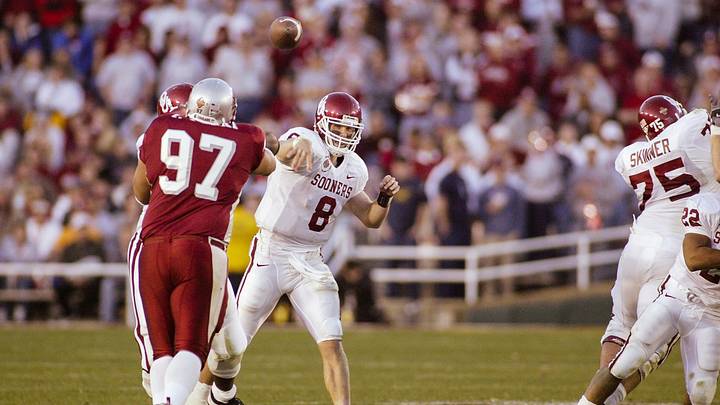
Nate Hybl was faced with a third-and-5. To that point, the second-year starter at quarterback had been all but perfect on third down, but the 12th Man was beginning to make their presence felt.
“We were in the same spot (back in 2000),” Hybl told Sooners On SI, recalling OU’s Sooner Magic moment of their national championship season.
There would be no Torrance Marshall play to save the Sooners that day, but there would be something just as important: a quarterback who had learned how to make plays in exactly these moments following a season of struggle.

Hybl identified cover zero in the Aggie defense, meaning the deep-boundary was going to be open should his guy beat the defender off the snap. That man was Curtis Fagan, and Hybl gestured towards the senior wide receiver, signaling to him to run deep.
The ball is snapped, and a quick three-step drop ensues. From there, Hybl already knew Fagan had beaten the cornerback Terrence Kiel. All he had to do was let it fly — something Hybl was supremely confident in.
“Sit down.”
He watched as his dime fell right into the hands of Fagan, who then sprinted 68 yards for the score that leveled the score at 20. Surrounded by 84,000 stunned and silenced Aggie fans, Hybl — a player not typically known for theatrics — savored the feeling.
“That was one of the sweetest moments,” Hybl said, “to make that play on the road and make them all sit down."
“The swag that comes with being in hostile environments helps grow your confidence.”
Going through finding some of the more visually impressive throws I can remember.
— Brady Trantham (@BradyDoesSports) August 10, 2026
Nate Hybl's throw to Curtis Fagan to tie the game at Kyle Field was pure awesome. Tied the game in a big environment. OU lost, but Reggie McNeal's out of body game had something to do with that. pic.twitter.com/WvbdtTXtws
That specific sequence, executed within such a hostile atmosphere with those stakes, simply wasn’t happening back in 2001. During his inaugural campaign as QB1 for Oklahoma, Hybl possessed the raw arm strength, but the confidence wasn’t there yet. He was immature, not off the field, but green to the pressure that comes with being the field captain of a blue blood. He needed experience, both good and bad.
After losing the starting spot again going into 2002, only to gain it back barely two games into the season, Hybl didn’t just have experience; he had a sense of freedom. It was a freedom that could come only from struggle. That freedom would serve him well.
In 2002, he showed the kind of second-year jump that Sooner quarterbacks must make. The result was a freer, more instinctive quarterback than the one who led the charge in his first year as the guy.
“In that moment, I was comfortable in the uncomfortable, and made the defense pay,” Hybl said.
Answering the Challenge Takes Time

Nate Hybl considers himself an overthinker, someone who reads between the lines of life’s events. That tendency shaped his first visit to Norman when he committed to the Sooners in 1999 and continues to inform his work as the founder of gusto!, an Atlanta-based fast-casual restaurant company.
It showed up starkly in 2001. Two weeks after then-No. 1 Oklahoma’s 20-game winning streak ended against Nebraska, Jason White’s season-ending ACL tear thrust Hybl back into the starting role, with the Sooners’ title hopes once again resting on his arm.
Bob Stoops knew his quarterback needed a nudge. Following a walk-through before a Week 11 matchup with Texas A&M, he asked Hybl to stay behind in the empty stadium.

“He rarely did this. He asked me to stay behind and sit in the front row of the empty stadium,” Hybl recalled. “He looked me in the eye and was encouraging me to not be afraid to be great. Don’t get in your own way. That was what I took away from it.”
Hybl saw the meeting as his coach trying to “unlock” him. Coming out of high school, he had run a Wing-T offense for his father. His long release and big arm were more naturally suited for a pro-style attack. At Oklahoma, he was learning the air raid on the fly, navigating a season with a suddenly small margin for error.
“When (Stoops) saw that I let it rip, I could play as well as anybody. Your challenge is potentially overthinking. Just let it rip," he said.
So Hybl tried. The payoff, though, was delayed.
The next day against Texas A&M, Oklahoma’s offense sputtered out of the gate. By the end of the first quarter, the Sooners trailed 10–0 after a Hybl interception that was fumbled and returned for a touchdown.
That was enough. From that point, he had one of his better performances of the season, going 22-of-31 with two passing touchdowns and a rushing score the rest of the way in a 31–10 win.
But as Hybl would tell you, he and the team still failed to meet their expectations. Two weeks later, with a trip to the Big 12 Championship and a potential national championship on the line, Oklahoma fell to Oklahoma State.

Improvement, at times, can be messy. It’s not always linear. Players can identify their flaws and work to correct them in the moment, but oftentimes the fruits of their labor don’t immediately manifest.
For Hybl, the real payoff from that conversation with Stoops didn’t show up the next week, or even a few games later. It came in the quiet work between seasons. He admitted that in 2001 that he “didn’t have the mindset to get the ball in my playmaker’s hands...
"I was trying to be a quarterback doing what his coaches said, ‘Go through reads one, two and three,’ instead of knowing Antwone Savage needs the ball, Mark Clayton needs the ball, give the ball to Quentin Griffin," he said.
By the time the next fall rolled around, the quarterback who’d been told to stop overthinking wasn’t suddenly perfect — he was just more comfortable being himself on the field. That’s how it usually works for players who recognize their flaws. The fix starts immediately, but the results often don’t fully materialize until the next season.
“The change came from confidence that comes from experience during wartime,” Hybl said. “As long as you keep your chin up and take the high road, you’re going to do better. I was pissed off. Nobody wants to be the damn bag that gets punched for six months. Part of it was confidence as I was moving away from being raw. Being drug through the mud a bit, wanting to be a leader.”
Past Meets Present

John Mateer and Nate Hybl are very different quarterbacks. Their play styles and outward demeanor lie on opposite ends of the spectrum. The list of similarities between the two is obvious — former Sooner quarterbacks and players who struggled in their first season as the starter.
Oklahoma fans may hope that list grows to three by the end of 2026 — a second-year leap that turns early struggles into comfort and consistency. The internal and on-field battles Hybl faced in 2001 produced a much more poised player by 2002. That’s where Mateer hopes to find himself.
“He doesn’t strike me as someone who was fearful, but confident and full of swag,” Hybl said of Mateer. “More on the aggressive side.”
Mateer’s attitude is infectious. He’s easy to root for. But two weeks after an awful performance in the Cotton Bowl against Texas, Mateer had to look at himself as similar to the man who held his position 24 years earlier when his coach sat him down for a chat in an empty stadium.
“When you have a game like that, you have to revisit where you come from,” Mateer said the week of the Ole Miss game. “I just realized that I could trust these guys around me. I have a control problem. It’s probably my personality. It’s not because I don’t believe in anyone. Trusting everybody and letting the game come to me — that’s something when I was younger I got away from.”
Mateer was the best player on his team at Little Elm High School. He was the key to Washington State’s success in 2024 during his first year as a starter. When he came to Oklahoma, he was suddenly around a level of talent he had never played with — yet the do-it-all, everything-rests-on-my-shoulders mentality remained.
After his injury in 2025, his consistency and level of play dipped drastically. Mateer’s acknowledgment of his own flaws paved the way for improvement, but just like with the former Sooner quarterback who was told to get out of his own way and simply let it rip, his improvement was not immediate.
“Mateer is already a guy who knows how to let it rip,” Hybl said. “I think that Brent Venables and the offensive staff have been working on how to unlock the best version of John.”
Even from afar, Hybl understands some of what Mateer has probably gone through.

“He’s proven resilient and tough, especially in the SEC. John has a unique opportunity. He should be the most comfortable he’s ever been despite the expectations. That’s my prayer for him," Hybl said.
That wasn't the case for Hybl at OU. During the 2002 offseason, the coaching staff chose not to alter Hybl’s throwing motion, instead trusting the longer, natural release that he had developed on his own.
"I remember Coach (Chuck) Long coming in and bringing it up," Hybl recalled. "He's a former big-time quarterback, former NFL player. He knew I was long, but it was gonna be too invasive to start messing with mechanics at that moment.
"So I vividly remember him saying, 'We're gonna roll with this,' and it wasn't until later that I realized that I actually had a quicker release in me and it made me a better quarterback in hindsight. I would've loved to have gotten there sooner."

Hybl found his quicker release in the pros. But his wish to have improved his mechanics earlier is rooted in his desire to have helped the team achieve more success rather than any individual glory. It now allows him a nuanced perspective on the amount of self-study and work Mateer has gone through during this offseason.
"I really applaud John and the staff for diving in and working on tweaks. It's risky and scary but I gotta think it'll pay off for John this year," Hybl said. “I love the fact that he’s demonstrated a growth mindset and is willing to be uncomfortable."
Timeless Trajectories

Nate Hybl waves off the comparison between himself and John Mateer, deflecting praise and redirecting it toward the team. Still, if Mateer traces a similar second-year arc in 2026, the payoff for Oklahoma could be huge.
“I don’t think many people are hoping John Mateer becomes Nate Hybl. Maybe they want him to be more Baker Mayfield or Kyler Murray,” he said. “Trajectories of growth are timeless, despite personalities. There is a reasonable expectation that Mateer will be much better this season.”
Both quarterbacks struggled — for some similar and some different reasons — in their first year as Oklahoma’s starter. While Mateer’s second season is yet to be written, Hybl’s jump in efficiency and production was apparent: going from a 14–13 touchdown-to-interception ratio in 2001 to 24–8 in 2002.
Quarterback | Year | Touchdowns | INTs | Comp. % | Yards |
|---|---|---|---|---|---|
Nate Hybl | 2001 | 14 | 13 | 58.4 | 2234 |
John Mateer | 2025 | 14 | 11 | 62.2 | 2885 |
Hybl and Mateer each ended their first seasons as Oklahoma’s quarterback less successfully than they would have preferred. Both campaigns were shaped by early injuries.
“For an OU quarterback, there is a little bit of tension between playing within the system and being special, or elite," Hybl said. "To be a pop culture star. Success is not guaranteed, but it’s afforded to you for being the QB at one of the more badass schools in the country.”
Hybl’s growth took time. He knew his flaws in 2001, but the rewards didn’t show up until a year later.
He understands that Mateer likely experienced some culture shock at Oklahoma while navigating the starting quarterback role — and all the highs and lows that come with it. Hybl described the “switch” that some of the great ones, like Mayfield or Murray, could seemingly flip on.
“Really rare one-percenters can do that. But OU fans get the feeling that Mateer has the moxie and the panache of a Mayfield to show up in big games," Hybl said.
How you show up in big games is largely how you’re remembered at a place like Oklahoma.
For Hybl, his improvements from Year 1 to Year 2 helped him make big plays when OU needed them — on the road at Kyle Field and in the Big 12 Championship against Colorado. His final game was his finest: an MVP performance in a Rose Bowl win over Washington State, the program’s first and only victory in the “Granddaddy of Them All.”
Quarterback | Year | Touchdowns | INTs | Comp. % | Yards |
|---|---|---|---|---|---|
Nate Hybl | 2002 | 24 | 8 | 57.6 | 2538 |
Not a bad swan song. But how will Mateer’s final season go? Hybl is confident that the growth mindset he has seen from afar will set him up for a similar second-year jump.
“They don’t have to score 60 (like Mayfield and Murray had to),” Hybl said. “And it doesn’t mean (Mateer) has to only play within the system. It’s more about him being comfortable and him playing a part within the comprehensive team effort in all phases.”
With his struggles in 2025 and the growth mindset Hybl praised, can Mateer make big plays on the road at Ann Arbor? Or Athens? In the Cotton Bowl?
It’s happened before. Players can improve. Sometimes it just takes a rocky road and an offseason of reflection and work to get there. Hybl had that background and came out stronger on the opposite side.
Maybe Mateer can, too.
Sign up to our free newsletter and follow us on Facebook and X for the latest news.
 Add us as a preferred source on Google
Brady Trantham covered the Oklahoma City Thunder as the lead Thunder Insider from 2018 until 2021 for 107.7 The Franchise. During that time, Trantham also helped the station as a fill-in guest personality and co-hosted Oklahoma Sooner postgame shows. Trantham also covered the Thunder for the Norman Transcript and The Oklahoman on a freelance basis. He received his BA in history from the University of Oklahoma in 2014 and a BS in Sports Casting from Full Sail University in 2023. Trantham also founded and hosts the “Through the Keyhole” podcast, covering Oklahoma Sooners football. He was born in Oklahoma and raised as an Air Force brat all over the world before returning to Norman and setting down roots there.