
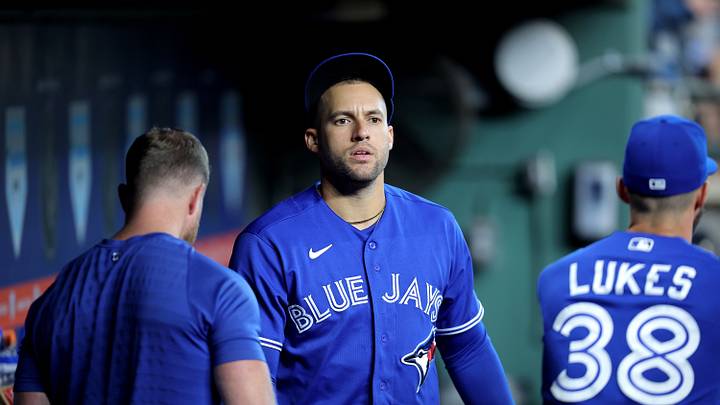
Blue Jays' George Springer Is Reviving His Season, But 2025 Form Is Still Far Away
In this story:
For years, George Springer’s greatest strength was turning pitches on the inner half into towering home runs. When a pitcher tried to beat him with velocity above his hands, Springer answered with a whip in his arms that sent the ball soaring into left field. Today, the same pitches that once fueled his power have become the source of his inconsistency at the plate.
Springer’s decline is not the result of a slump or a lack of focus. Opposing pitchers have lost their respect for his bat because they discovered his secret: they no longer need to throw a blazing 99-mph fastball to beat him. All it takes is a routine sinker at his hands to leave him without an answer.
The radar evidence exposes the root of the problem. After losing just one mile per hour in hand-speed acceleration against the four-seam fastball — dropping from 74.5 to 73.5 mph — Springer’s reaction time fell out of sync. That slight loss of speed reduced his explosive swings from 47.1% to 39.4%. In a game decided by milliseconds, falling behind on the inner edge completely stripped away his ability to dominate the strike zone.
Once pitchers realized Springer’s bat was arriving late against velocity, the league shifted its attack directly toward his body. Pitchers began crowding him with sinkers, causing his batting average against the pitch to collapse to .192 and the authority of his contact to disappear. To avoid being exposed by fast pitches, the veteran made the most dangerous adjustment of all: starting his move blindly, committing before the ball had even left the pitcher’s hand.
The Breakdown of His Swing and the Summer Revival

Statistics are all credited to Baseball Savant.
That need to anticipate contact destroyed the mechanics that had sustained his career. To get to the fastball on time, Springer began opening his front shoulder too early, causing his solid-contact rate against the pitch to fall from 23.0% to 18.3% and cutting his peak-impact metric, Blast%, almost in half, from 15.1% to 8.3%.
However, the season had an entirely different turn waiting for him after the calendar crossed its midpoint. Following a disastrous first stretch — when his production sank to a mediocre 92 wRC+ and strikeouts were alarmingly outnumbering walks — the veteran found a way to survive through intelligence. After the All-Star break, his plate discipline changed completely: he nearly cut his strikeout rate in half and doubled his walk rate. That adjustment has sparked a notable resurgence, lifting his OPS to a respectable .838 and pushing his wRC+ to a bright 138, briefly bringing back memories of the star outfielder he once was.
George Springer changed after the All-Star break.
— Yirsandy Rodríguez (@Yirsandy) August 11, 2026
He went from a .677 OPS and 92 wRC+ to .838 and 138.
The biggest change? His strikeout rate: 20.1% before the break, 11.8% after.
He didn’t get his 2025 bat back. He bought himself time to make better decisions. pic.twitter.com/i8h5RQqOgK
Even with that summer revival, opposing pitchers never backed away from the trap on the outer part of the plate. Knowing the veteran had to protect himself from inside velocity at all costs, opposing attacks continued to hammer him with breaking pitches away, limiting the authority of his deep contact and leaving his effectiveness against the slider at a negligible 3.9% rate of hard-hit balls.

The game does not forgive the silent erosion of physical tools. Radar readings and adjustments in patience can provide a remarkable second wind, but the field demands that the reflexes remain intact. All it takes is for the whip in a hitter’s arms to lose a single mile per hour for him to have to rely more heavily on guile and a trained eye, forced to survive in a matchup where the margin for error no longer belongs to him.
For the Blue Jays, the resurgence comes at a particular moment. Springer’s contract expires at the end of this season, and his name has already surfaced in conversations about a potential trade before the deadline. He now has a few months to show that this second wind can become something more than a temporary recovery — and give Toronto a reason to keep counting on him.
 Add us as a preferred source on Google
Yirsandy is a baseball writer specializing in MLB coverage with experience across multiple teams and storylines. He currently writes for Diamond Centric, where he covers the New York Mets, San Diego Padres, Chicago Cubs, Milwaukee Brewers, and Kansas City Royals. My work focuses on game coverage, player analysis, and storytelling that connects performance with context. My Substack has also been an important part of my writing development, where I’ve built much of my baseball coverage and storytelling voice over time. I’m passionate about combining reporting, research, and thoughtful analysis to produce engaging baseball content for readers.
Follow Yirsandy