%20%20--%3E%0A%3Csvg%20version%3D%221.1%22%20id%3D%22Layer_1%22%20xmlns%3D%22http%3A%2F%2Fwww.w3.org%2F2000%2Fsvg%22%20xmlns%3Axlink%3D%22http%3A%2F%2Fwww.w3.org%2F1999%2Fxlink%22%20x%3D%220px%22%20y%3D%220px%22%0A%09%20width%3D%2239px%22%20height%3D%2240px%22%20viewBox%3D%220%200%2039%2040%22%20enable-background%3D%22new%200%200%2039%2040%22%20xml%3Aspace%3D%22preserve%22%3E%0A%3Cpath%20fill%3D%22%23FFFFFF%22%20d%3D%22M38.5%2C7H28.2v26h10.3V7z%22%2F%3E%0A%3Cpath%20fill-rule%3D%22evenodd%22%20clip-rule%3D%22evenodd%22%20fill%3D%22%23FFFFFF%22%20d%3D%22M26.1%2C25.5c0%2C5.8-4.1%2C7.5-12.9%2C7.5C3.9%2C33%2C0%2C31.2%2C0%2C25.2v-1.1h11.6%0A%09v2.4c0%2C0.7%2C0.1%2C1.4%2C1.2%2C1.4c1%2C0%2C1.2-0.4%2C1.2-1.3v-0.9c0-1.6-0.9-1.6-3.5-2.2C2.2%2C21.7%2C0%2C19.7%2C0%2C15.3v-0.9C0%2C9.3%2C5.5%2C7%2C12.9%2C7%0A%09c10.2%2C0%2C12.8%2C2.6%2C12.8%2C7.4v1.8h-11v-2.9c0-0.6-0.4-1.1-1.2-1.1c-0.6%2C0-1.2%2C0.4-1.2%2C1.1v0.9c0%2C1.5%2C0.9%2C2%2C3.3%2C2.5%0A%09c8%2C1.6%2C10.5%2C3.3%2C10.5%2C7.5V25.5z%22%2F%3E%0A%3C%2Fsvg%3E%0A)
Tom Verducci’s Top 10 Truths to Expect This MLB Postseason
In this story:
This article is a part of Verducci’s View, a new weekly baseball newsletter from Sports Illustrated senior writer Tom Verducci. Every Monday, Tom empties out his notebook over email and covers MLB’s hottest topics, provides in-depth analysis through both text and video breakdowns, looks forward to what’s worth watching during the week and more.
The postseason is here, which means we have all this data from 2,460 regular season games and we know nothing. The postseason runs on its own energy and its own rules of engagement.
Take last postseason as an example. The Blue Jays, who ranked 19th in ERA, rumbled all the way to taking a lead to the bottom of the ninth in World Series Game 7, getting there with the help of a pitcher who began the year in A ball (Trey Yesavage). And then Miguel Rojas hit a home run, his first all year off an actual right-handed pitcher. (He hit one off a position player).
The baseball postseason never disappoints because the comforting grace of 162 games dies at the urgency of best-of-three, -five and -seven game series. And it never fails to surprise us.
The nature of the postseason can make predictions even more guesswork than usual. But there are characteristics about postseason play you can count on. Here are the top 10 truths about what to expect this postseason:
1. Don’t overthink it. Game 1 is huge in a three-game series.
In the three seasons with best-of-three wild-card series, the team that wins Game 1 wins the series 11 of 12 times. The only exception was the Yankees bouncing back to take out the Red Sox last year.
2. Home field matters—slightly.
People like to downplay the advantage of playing at home in baseball compared to other sports, especially after the 2023 postseason when home teams went 15–26. Don’t be fooled. You’d much rather be playing at home, even if the edge is very small. The postseason can swing on small edges. And the boost goes up with a chance to close out a series.
Home teams this season had a .528 winning percentage. Over the past 10 postseasons (excluding 2020), their win percentage is .536. But when a potential clincher is in play, their win percentage goes up to .573.
Here are the winning percentages over the past decade for home teams in the regular season, in the postseason and potential clinchers. You see dips and rises in the postseason win percentage because the sample size isn’t big enough. But over time, and especially in big games recently, home field has some meaning.

3. Craig Stammen of the Padres will be the most aggressive manager.

Stammen, the rookie manager, knows the strength of the team is the depth of its bullpen. The starters? Eh. Only the White Sox, Nationals and Blue Jays got fewer innings out of their starters.
Third time around is bullpen time for Stammen—or even earlier in the wild-card round. The back-end combo of Adrian Morejon and Mason Miller can get nine outs with lots of swing and miss. San Diego’s endgame has the highest average velocity of any team in recorded history—by far.
Highest Fastball Velocity, Innings 8 and 9, MLB 2008-2026
Team | FB Velocity (mph) |
|---|---|
1. 2026 Padres | 97.4 |
2. 2026 Phillies | 96.7 |
3. 2023 Orioles | 96.6 |
4. 2026 Brewers | 96.5 |
4. 2023 Phillies | 96.5 |
4. 2025 Rockies | 96.5 |
4. And yet the Padres do not have the best bullpen.
That honor goes to the Milwaukee Brewers.
The Milwaukee pen, chock full of platoon-neutral guys who can throw a hundred, ranks first in wins, second in slugging allowed, second in OPS+ and third in ERA. They just don’t let wins get away and they win bullpen games (48–23).
Postseason Bullpen Rankings
1. Brewers
2. Padres
3. Red Sox
4. Braves
5. Guardians
5. Teams will be more careful with their ABS challenges.
This is a historic postseason: the first in which players can overturn ball-strike calls by umpires using technology. Teams get two unsuccessful challenges per game, plus one in each extra inning. Managers must remind their players not to burn challenges early in the game on borderline pitches in low-leverage counts.
For teams to get to the late innings of a postseason game without a challenge will be considered a strategic failure. It’s a new level of accountability in the cauldron of October: woe to the player who wastes a challenge early and leaves his teammates without remedy in a crucial spot. It’s the postmodern error.
These are the players who need to be reined on because of their propensity for poor challenges: Ceddanne Rafaela of Boston (25% success rate), Matt Olson of Atlanta and Garrett Mitchell of Milwaukee (30%), Michael Harris II of Atlanta (33%), Michael Busch of the Cubs (35%) and Manny Machado of San Diego and Jazz Chisholm Jr. of the Yankees (36%).
6. The Dodgers win close, low-scoring games that define October.
Yes, they look vulnerable at times, but the Los Angeles Dodgers are a playoff-proven team with star players who come through in big spots. With the likes of Mookie Betts, Shohei Ohtani, Freddie Freeman and Will Smith, the Dodgers are like the Yankees of the late 1990s: they are full of big-time playmakers who deliver in the postseason. And, like those Yankees teams, they send an ace-quality starter to the mound every night, so they don’t let games get away early. It’s a winning combination: starters with length and great situational hitters.
The small ball of the Rays and Brewers is impressive. But it’s the Dodgers who found ways to win more games with four runs or less than any other team.
Most Wins Scoring 4 Runs or Less, 2026
Team | Record | Win Pct. |
|---|---|---|
1. Dodgers | 39–52 | .429 |
2. Rays | 38–41 | .481 |
3. Brewers | 34–49 | .410 |
4. Braves | 33–54 | .379 |
5. Guardians | 33–63 | .344 |
This is what they do. Over the last two postseasons the Dodgers have a winning record with no more than four runs (8–7). How impressive is that? The rest of baseball wins only 26% of the time with so few runs.
Postseason Games Scoring 4 Runs or Less
Year | Dodgers W–L | Dodgers Win% | All Others W–L | All Others Win% |
|---|---|---|---|---|
2025 | 5–4 | 55.6% | 14–39 | 26.4% |
2024 | 3–3 | 50% | 11–31 | 26.2% |
Totals | 8–7 | 53.3% | 25–70 | 26.3% |

7. The Guardians will keep games close.
Cleveland manager Steven Vogt does a masterful job running games. He has a Mariano Rivera-like weapon in lockdown closer Cade Smith, who is so efficient he can get five-out saves on back-to-back days.
The Cleveland bullpen is underrated. It led the majors with 10.2 strikeouts per nine innings while posting a 3.54 ERA. Only seven previous teams had a bullpen with those numbers. Five of them reached at least the LCS.
Lowest ERA for Bullpens with SO/9 of 10.2 or Better
Team | Bullpen ERA | Result |
|---|---|---|
1. 2022 Astros | 2.80 | Won WS |
2. 2018 Astros | 3.03 | Lost ALCS |
3. 2017 Yankees | 3.34 | Lost ALCS |
4. 2018 Yankees | 3.38 | Lost ALDS |
4. 2017 Dodgers | 3.38 | Lost WS |
6. 2018 Brewers | 3.47 | Lost NLCS |
7. 2018 Padres | 3.53 | Missed playoffs |
8. 2026 Guardians | 3.54 | ? |
8. The home run is the coin of the postseason realm.
You probably know I’ve been on this for years: as hits grow more difficult in the postseason, the ability to change the score with one swing becomes more important. The past six World Series winners have finished in the top four in MLB in home runs. That’s good news for the Astros, Yankees and Cubs, who finished 1-2-3.
Home Runs by World Series Winner, 2020-25
Team | HR | MLB Rank |
|---|---|---|
2025 Dodgers | 244 | 2 |
2024 Dodgers | 233 | 3 |
2023 Rangers | 233 | 3 |
2022 Astros | 214 | 4 |
2021 Braves | 239 | 3 |
2020 Dodgers | 118 | 1 |
The World Series last year was decided by home runs: the game-tying home run by Rojas in the ninth and the game-deciding home run by Smith in the 11th.
The home run rate last year in the postseason was higher than what it was in the regular season, 1.20–1.16 per team game.
That doesn’t mean a team without elite home run power can ‘t win the World Series. It means it will take extraordinarily clean baseball for a team to break this trend and become the first World Series winner with less than 199 home runs in a full season since the 2015 Royals.
What does it take to win a World Series without home run power? Those 2015 Royals hit an incredible .349 that postseason with runners in scoring position.
Highest Postseason RISP, 2008-2025 (Min. 50 AB)
Team | Postseason RISP | Result |
|---|---|---|
1. 2018 Red Sox | .364 | Won WS |
2. 2015 Royals | .349 | Won WS |
3. 2009 Phillies | .327 | Lost WS |
4. 2025 Yankees | .315 | Lost ALDS |
5. 2008 Rays | .301 | Lost WS |
9. Walks go up.
I have chronicled how fastball use continues to hit all-time lows as the foundations of modern pitching are the three S’s: shaping, sequencing and spin. Pitchers are taught to work away from slug and seek chase swings and misses. In this way of thinking, walks are not the bugaboo they used to be.
This philosophy of “Don’t give in; I’d rather walk this guy and get a fresh count” is even more ingrained in the postseason. Last year the walk rate rose from 3.16 per team game in the regular season to 3.48 in the postseason. It will be even higher this postseason because of ABS.
And for the 10th postseason truth, our breakdown of the week.
📺 Breakdown of the Week
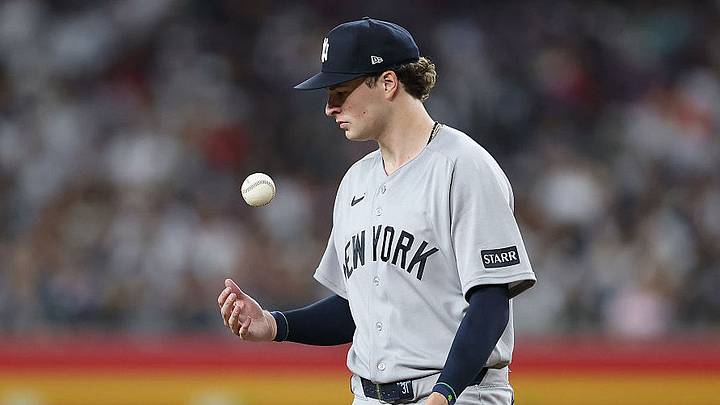
10. No one will live on the top rail of the strike zone more than Yankees righthander Cam Schlittler.
Highest Average Pitch Height, 2026 (Min. 1,000 pitches)
Pitcher | Avg. Pitch Height |
|---|---|
1. Cam Schlittler, Yankees | 2.71 |
2. Payton Tolle, Red Sox | 2.55 |
3. Jacob Misiorowski, Brewers | 2.54 |
If you just include Schlitter’s heavy arsenal of fastballs (four-seam, sinker and cutter), the numbers are even more impressive. His average fastball height is 2.86 feet off the ground, which generally equates to a smidgen under the top rail of the strike zone. Nobody in baseball is close to him when it comes to elevated heaters:
Most Top-Rail Fastballs, 2026 (2.86’ and higher)
Pitcher | Amount | Pct. | BA |
|---|---|---|---|
1. Cam Schlittler, Yankees | 1,357 | 44.6% | .123 |
2. Jacob Misiorowski, Brewers | 866 | 33.6% | .121 |
3. Sean Burke, White Sox | 837 | 29.1% | .321 |
If the Red Sox are going to touch up Schlittler, who owns them, they are going to have to win the battle at the top of the strike zone. Including his wild-card gem last year, Schlittler in his career against his hometown team is 3–1 with a 0.56 ERA, nine walks and 39 strikeouts in 32 1/3 innings.
It’s a bad matchup for Boston, which ranked 22nd hitting against elevated fastballs (.199). This breakdown shows you how Schlittler has dominated Wilyer Abreu the same way repeatedly. There is not much mystery to where Schlittler pitches Abreu:

But as you will see in the breakdown, last month Abreu finally made an adjustment on one of those high heaters from Schlittler and ripped a double. Will it carry over into their wild-card matchup?
 Add us as a preferred source on Google
Tom Verducci is a senior writer for Sports Illustrated who has covered Major League Baseball since 1981. He also serves as an analyst for FOX Sports and the MLB Network; is a New York Times best-selling author; and cohosts The Book of Joe podcast with Joe Maddon. A five-time Emmy Award winner across three categories (studio analyst, reporter, short form writing) and nominated in a fourth (game analyst), he is a three-time National Sportswriter of the Year winner, two-time National Magazine Award finalist, and a Penn State Distinguished Alumnus Award recipient. Verducci is a member of the National Sports Media Hall of Fame, Baseball Writers Association of America (including past New York chapter chairman) and a Baseball Hall of Fame voter since 1993. He also is the only writer to be a game analyst for World Series telecasts. He lives in New Jersey with his wife, with whom he has two children.