
How the Magic Contain Anthony Edwards & LaMelo Ball
In this story:
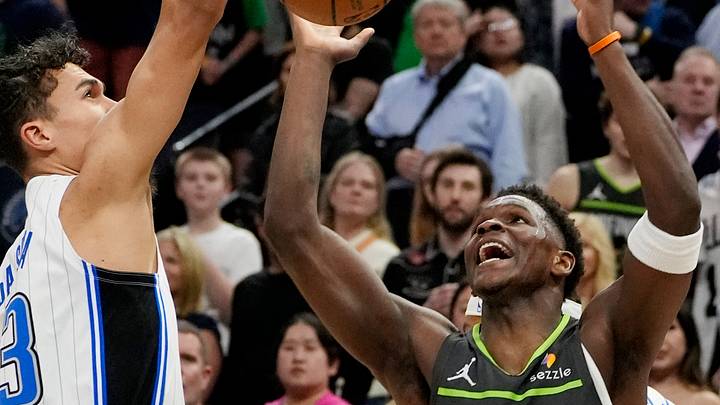
Fresh off a season-opening loss at home, Orlando looks to bounce back with the Minnesota Timberwolves in town.
Minnesota rolls in fresh off blowing out the Heat in Miami, with the team averaging a league-high 50 three-point attempts through the its first two games.
That leaves us with a handful of questions that will only be answered tonight on the hardwood:
What strengths did Orlando show in Game 1 that they can lean on in Game 2?
How can Sean Sweeney's Magic adjust the gameplan to deter Minnesota's 3-ball?
How should the magic attack Rudy Gobert, Minnesota's defensive anchor putting a lid on the rim down low, where Orlando usually likes to attack?
3 Keys to Magic Win vs Timberwolves

1. Attack the Paint, even with Gobert waiting
Let's say this once and get it out of the way – all stats listed in this article are a small sample size; it's only been 1 or 2 games from each team. With that said, can we learn anything about the style of play these teams want to run from that small sample? Let's dig into the numbers.
Orlando rated highly in a handful of offensive playtypes and actions in Game 1, where they all mostly revolved around one thing – the drive and kick.
Orlando splashed 1.12 PPP on 34 Spot Up possessions against the Atlanta Hawks on opening night.
The Magic drove the ball 44 times, which would be the 3rd-most of any team by average, while scoring 23 PTS and racking up 12 FTA off those Drives, which would be the most of any team by average.
What's key is Orlando also passed the ball on 52.3% of their drives, ranking 5th in that drive-and-kick rate, with only 1 turnover on all those possessions, the 5th-best rate.
On top of that, in halfcourt pick-and-rolls including passes, the team created 0.96 PPP on 47 possessions, compared toe P&R scoring without passes which scored 0.5 PPP on 26 possessions.
The Magic creating a sustainable drive-and-kick machine is how they generated their most efficient shots at the rim, at the line, and from deep against the Hawks, laying out a plan of attack for this offense going forward that should create good looks against just about any opponent.
Orlando must force the Timberwolves' defense into rotations, create good looks from deep and at the rim while drawing fouls out of drives and pick-and-roll. Even with Gobert down low, if Orlando can drive-and-kick enough within the 24-second shot clock, they might draw Gobert just far enough away from the rim to create the angle they need for Paolo Banchero to hit a short middy or draw a foul, Franz Wagner to touch in a floater, or Desmond Bane to sneak in a bump-and-finish finger roll.
2. Deter Ant & LaMelo 3pt Shooting
One way to keep up with the Timberwolves' onslaught of 3pt shooting is ball denial, screen navigation, and getting up under the jersey of Minnesota's best players – pressure the ball, rotate hard, run the open shooter off his spot, and then get back in position to do it again.
While it's just two outings in the regular season, Minnesota has clearly bought into the directive of getting threes up from its starting backcourt and asking questions later. Ball is launching a light thirteen threes per game on an impressive 38.5% 3P% rate, while Edwards has somehow pushed the envelope even higher into volcanic lava territory, launching a staggering seventeen three-pointers per game, while somehow being even more efficient than Ball on that volume, splashing 53% 3P%!
Obviously, these two guards might see those numbers fluctuate throughout the season, but they are both 3pt snipers in their own way. Ball being more of a super connective playmaker and ever-rescreening handoff extraordinaire; Edwards playing a role closer to tough shot-making assassin looking to pull-up in your face or dunk on your head on any given play.
Edwards is scoring 1.3 PPP in ISO, the 100th percentile by-far best in the league, compared to just scoring 0.9 PPP as P&R Ball-Handler and creating 0.8 PPP in P&R including passes. On the contrary, Ball is thriving as Minnesota's P&R Ball-Handler whether he's scoring or passing; denying both from the start with heavy ball pressure throughout could be key. Orlando can't risk doubling either star because the ball will find an open man or work its way back to the other star, but they do have the personnel to switch heavy, rotate hard, and contest everything.
Between Orlando's versatile defense spearheaded by Franz Wagner, Jalen Suggs, and Wendell Carter Jr., the Magic can look to swarm the ball-handler at all times, deny the star scoring guard off ball at all times, switch practically everything, and always be closing out hard, especially on those two. While this idea could open up the drive-and-kick game for others, at least the Timberwolves' primary option is taken out.
As long as Orlando's team defense sustains those rotations, forcing a semi-contested shot from a role player will always be a better defensive possession than leaving a star scorer 3pt sniper even remotely open to create the way they want, allowing them to find a rhythm.
Cook @Josh_Cohen_NBA
— Ryan Kaminski NBA (@beyondtheRK) October 10, 2026
"I don't know if there's a player that has better endurance and conditioning than (Franz Wagner)
He never burns out...
He is a full force – relentless, persistent, never-ending... he plays both ends"
𝐋𝐞𝐚𝐫𝐧𝐢𝐧𝐠 𝐁𝐚𝐬𝐤𝐞𝐭𝐛𝐚𝐥𝐥 @SwishTheory pic.twitter.com/lPUHFSctL1
3. Stick to what worked offensively in Game 1 – Paolo, Franz, Bane, da Silva
Feed Point Wagner & Bullyball Banchero the ball to attack the paint at will while asking those barreling big wing stars to keep their head up on those drives looking for Bane & da Silva from deep.
Banchero did an incredible job in Game 1 of taking advantage of his advantage creation, often starting in efficient spots of the floor with the ball, making quick decisions to shoot, score, draw the foul, or fake-attack the rack into a jump-pass kickout to Bane.
Point Wagner has blossomed right before Magic fan's very eyes. One real improvement this season looks to be the combination of pristine spacing and positioning for everyone off ball while putting that ball in the hands of Wagner more often and letting him initiate more offense. This tends to put all of Orlando's key players in ideal positions to succeed, creating the initial advantage to get the defense moving and get the ball swinging to the open man or best shot for the team.
Bane and da Silva both launched exactly 10 threes in the first game, a beautiful sight to behold. Orlando finding a way to target 3pt shots for not just the open man, but creating a high volume of open shots for their best 3pt shooters, is a great path to improving the team's offensive efficiency.
Bane is a proven 3pt sniper in every situation, while da Silva has shown to knock down anything as an off-ball moving threat and in catch-and-shoot. Orlando driving through its strong forward stars and kicking specifically to these two shooters first and foremost outlines their path to success offensively; spending halfcourt plays distracting the defense with misdirection to help break one of these shooters free is another great plan of attack.
The Magic leaning even heavier on the drive-and-kick game through its best players in driving and shooting is their recipe to success, now it's up to the team's chefs to get to cookin'.
 Add us as a preferred source on Google

Ryan is a basketball scout data analyst who has been covering the Orlando Magic, NBA, and NBA Draft with a focus on roster building strategy, data analytics, film breakdowns, and player development since 2017. He is credentialed media for the Orlando Magic along with top high schools in Central Florida where he scouts talent in marquee matchups at Montverde Academy, IMG Academy, Oak Ridge, and the NBPA Top-100 Camp. He generates basketball data visualizations, formerly with The BBall Index. He has two B.A.s from Florida State University in Business Management and Business Marketing. Twitter/YouTube/Substack: @BeyondTheRK