%20%20--%3E%0A%3Csvg%20version%3D%221.1%22%20id%3D%22Layer_1%22%20xmlns%3D%22http%3A%2F%2Fwww.w3.org%2F2000%2Fsvg%22%20xmlns%3Axlink%3D%22http%3A%2F%2Fwww.w3.org%2F1999%2Fxlink%22%20x%3D%220px%22%20y%3D%220px%22%0A%09%20width%3D%2239px%22%20height%3D%2240px%22%20viewBox%3D%220%200%2039%2040%22%20enable-background%3D%22new%200%200%2039%2040%22%20xml%3Aspace%3D%22preserve%22%3E%0A%3Cpath%20fill%3D%22%23FFFFFF%22%20d%3D%22M38.5%2C7H28.2v26h10.3V7z%22%2F%3E%0A%3Cpath%20fill-rule%3D%22evenodd%22%20clip-rule%3D%22evenodd%22%20fill%3D%22%23FFFFFF%22%20d%3D%22M26.1%2C25.5c0%2C5.8-4.1%2C7.5-12.9%2C7.5C3.9%2C33%2C0%2C31.2%2C0%2C25.2v-1.1h11.6%0A%09v2.4c0%2C0.7%2C0.1%2C1.4%2C1.2%2C1.4c1%2C0%2C1.2-0.4%2C1.2-1.3v-0.9c0-1.6-0.9-1.6-3.5-2.2C2.2%2C21.7%2C0%2C19.7%2C0%2C15.3v-0.9C0%2C9.3%2C5.5%2C7%2C12.9%2C7%0A%09c10.2%2C0%2C12.8%2C2.6%2C12.8%2C7.4v1.8h-11v-2.9c0-0.6-0.4-1.1-1.2-1.1c-0.6%2C0-1.2%2C0.4-1.2%2C1.1v0.9c0%2C1.5%2C0.9%2C2%2C3.3%2C2.5%0A%09c8%2C1.6%2C10.5%2C3.3%2C10.5%2C7.5V25.5z%22%2F%3E%0A%3C%2Fsvg%3E%0A)
The Giants’ Trade for J.J. McCarthy Is a Galaxy Brain Move That Goes Too Far
In this story:
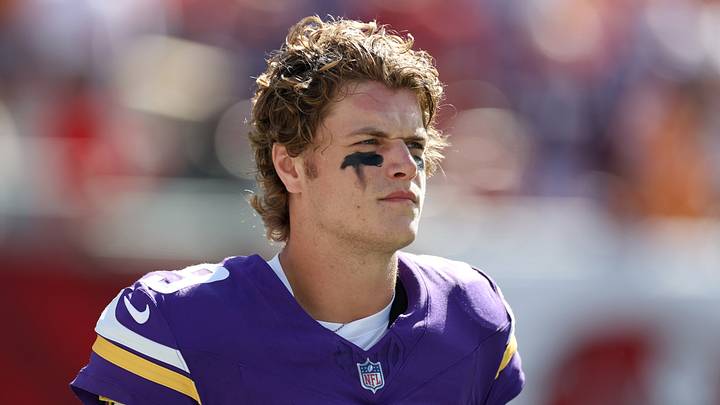
Welcome, welcome. Let’s do away with the niceties, put down our coats and get to the reason we’re all gathered here today: I’m not sure it’s possible to dislike a trade more than I dislike the one the Giants just swung with the Vikings for former first-round pick J.J. McCarthy. In an attempt to salvage the first season of the John Harbaugh era while sitting at 2–1, with upcoming games against the bottom-feeding Cardinals and Jayden Daniels–less Commanders, and with a glut of more capable veterans either enjoying early retirement or resting on a bench somewhere, the Giants have opted for the plan that brings the equivalent of a still-active World War II–era hand grenade into their locker room, knowing only that it will explode, just not when or for what reason.
Let’s take this clinically, ranking four aspects of this trade I abhor the most, from greatest to least.
1. The Jaxson Dart effect
In trading for a 23-year-old first-round pick, the Giants are wedging a thumb into the eye socket of their own 23-year-old first-round pick. Say what you will about Dart’s long-term prospects, but the kid wanted to reenter the game against the Rams after sustaining a season-ending knee injury. He is a gamer with a heart the size of an iPad. He has been nearly everything you’ve asked of him except durable. How is he going to feel when a quarterback with the same developmental timeline is added to the room, with one less year on his own rookie contract and an equal amount of pressure to prove himself before hitting the open market? If McCarthy eventually beats out Jameis Winston for the job—which, we’ll get to in a moment, but why would the team make the move if they didn’t feel McCarthy could beat out Winston for the job?—Dart’s confidence would understandably get hurled into the wood chipper. Adding to this, McCarthy was coached at Michigan by John Harbaugh’s brother, Jim. Jim had said repeatedly heading into the 2024 draft that McCarthy was the best quarterback, ahead of Caleb Williams, Jayden Daniels, Drake Maye, Michael Penix Jr. and Bo Nix. While this was obviously soaked in hyperbole, the typical job of the car salesman college football coach to prop up a member of his program, Dart has to wonder what Jim has shared privately with John about McCarthy and what piqued John’s interest in having a developmental prospect in the first place. There is no way this move doesn’t at least momentarily shake up the foundation on which Harbaugh and Dart’s relationship exists, no matter how much prior warning Dart received. How much will Dart enjoy his numbers being charted opposite McCarthy’s in training camp next summer? I think you know the answer.
2. The locker room impact
Entrusting your young players to a room led by Winston is a bit like all the parents who kept letting their schoolchildren attend class with Ms. Frizzle on the Magic School Bus. Every day could either be packed with innocent wonderment or a voyage so irresponsibly perilous that it could have resulted in the instantaneous disappearance of an entire grade à la Weapons. I’m not going to pretend that riding the Jameis-coaster is a palatable option, especially for a coach like Harbaugh, who prefers more predictable quarterback play. But we cannot also ignore the mounting evidence that McCarthy was an issue in the Vikings’ locker room. In this piece, from my friend Tyler Dunne at Go Long, teammates mention everything from McCarthy’s performative post-game mean mugging to the decision to insist on doing the Griddy after a touchdown, even though his head coach asked him not to, to the bizarre treatment of an injury that occurred after he checked himself out of a game. It paints a picture of someone who was not mature enough for the moment despite being allowed a year-long internship beside Sam Darnold and under the tutelage of Kevin O’Connell, one of the top coaches in the sport. McCarthy would also push back, as Dunne reports, on strategy that O’Connell had baked into the game plan.
The Giants’ locker room is already personality-maxxed. It is like a casting call for an ill-fated State Farm commercial franchise. Certainly, his first two seasons in the NFL could have been a valuable learning experience for McCarthy, which is what you’d assume Harbaugh is gambling on. But Justin Fields is only 27. Anthony Richardson Sr. is 24. Will Levis is sitting on the Jets’ practice squad. I suppose you can argue that the upside of any of those players is nowhere near as high as McCarthy’s, but neither is the cellar.

3. The galaxy brain-ification of the QB position
In the immediate aftermath, my guess is this trade will be praised because of the *whiffs a glass of farts* asset management. Quarterbacks on rookie contracts are incredibly valuable. It’s also true that teams that get drunk on this idea end up taking Dillon Gabriel in the third round and Shedeur Sanders in the fifth round, and wonder why their fan base has split itself in half like warring tribes of the pre-American Southwest.
It’s good to hoard and store valuable assets, so long as those assets can exist together constructively. The Packers will never get the full scope of credit they deserve for handling the eternally discontented and martyred Aaron Rodgers existing on the roster at the same time as Jordan Love. The Giants don’t have nearly the same experience level, with the most obvious example being the pre-Harbaugh transition from Eli Manning to Daniel Jones two games into Year 2 of the Pat Shurmur era. If you want to see a fan base that can get easily irritated, give them a glimpse of competent quarterback play and tinker with the idea of replacing that person. Ben McAdoo was sacrificed to the coaching gods for daring to think that Geno Smith had more remaining career upside than a near-retirement Manning, or that the Giants may want to think about taking a kid named Patrick Mahomes.
On its face, getting a quarterback with a 10% chance of materializing as a possible first-round talent for a fifth-round pick is a great deal. We can see every possible trade value chart and make this assessment clearly. But we are less inclined to overlay this with the cost of the experiment itself. In Cleveland, for example, even though Deshaun Watson is clearly better than Sanders, the team is constantly plagued by a fragment of the fan base that cannot accept the idea, which creates an environment that, when Watson isn’t playing well, is borderline unsustainable. We were one good Watson start against the Buccaneers away from a full-scale riot in Cleveland’s home opener on Sunday. You cannot live in fear of a fan base that, if it had been calling the shots, probably would have tried to hire Jon Gruden 30 times, install Bill Cowher as defensive coordinator and throw Joe Milton III under center for eight games. But you can save your team inevitable headaches as well.
4. Mixed messaging
The Giants have two very winnable games coming up against the Cardinals and Commanders. The only legitimate sample size Harbaugh got with Winston as the starter came amid a Nor’easter that flooded a large portion of the Jersey Shore. Out of all the Giants on the field on Sunday, Winston wasn’t in the top three of players who made dangerous decisions that could have possibly impacted the victory. The one thing Winston lacks that McCarthy has, as we mentioned, is upside. I’m curious what Malik Nabers and Cam Skattebo will think about the value of upside at the quarterback position—again, assuming the Giants eventually move from Winston to McCarthy—as both are hurtling toward respective contract years. Skattebo, who plays the game with the freewheeling nature of a bull riders’ association distraction clown, would see a drastic increase in eight-man boxes with McCarthy. Nabers, I’m sure, is looking at Justin Jefferson’s 10-game stat line with McCarthy under center in Minnesota: 4.4 catches and 54 receiving yards per game, about a 55% catch rate.
Why Harbaugh would make this trade
Now, let’s be fair to Harbaugh for a moment and understand his own personal ethos and reasoning for making this trade. I can picture Harbaugh reading this column and disliking it because we are fundamentally different people. Harbaugh will take information and ask why not, whereas someone like me might take a sampling of information and suggest we burn everything to the ground; that McCarthy is in the company of Paxton Lynch, Trey Lance and Johnny Manziel in terms of first-round picks who ended up starting precious few games before the team decided to cut bait. Harbaugh is a calculated optimist who has made a living out of bucking trends on both sides of the ball. The Ravens’ defensive structure he fostered in Baltimore is now a league-wide destroyer of quarterbacks and it notched another Super Bowl title last year in Seattle. The shift into a Lamar Jackson offense in 2018 to ’19 altered the behavior of countless NFL teams in its wake. When you consider this, trading for McCarthy and getting him up to speed as a serviceable quarterback in an RPO-heavy offense doesn’t feel ridiculous. Nor does the idea of getting McCarthy and Dart to like one another. Harbaugh took two established play-callers in Matt Nagy and Greg Roman, with no personal history or schematic common ground, and plunked them 20 inches apart in a coaches booth every Sunday. He believes in people growing together.
Similarly, I can see the Giants’ thought process if the next two games result in losses. At that point, they’d be 2–3 with both Eagles games, and matchups with the Lions, Seahawks, Cowboys, Jaguars, Colts and Texans left on the schedule. Would it not be better—even though Winston is technically signed through next season—to have a higher-upside backstop for Dart, who has missed time in each of his first two seasons?
That is the world Harbaugh chooses to live in. And, if the McCarthy trade is any indication, it is clearly Harbaugh’s world in East Rutherford. Everyone, including Dart, needs to get used to that.
 Add us as a preferred source on Google
Conor Orr is a Senior Writer for Sports Illustrated with more than 15 years of experience covering the NFL. His work has been cited in Best American Sportswriting and has won a PFWAA award. Prior to Sports Illustrated, he covered both the Giants and Jets for The Star-Ledger. Conor lives in New Jersey with his amazing wife and three children.
Follow author