%22%3E%0A%3Cpath%20fill-rule%3D%22evenodd%22%20clip-rule%3D%22evenodd%22%20d%3D%22M156.868%204.36764C162.691%20-1.45588%20172.132%20-1.45588%20177.956%204.36764C183.779%2010.1912%20183.779%2019.6324%20177.956%2025.4559L167.412%2036L156.868%2025.4559C151.044%2019.6324%20151.044%2010.1912%20156.868%204.36764ZM159.509%207.55761C159.448%207.86849%20159.416%208.39718%20159.416%209.14566V10.4189C159.416%2011.1832%20159.448%2011.7198%20159.513%2012.0267C159.578%2012.3317%20159.778%2012.6168%20160.117%2012.8762C160.456%2013.1376%20160.903%2013.3316%20161.458%2013.4623C162.012%2013.593%20162.6%2013.6584%20163.337%2013.6584C164.073%2013.6584%20164.717%2013.591%20165.269%2013.4524C165.822%2013.3158%20166.261%2013.1178%20166.586%2012.8604C166.911%2012.6029%20167.105%2012.3178%20167.166%2012.0069C167.228%2011.6961%20167.259%2011.1674%20167.259%2010.4189V9.14566C167.259%208.38134%20167.228%207.84473%20167.162%207.53781C167.097%207.23287%20166.897%206.94971%20166.558%206.68834C166.22%206.42696%20165.772%206.23291%20165.218%206.10223C164.663%205.97154%20164.036%205.90619%20163.339%205.90619C162.602%205.90619%20161.959%205.97352%20161.406%206.11213C160.852%206.24875%20160.414%206.44677%20160.089%206.70418C159.765%206.9616%20159.571%207.24673%20159.509%207.55761ZM164.776%2024.8638C168.376%2024.8638%20170.057%2024.2064%20170.057%2021.862V21.858V21.3155C170.057%2019.6581%20169.016%2018.971%20165.752%2018.3136C164.778%2018.1136%20164.408%2017.9136%20164.408%2017.3136V16.9414C164.408%2016.6543%20164.677%2016.5117%20164.913%2016.5117C165.249%2016.5117%20165.418%2016.7137%20165.418%2016.9414V18.1136H169.891V17.3988C169.891%2015.4563%20168.847%2014.4266%20164.677%2014.4266C161.65%2014.4266%20159.396%2015.3414%20159.396%2017.3711V17.7433C159.396%2019.5155%20160.305%2020.3155%20163.701%2021.0303C163.78%2021.0472%20163.855%2021.063%20163.927%2021.0781C164.829%2021.2674%20165.147%2021.3341%20165.147%2021.9174V22.2897C165.147%2022.6619%20165.046%2022.8045%20164.642%2022.8045C164.17%2022.8045%20164.137%2022.5471%20164.137%2022.262V21.2897H159.394V21.7471C159.394%2024.149%20160.976%2024.8638%20164.776%2024.8638ZM170.924%2024.5569H175.425V14.7355H170.924V24.5569ZM172.455%2013.5019H175.425V6.06064H172.592V9.411L170.693%206.06064H167.859V13.5019H170.693V10.1199L172.455%2013.5019ZM163.769%2012.152C163.704%2012.2688%20163.555%2012.3262%20163.325%2012.3262L163.327%2012.3282C163.104%2012.3282%20162.959%2012.2767%20162.898%2012.1758C162.836%2012.0748%20162.805%2011.8074%20162.805%2011.3758V7.90068C162.805%207.51852%20162.852%207.28684%20162.945%207.20962C163.038%207.13239%20163.175%207.09279%20163.351%207.09279C163.559%207.09279%20163.698%207.14031%20163.765%207.23734C163.832%207.33239%20163.866%207.55416%20163.866%207.90068V11.3203C163.866%2011.7579%20163.834%2012.0352%20163.769%2012.152Z%22%20fill%3D%22white%22%2F%3E%0A%3Cpath%20d%3D%22M134.707%2035.9991C129.823%2035.9991%20126.029%2035.0305%20122.478%2033.2547L125.303%2027.7255C127.765%2029.017%20130.227%2029.8242%20133.254%2029.8242C136.684%2029.8242%20138.5%2028.0484%20138.5%2024.9811V24.3354C137.249%2025.7479%20135.191%2027.3623%20132.124%2027.3623C126.433%2027.3623%20122.316%2023.3264%20122.316%2017.2322V17.1515C122.316%2010.9766%20126.514%206.90039%20131.599%206.90039C134.828%206.90039%20136.724%208.11115%20138.339%209.76586V7.42506H147.5V23.8914C147.5%2027.9677%20146.653%2030.7524%20144.635%2032.7704C142.657%2034.748%20139.63%2035.9991%20134.707%2035.9991ZM134.868%2020.6627C137.128%2020.6627%20138.541%2019.1291%20138.541%2017.1919V17.1112C138.541%2015.2143%20137.088%2013.6807%20134.868%2013.6807C132.608%2013.6807%20131.195%2015.2547%20131.195%2017.1919V17.2726C131.195%2019.1695%20132.648%2020.6627%20134.868%2020.6627Z%22%20fill%3D%22white%22%2F%3E%0A%3Cpath%20d%3D%22M96.9492%2029.4629V7.42701H106.111V10.4943C107.523%208.67813%20109.743%206.90234%20112.851%206.90234C117.492%206.90234%20120.398%209.96961%20120.398%2014.9337V29.4629H111.236V17.8799C111.236%2015.9831%20110.106%2014.8934%20108.734%2014.8934C107.362%2014.8934%20106.111%2015.9831%20106.111%2017.8799V29.4629H96.9492Z%22%20fill%3D%22white%22%2F%3E%0A%3Cpath%20d%3D%22M84.8096%205.85202V0H94.2939V5.85202H84.8096ZM84.971%2029.4619V7.42602H94.1324V29.4619H84.971Z%22%20fill%3D%22white%22%2F%3E%0A%3Cpath%20d%3D%22M58.877%2029.4619V0H68.0384V10.3722C69.451%208.55606%2071.6707%206.90135%2074.7783%206.90135C79.4196%206.90135%2082.3254%209.96862%2082.3254%2014.9327V29.4619H73.164V17.8789C73.164%2015.9821%2072.0339%2014.8924%2070.6617%2014.8924C69.2895%2014.8924%2068.0384%2015.9821%2068.0384%2017.8789V29.4619H58.877Z%22%20fill%3D%22white%22%2F%3E%0A%3Cpath%20d%3D%22M47.3991%2029.9876C43.1211%2029.9876%2039.2466%2028.8979%2036.0986%2026.7992L39.2063%2021.5929C41.8699%2023.2477%2044.8565%2024.0548%2047.3587%2024.0548C48.2466%2024.0548%2048.6906%2023.853%2048.6906%2023.3284V23.2477C48.6906%2022.8037%2048.287%2022.5212%2046.0673%2021.9562C40.4977%2020.584%2037.0672%2019.0907%2037.0672%2014.5302V14.4494C37.0672%209.60638%2040.9417%206.90234%2046.6726%206.90234C50.3049%206.90234%2053.8969%207.8306%2056.5605%209.44495L53.6547%2014.8934C51.3139%2013.6019%2048.4888%2012.8351%2046.6323%2012.8351C45.7444%2012.8351%2045.3408%2013.0772%2045.3408%2013.5212V13.6019C45.3408%2014.0458%2045.8251%2014.3284%2048.0448%2014.8934C53.6143%2016.2656%2056.9641%2017.7992%2056.9641%2022.3194V22.4001C56.9641%2027.2028%2053.3722%2029.9876%2047.3991%2029.9876Z%22%20fill%3D%22white%22%2F%3E%0A%3Cpath%20d%3D%22M25.5312%205.85202V0H35.0156V5.85202H25.5312ZM25.6927%2029.4619V7.42602H34.8541V29.4619H25.6927Z%22%20fill%3D%22white%22%2F%3E%0A%3Cpath%20d%3D%22M0%2029.4621V1.21094H23.6503V9.2827H9.44396V12.8746H22.6413V20.2199H9.44396V29.4621H0Z%22%20fill%3D%22white%22%2F%3E%0A%3C%2Fg%3E%0A%3Cdefs%3E%0A%3CclipPath%20id%3D%22clip0_16330_64756%22%3E%0A%3Crect%20width%3D%22182%22%20height%3D%2236%22%20fill%3D%22white%22%2F%3E%0A%3C%2FclipPath%3E%0A%3C%2Fdefs%3E%0A%3C%2Fsvg%3E%0A)
How I Trigger Trout to Bite When Nothing Else Is Working
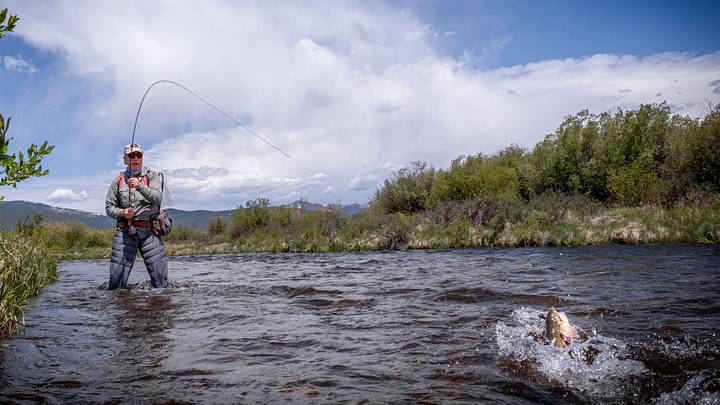
There will be days when you are fly fishing for trout, and the fish aren't biting what you are throwing. You can jump back and forth between different nymphs and dry flies and still come up empty.
When this happens, I fall back on a technique conventional bass anglers use to efficiently find feeding fish or trigger a strike from non-feeding fish.
Search and Trigger
Bass anglers use "search baits" to cover water quickly and find an active fish. A search bait is a lure that does three things. It covers a lot of water efficiently, presents at a selected depth, and gets a detectable response. Once the angler finds an active fish, they slow down and work the area more thoroughly. If nothing happens after a few casts, they move on to actively search more water.

You can do the same thing in fly fishing with a streamer.
Using a Streamer as a Search Bait
A streamer works as a search bait because it is easy to fish in a way that efficiently covers a lot of water and can trigger strikes from territorial or reactionary, non-feeding fish. And if you find a fish in feeding mode, a streamer represents a lot of calories for little effort.

A Sinking Line Will Catch You More Fish
If I'm fishing a lake or a section of river deeper than three feet, I like to use a dedicated sinking line. A sinking tip will work, but make sure it is at least 10' long. The water dictates the "Inches Per Second (IPS)" sink rate, and this is something you will have to learn through trial and error. Learning to fish a sinking line is worth the time and investment. I can't stress this enough: using a sinking line will lead to more caught fish.
Learn From the Best
There are a lot of opinions and techniques on fishing a streamer. I'm a big believer in what Kelly Gallup teaches, but I also take bits and pieces from other anglers and add them to my own experience. It is like any skill. Learn the basics of the technique, master them, and then develop your own style.
Black Rabbit Fur for the Win
When I'm using a streamer as a Search and Trigger bait, I'm very particular about what streamer I use. 80% of the time, I choose a 3-4" black rabbit fur pattern with small dumbbell eyes and a stinger hook in place of a main body hook.
Why Rabbit Fur
Rabbit fur has some of the most realistic, tantalizing movements of any fly or streamer I've ever fished. You don't have to manipulate it or give it any action. The slightest of currents will make the fur dance, move, wiggle and flow. This is great for a beginner angler or anyone new to streamer fishing.
A Basic Retrieve Will Catch You Fish
A good basic technique that will catch you fish is to cast across and slightly down current. Let the moving water sweep the streamer downstream as it swings back to you. Strip it back slowly, making sure to let it pause during the retrieve.
This is a very basic cast-and-retrieve and a good place to start. It will get you hook-ups, and from this basic technique you can develop variations as you learn. One thing to keep in mind is that you are in search mode. Don’t just stand in one place and cast for long periods of time. Probe the water at different depths and across its width, making sure to check the nooks and crannies, then take a few steps downstream and do it again.

Stinger Hooks Increase Hookups
On my streamers, I prefer a stinger hook near the tail. When trout aren’t feeding aggressively, they'll sometimes cautiously nip at the tail end of a streamer, and then decide to move on. They seem to be more curious than hungry. The stinger positioned at the end gives me a better chance of hooking a cautious fish.
Tie Your Own
It’s hard to find a black rabbit fur streamer pattern in a fly shop with dumbbell eyes AND a stinger hook. These are my preferences. The dumbbell eyes are negotiable; the stinger hook isn't.
Tying up a black rabbit fur streamer is an easy pattern and a good excuse for learning how to tie flies if you don’t already. Plus, you'll be surprised how satisfying it is to catch something on a streamer you tied yourself.
Find a video on how to tie a Bunny Leech or Rabbit Fur Zonker. These are great “Search Bait” patterns, and you can add variations of dumbbell eyes and a stinger hook.
A Marabou Streamer With a Stinger Hook
How I Became a Believer in the Black Rabbit Fur Streamer
I became a believer while guiding in Alaska. The trout fishing really takes off when sockeye salmon arrive in the river. The wild rainbow trout follow them into the river from the lakes and wait for the salmon to start dropping eggs. Once this happens, it becomes a feeding frenzy as the trout gorge themselves on the round little balls of protein. A skinny trout on the first of July is a football-shaped fish by the end of August.
It was also at the end of August that the trout bite would begin to slow down. The eggs were still floating downriver, but the fish were so stuffed they'd stop feeding to digest. I've caught trout fully gorged, their mouths full of eggs, and they couldn't swallow.

The Fish Bite Stopped
The river I guided on was crystal clear, so you could easily see a large trout holding position in the slow current. A week earlier, you would drift a bead to this fish, and it would aggressively take. But because they were so full, you could drift an egg pattern past its nose again and again, and it showed no interest. It looked to be asleep or in a food coma.
It was frustrating; the bigger the fish, the bigger the frustration. Somewhere along the way, probably out of desperation, I learned to throw a black rabbit-fur streamer at least a few times before giving up on the fish. Often enough, the trout would come alive out of its stupor and chase the streamer down. It didn't happen every time, but it happened enough that it was always worth trying.
Aggression vs Feeding
I still don’t know why the trout suddenly turned on when a black streamer appeared. My kinda-educated guess is that the fish's behavior looked more like instinct mixed with aggression, than feeding. I can say for certain that it led to a lot of big fish being caught that otherwise would have been passed on.

Keep It Simple
What I do know is that black worked better than any other color. More specifically, a 3-4 inch streamer made from black rabbit fur, with dumbbell eyes and a stinger hook. There are times to use other colors and streamer styles, but when I’m searching for fish and trying to trigger a strike, this black rabbit fur combo is my go-to.
Search and Trigger is what I turn to when dry flies and nymphs aren’t catching. I can cover water quickly and find a hungry trout, or one I can trigger into striking. After a long day with no action, experiencing a trout hit a streamer on a tight line will wake you right up. A big fish suddenly yanking the fly line out of my hand is a feeling like no other. ~ KB
Follow me on Instagram @KenBaldwin7. I share the stories behind my articles, photos from my fly-fishing adventures, lots of Alaskan Brown Bear photography, gear I’m testing, and the outdoor places that inspire them.
"Slow down...listen to the hoppers...be patient with yer wife...eat sardines with hot sauce... catch “Gagger” trout!!!" –Flip Pallot
 Add us as a preferred source on Google
Ken Baldwin is a Writer/Editor for Fishing On SI, where he writes stories about fly fishing and the lifestyle that surrounds it. His writing and photography have appeared in Men's Journal, Catch Magazine, Fish Alaska, and the American Angler. He also created and hosted the TV show Season on the Edge, which aired on NBC Sports and in seven countries, showcasing travel, adventure, and culture through the lens of fishing. For twenty years, Ken worked as a fly fishing guide in Alaska, which gave him opportunities to hang out with and photograph the Alaskan brown bear. His experience photographing the brown bear helped him land a job with the Netflix documentary Our Planet 2, narrated by David Attenborough. If you dig deep enough in Ken's resume, you will see that he played the terrorist "Mulkey" in the film Die Hard 2 before fly fishing took over his life. Ken is a graduate of the University of Washington.
Follow KenBaldwinOnSI