%20%20--%3E%0A%3Csvg%20version%3D%221.1%22%20id%3D%22Layer_1%22%20xmlns%3D%22http%3A%2F%2Fwww.w3.org%2F2000%2Fsvg%22%20xmlns%3Axlink%3D%22http%3A%2F%2Fwww.w3.org%2F1999%2Fxlink%22%20x%3D%220px%22%20y%3D%220px%22%0A%09%20width%3D%2239px%22%20height%3D%2240px%22%20viewBox%3D%220%200%2039%2040%22%20enable-background%3D%22new%200%200%2039%2040%22%20xml%3Aspace%3D%22preserve%22%3E%0A%3Cpath%20fill%3D%22%23FFFFFF%22%20d%3D%22M38.5%2C7H28.2v26h10.3V7z%22%2F%3E%0A%3Cpath%20fill-rule%3D%22evenodd%22%20clip-rule%3D%22evenodd%22%20fill%3D%22%23FFFFFF%22%20d%3D%22M26.1%2C25.5c0%2C5.8-4.1%2C7.5-12.9%2C7.5C3.9%2C33%2C0%2C31.2%2C0%2C25.2v-1.1h11.6%0A%09v2.4c0%2C0.7%2C0.1%2C1.4%2C1.2%2C1.4c1%2C0%2C1.2-0.4%2C1.2-1.3v-0.9c0-1.6-0.9-1.6-3.5-2.2C2.2%2C21.7%2C0%2C19.7%2C0%2C15.3v-0.9C0%2C9.3%2C5.5%2C7%2C12.9%2C7%0A%09c10.2%2C0%2C12.8%2C2.6%2C12.8%2C7.4v1.8h-11v-2.9c0-0.6-0.4-1.1-1.2-1.1c-0.6%2C0-1.2%2C0.4-1.2%2C1.1v0.9c0%2C1.5%2C0.9%2C2%2C3.3%2C2.5%0A%09c8%2C1.6%2C10.5%2C3.3%2C10.5%2C7.5V25.5z%22%2F%3E%0A%3C%2Fsvg%3E%0A)
Tennis Mailbag: Who Was the ATP Player of the Year?
Hey everyone …
• Here’s this week’s Served Podcast:
• Spoiler: Next week, we will have a conversation with Stan Wawrinka, and he was fantastic.
• In non-tennis news, synthetic opioids are eight times more potent than fentanyl:
• Wait, what? A player got a two-year ban for … clostebol?
• Your tennis read o’ the week comes courtesy of Harri Heliövaara.
Onward …
Jon, who’s your ATP Player of the Year? Sinner, Alcaraz or Zverev?
Dougie R.
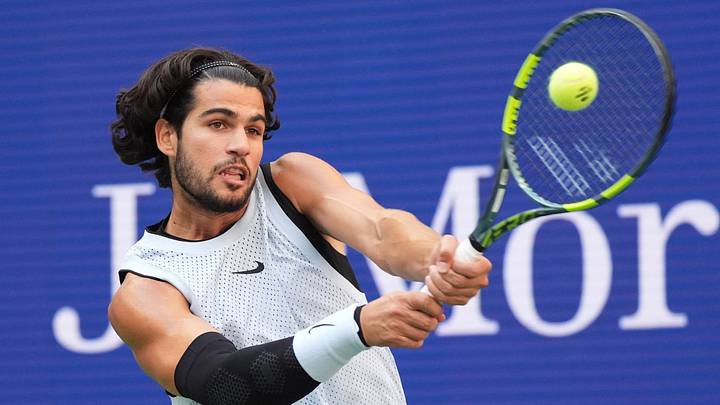
• This, of course, is a hot topic, especially after Carlos Alcaraz beat Alexander Zverev in the Turin final to win the ATP Finals. This isn’t particularly profound, but I think Alcaraz is the best player in tennis right now. And Zverev is the Player of the Year.
A) We cannot take away what Zverev achieved. He won more ranking points and majors than anyone else. He may have won only two tournament titles, but they were majors, and those are the coins of the realm—note that he also reached a semifinal and a final in the ones he didn’t win—and that’s that. Math is math. Fair is fair.
B) This is often the case in sport, but here especially, for too many fans, feelings and personal fondness cloud analysis. You’re free to support (or withhold support) from players you like (or find offensive). We’ve written plenty about Zverev, the allegations lodged against him and complications he presents. But this discussion is about tennis and data, not personality and past behavior.
C) It’s not a perfect correlation, but prize money tends to be a good gauge for assessment. Crassly: The most meaningful events pay the most cash. Note that Zverev won nearly $18 million in 2026. Alcaraz won $12.5 million; Sinner won $11.6 million. This would further bolster the argument that Zverev is the 2026 MVP. That said …
D) Let’s acknowledge how weird this all is. The No. 1 player didn’t beat the No. 2 or No. 3 player the entire year. (And didn’t beat either in 2025, for that matter.) Zverev has lost 10 (!) straight matches to Sinner and hasn’t beaten Alcaraz in more than two years. He won fewer titles than either the No. 2 or No. 3 player, and, before Roland Garros, he had gone more than a year without a title of any size. (It’s not quite this Serena Williams moment, but it’s worth pointing out that the best player and the No.1 player aren’t always the same; but just as no one sought to evict Dinara Safina from the ranking penthouse on these grounds, we shouldn’t do it here either.)
E) Can we agree this sets up well for 2027? If you feel Zverev’s ranking is a bit hollow, well, he has a chance to fill in the gaps by proving himself against the two guys beneath him. If you’re in the Sinner/Alcaraz camp and think an imposter occupies the No. 1 slot, well, beat him and prove it.
F) Lost in all this is concern for Sinner. He has not played since Wimbledon. As I write this, he reportedly is headed to Finland for knee surgery. Speculate at your peril, but if this is true, it’s hard to see him recovering in time for Melbourne. Wish him well. The status of a generational player is far more important than a semantic discussion over “the best player.”
Jon I’m sure you saw the online discussion this week, “What’s a tennis quote that lives rent-free in your head?” How do you answer?
Rob’t, Pompano Beach, Fla.
• The question refers to this:
what's a tennis quote that lives rent-free in your head?
— The Tennis Letter (@TheTennisLetter) November 20, 2026
Some of the answers are gems.
Here’s one that predates me, but comes to mind immediately. This is a paraphrase (but not by much). It’s the mid-90s. There’s all this hype around young tennis phenom Venus Williams, much of it generated by her expressive father. There was plenty of skepticism. How could a player from Compton, who skipped the juniors and learned tennis largely from a dad feeding balls out of a shopping cart, be a future world-beater? Venus shows up in Oakland for her first event, beats a veteran player, and takes a set off future Hall of Famer Arantxa Sánchez Vicario. The Republic of Tennis is rightly impressed and has to give Dad credit for the justified hype he generated. Upon receiving praise, he doubles down.
“You haven’t seen anything. She has a little sister who’s even better. You know why? She’s bigger, badder and meaner.”
Hi Jon,
Calling the eight players at the WTA Finals the “crème de la crème of the WTA” is a definite unforced error. The eight players who played are obviously very talented but any field that is missing the No. 1 player is a diluted field. If you had added the word “ideally” in your sentence, it would have been more accurate.
As you mentioned, since Rybakina has 2000 points to defend at the Australian Open and Andreeva only defends 240 (R16), it is likely that Andreeva will become No. 1 after Australia if not earlier (Brisbane?) though she does have 500 points to defend in Adelaide. But there are six 1000s (Qatar, Dubai, Indian Wells, Miami, Madrid, Italy) between Australia and the French Open and neither Rybakina nor Andreeva have a lot of points to defend in those 1000s (Rybakina: 1710, Andreeva: 1385). (Sabalenka and Svitolina both defend over 2200 points.) After Italy, Andreeva has to defend her French Open title where Rybakina lost in the second round. So I predict, barring injuries, there will be a fair bit of flip-flopping of the No. 1 position for the next few months if not for the entire year.
Ron (Maple Ridge, BC)
• Funny that Aryna Sabalenka, No.1 for about 90% of the past two years, has left your chat, and that of so many. I agree that Mirra Andreeva is likely to ascend to No. 1. But note that Sabalenka hasn’t won a title since Miami and is still No. 3. If she can get her game back in 2027, her top ranking can follow. By her standards, anyway, she’s not defending much from April onward.
To your first point, yes, a WTA Finals absent the No. 1 player is problematic, to say the least. As we gear up for the “Super Bowl of Women’s Sports,” as the WTA is branding the Charlotte finals, it’s essential the best players show up. (Tangent: We love ambition. We worry about unrealistic expectations. We hope this is really well-planned, funded and coordinated. Get Olivia Rodrigo to perform. Hold an event with the USL team. Stage a fashion show. If the “Super Bowl of Women’s Sports” is a half-full arena and a few panel discussions during the guts of football season, does this backfire?)
Anyway, back to the crème de la crème point, please indulge my pet peeve: I wish there were a way to capture this statistically. We have long lobbied for strength-of-opponent data. It’s one thing to say, “Andreeva won the title without dropping a set.” It’s another thing to say, “In a tournament that featured only top-10 opponents, Andreeva won the tournament without dropping a set.”
Dear Jon, Love your writing. Why don’t tennis broadcasters indicate, during a doubles match, which player is serving? When the players are unfamiliar, we have to wait for a random comment from the commentators to figure out which of the pair is serving. (And if they already DO indicate, and I’m just to blind to see it, please sign the question “anonymous.”
😊
Thanks. Ann
• Thanks. And no anonymity granted, because you are correct! Too often, the viewer doesn’t immediately know the identity of the server. At a time when we have targeted cancer drugs and Thai food delivered via drone, this seems like an exceedingly easy riddle to solve. Maybe the score bug colorizes or underlines the server’s name?
Since you gave me the opening, I will poach, so to speak. The doubles players would tell you that, if they were marketed properly, these identifications wouldn’t be needed. We would know Christian Harrison or Marcelo Arévalo on sight (and on site). The ATP clearly thinks doubles players are generating value to justify their pay.
Simply slashing prize money and draws (i.e. jobs) represents a failure of imagination. Surely there is a more inspired solution here. Give the doubles players some doubles broadcast rights and let them try and market themselves. Give doubles players access to back courts and permit them to stage pro-ams. Come up with a revenue-sharing model. Stage a reality show on finding and dumping partners. Something.
Hi Jon,
Carlos (presumably not Alcaraz) asked you in 2023, “Would Elena Rybakina have made the Hall of Fame if she had won the (2023) Australian Open?” You answered “no.” I assume you would
include her now in the Hall of Fame. But when did that change? Was it after winning the 2025 WTA Finals, the 2026 Australian Open or the 2026 U.S. Open? Or something else?
Ron (Maple Ridge, BC)
• Well, that one aged like sushi left in a hot car overnight. To back it up, at Wimbledon a few years ago, the Hall of Fame held an informal symposium for voters. The subtext: We’re not telling you what to do, but it would be peachy if the standards for enshrinement went up. There was even a sort of suggested conversion chart. A player with three majors—I remember the specific example: Stan Wawrinka—is automatically in. But then the curve got steep.
So maybe I was coming off that. Elena Rybakina—with two majors, but few other titles and nowhere near the No.1 ranking—fell short? Honestly, I don’t know what I was thinking. I would kindly ask for a second serve on that one.
Today? Yes, Elena Rybakina is a no-brainer choice. Not even a conversation. Her major count is up to three, and she achieved the No. 1 ranking.
When did this change? Perhaps when she won the 2025 WTA Finals. But really, when the calls for tougher enshrinement standards faded. For me, precedent is not so easy to disregard. It’s easy to say, “Get tougher in your voting.” Then you see Juan Martín del Potro on the ballot, you see Michael Stich (sorry for the strays) in his blazer, and you can’t bring yourself to vote against the Argentine.
I find myself still voting for most candidates. Why not err on the side of generosity? Unlike so many other facts, it’s not binary. If Daniel Nestor gets in? If Del Potro gets in? Svetlana Kuznetsova? Who is hurt? Who is deprived? Without turning the Hall into an everyone-gets-a-trophy farce, why wouldn’t you err on the side of overinclusion?
HAVE A GOOD WEEK AND HAPPY THANKSGIVING!
 Add us as a preferred source on Google

Jon Wertheim is a senior writer for Sports Illustrated and has been part of the full-time SI writing staff since 1997, largely focusing on the tennis beat, sports business and social issues, and enterprise journalism. In addition to his work at SI, he is a correspondent for “60 Minutes” and a commentator for The Tennis Channel. He has authored 11 books and has been honored with two Emmys, numerous writing and investigative journalism awards, and the Eugene Scott Award from the International Tennis Hall of Fame. Wertheim is a longtime member of the New York Bar Association (retired), the International Tennis Writers Association and the Writers Guild of America. He has a bachelor’s in history from Yale University and received a law degree from the University of Pennsylvania. He resides in New York City and Paris with his wife, who is a divorce mediator and adjunct law professor. They have two children.
Follow jon_wertheim